Decoding the TPM
What a Technical Program Manager Actually Does — and Why It's One of the Most Underrated Roles in Tech
"Everyone knows the TPM is in the meeting. Nobody's quite sure why — until things start going wrong."
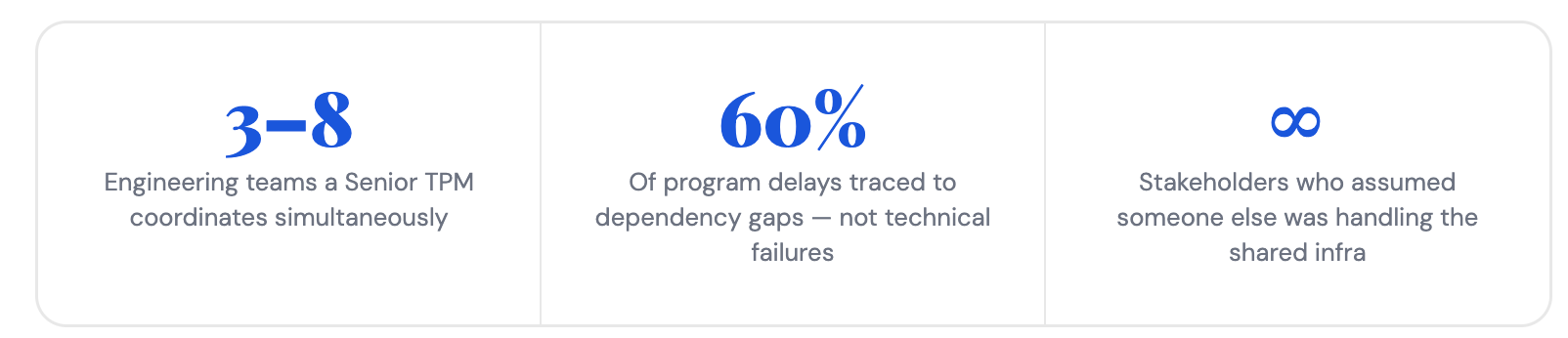
I've heard this joke more times than I can count from the time I've stepped into in Cisco. And honestly? It has a grain of truth buried in it. The TPM role is one of the most misunderstood positions in the tech industry — even by the people who work alongside us every day.
Ask five engineers what a TPM does and you'll get five different answers. Ask five product managers and you'll get five more. That ambiguity isn't a bug in the role. It's part of the design. A good TPM adapts to wherever the program needs them most — which means the job looks different in every room they walk into.
So let me try to decode it. Not with a textbook definition. With the real version — what this work actually feels like from the inside, and what it takes to do it well.
01 / The Bridge Nobody Sees
At its core, the TPM job is translation. Business strategy speaks one language. Engineering execution speaks another. Very few people in a tech organization are fluent in both — and even fewer are willing to sit in the middle and take responsibility for making the two sides understand each other.
That's what a TPM does. Every day. In every meeting, email, status update, and design review.
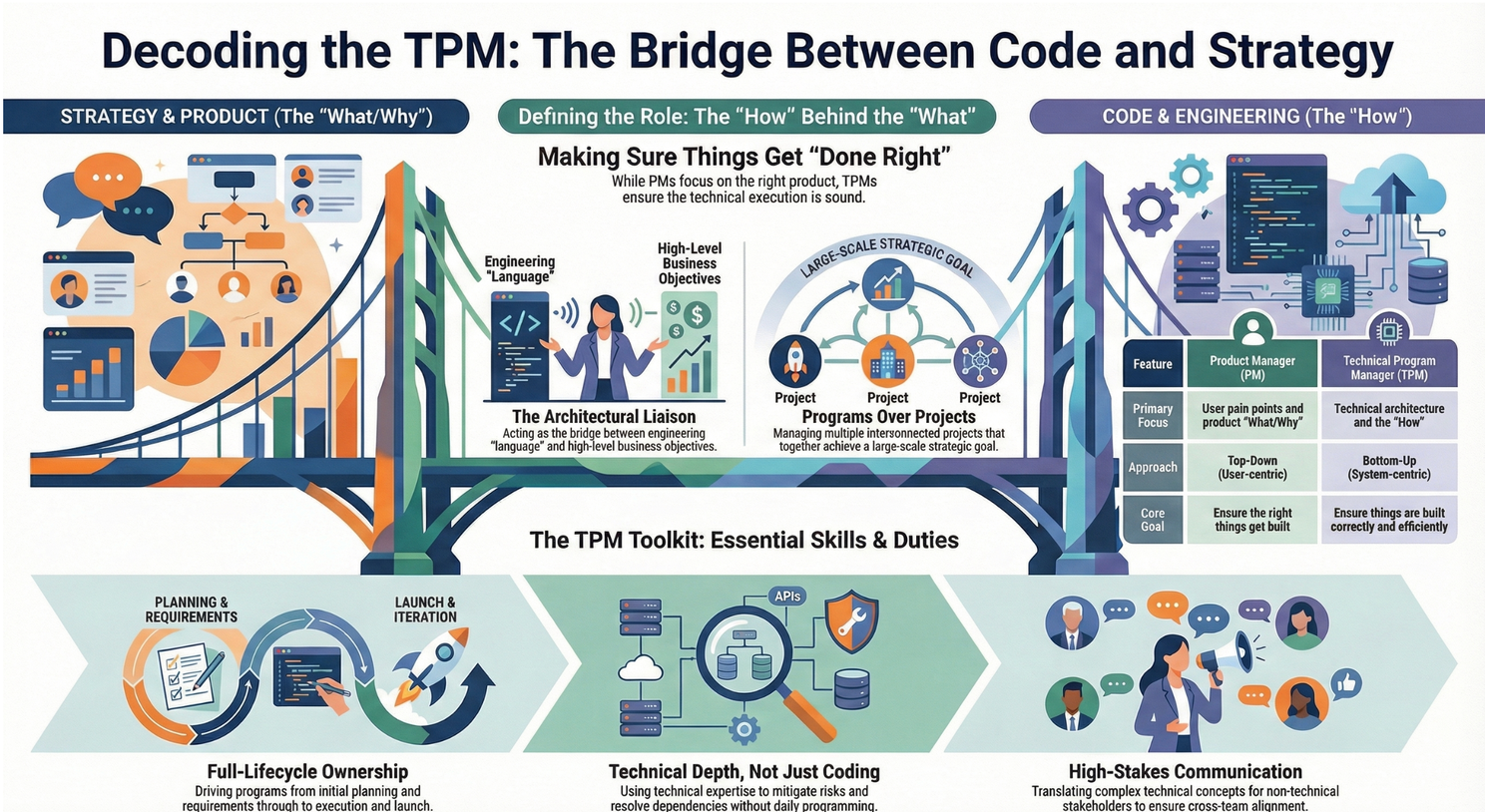
↑ The TPM sits at the intersection of business goals and engineering execution — actively translating across both worlds.
The infographic above frames the TPM as "ensures things are done right" versus the PM who finds "the right things to do." Useful framing — but in practice the line blurs constantly. A TPM who only worries about execution and never questions the strategy is just a project coordinator. A TPM who challenges the roadmap without owning delivery is an armchair advisor.
The real skill is knowing when to wear which hat — and having enough credibility with both sides to be heard in either room.
The one-liner I use with new stakeholders: "I don't write the code. I make sure the right code gets written, by the right teams, in the right order, with the right people aware of the right risks — at the right time."
02 / PM vs. TPM: The Distinction That Actually Matters
I get this question constantly from mentees and folks transitioning into the role. "Is a TPM just a PM with a technical background?" Short answer: no. Longer answer: it's more about what you're accountable for than what you know.
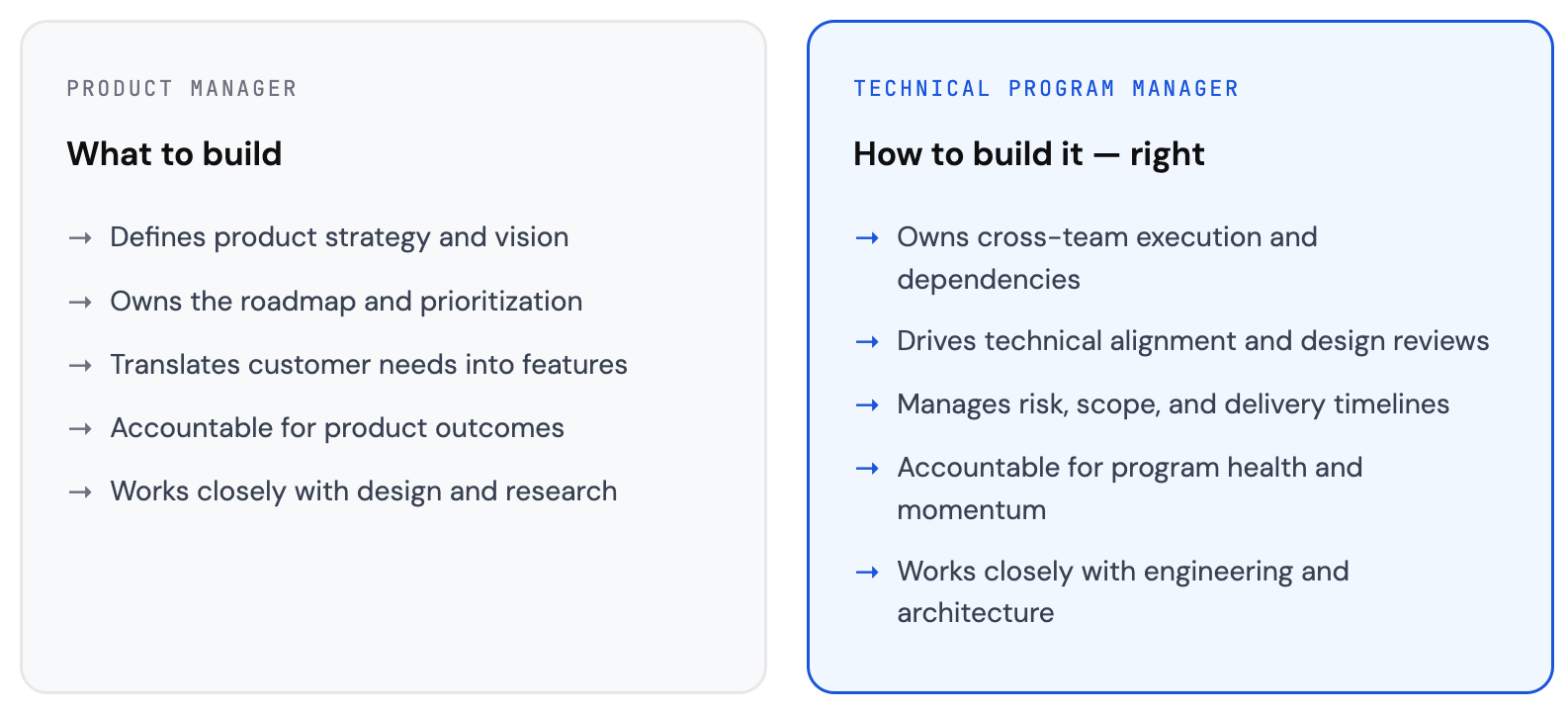
In smaller companies, one person often does both. At scale — Amazon, Google, Meta — they're deliberately separated. The PM asks "should we build this?" The TPM asks "can we build this, and how do we make sure we actually do?"

03 / The Development Lifecycle — Owned End to End
Here's what a typical TPM program looks like in practice. It's not a handoff at requirements and a wave goodbye at launch. It's the whole arc — and the TPM's fingerprints are on every stage.

Every step of that lifecycle has landmines. Dependencies invisible until two sprints before launch. Design decisions that seemed fine in isolation but create integration nightmares at scale. Teams who technically said "yes" to a timeline but never actually believed in it.
The TPM's job is to find those landmines early — before they detonate — and build the structures (the right meetings, the right docs, the right escalation paths) that give the program its best chance at a clean delivery.

04 / Technical Without Always Coding
Let's address the elephant in the room. One of the most common misconceptions about TPMs is that they must write production code. Some do. Many don't. And whether you can code is often far less important than whether you can think technically.
What does that mean in practice? Sitting in a system design discussion and asking the question that surfaces the hidden bottleneck. Understanding why a microservices migration is fundamentally different from a monolith refactor — not at the code level, but at the risk and dependency level. When an engineer says "that's not technically feasible," knowing enough to ask the right follow-up rather than just accepting the answer.
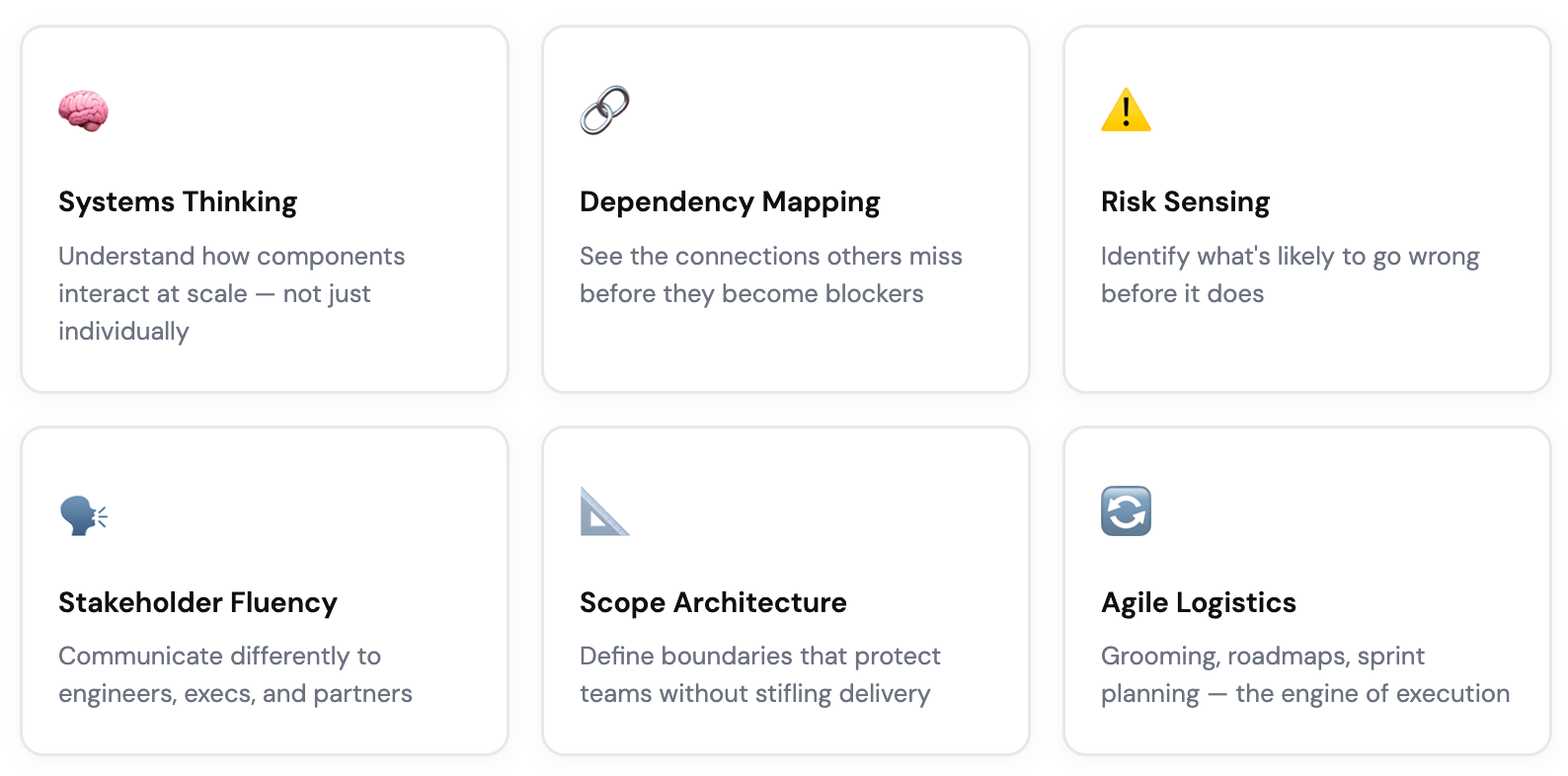
I've seen exceptional TPMs from software engineering backgrounds. I've also seen exceptional TPMs from program management, consulting, and operations — who learned enough systems thinking to earn deep trust from their engineering partners. The credential on your resume matters far less than the credibility you build in the room.
The best TPMs don't just manage programs. They make the program itself smarter about itself.
— What I aim for in every program I run
But here's what nobody tells aspiring TPMs — and it's important.
There's an unspoken expectation when a TPM joins a new team: hit the ground running, make technical calls with confidence, add value from day one. That expectation is understandable. It's also unfair.
Technical context doesn't transfer. The instincts you built on a data infrastructure program don't automatically apply when you're dropped into an AI labeling platform or a hardware-software integration stack. The vocabulary is different. The failure modes are different. The engineers who hold critical system knowledge aren't going to hand it to you in an onboarding doc.
Real depth in a new domain takes time. Not days — months. Months of sitting in the right rooms, reading design docs, asking questions that feel too basic, and slowly building enough mental model to anticipate where the system breaks. TPMs who perform confidence before earning it tend to make expensive assumptions early and spend the rest of the program managing the fallout.
The honest timeline: month one, you're listening and pattern-matching. By month three, you see the dependency structure clearly enough to ask genuinely useful questions. Around month six, you start having real intuition — where the risk lives, which teams underestimate complexity, which decisions will create pain a year from now.
That's not slow. That's the job working exactly as it should.
What a good TPM brings immediately — even before technical depth is built — is structure. The right meetings. The right visibility. The right questions surfaced, even when they can't yet answer them. And the flexibility to keep learning the domain while simultaneously keeping the program moving.
That last word matters. Flexibility. A TPM who applies the same playbook to every system — treating a mobile app launch identically to a machine learning pipeline — will struggle. The technical context changes the program mechanics. You have to adapt to the terrain you're actually in, not the one you're most comfortable with.
The best TPMs are comfortable saying "I don't know this system yet — but I'm going to." Then they actually do. They stay curious, ask the questions that feel uncomfortable, and build credibility through genuine engagement rather than borrowed jargon.
You don't become an expert in a system in a week. You don't become a trusted technical voice on a team in a month. You get there by staying curious and doing the work — quietly and consistently — until the engineers in the room start treating your questions as the ones worth stopping for.
That's the goal. Be patient enough to reach it properly.
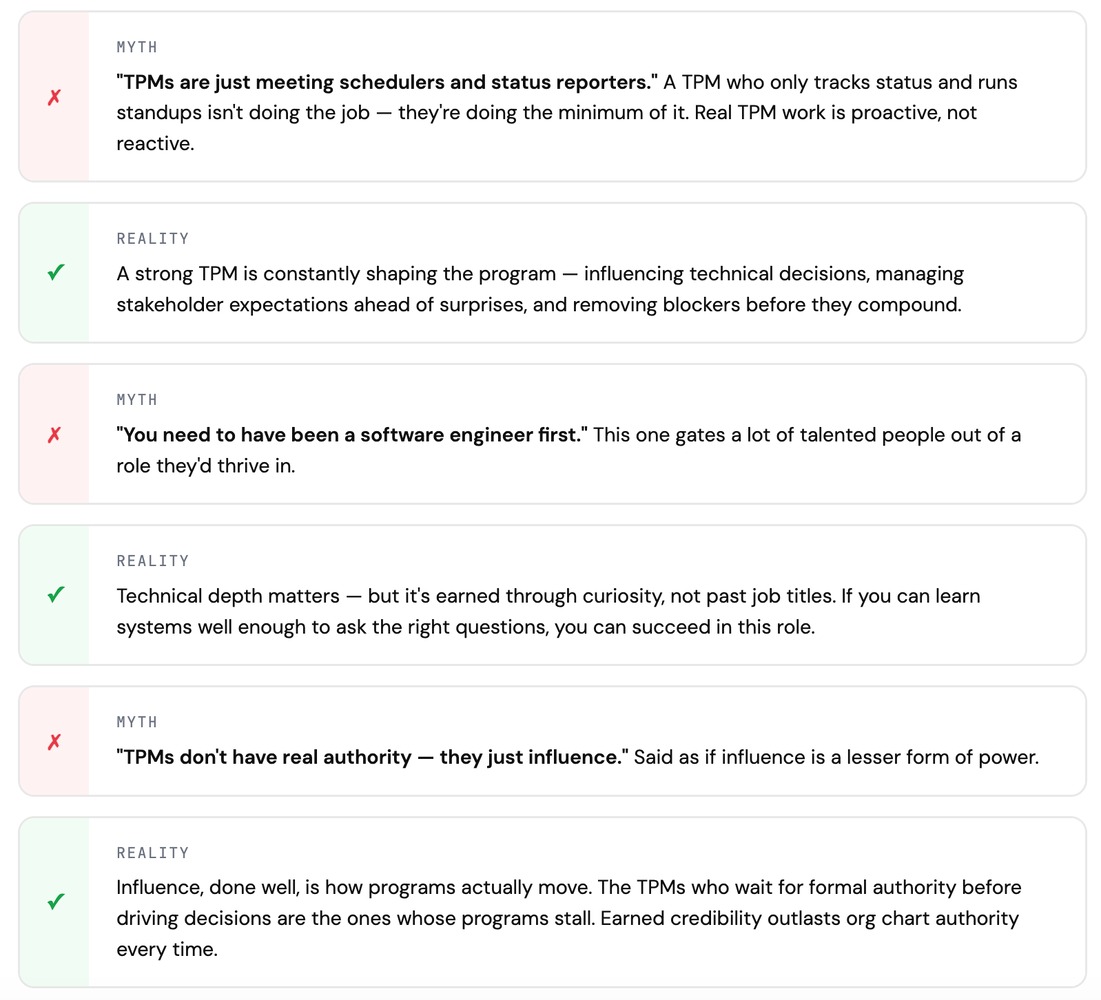
05 / The Myths Worth Busting
If you're considering this career path — or trying to level up within it — here are the misconceptions that trip people up most often.
06 / Cross-Functional Complexity at Scale
Here's something that only becomes clear once you've managed a large program: the more teams involved, the more the role shifts from
execution management to information architecture.
When you're running a program that touches hardware, AI models, speech recognition, and a consumer-facing app simultaneously — not hypothetical; this is the kind of program TPMs run at big tech companies — the job isn't about knowing each domain deeply. It's about making sure information flows correctly between them.

This is why TPMs who've managed complex, multi-team programs are so valuable at senior levels. It's not individual skill sets. It's pattern recognition — knowing where gaps tend to appear and building structures that catch them early.
From my own experience running programs like Sherlock (a human / ML labeling platform modernization) and a cross-team portfolio spanning three distinct engineering organizations — the coordination overhead is real, and managing it well is the difference between a program that ships and one that drifts indefinitely.
07 / If You're Aspiring to This Role
Let me be direct with people earlier in their career who are considering a move into TPM.
Start building systems literacy now. You don't need to code — but you need to understand distributed systems, APIs, data flows, and why certain architectural decisions create long-term pain. Read design docs. Ask engineers to explain their work. Curiosity is the entry point.
Own outcomes, not activities. The instinct at junior levels is to demonstrate effort — I ran the meeting, I sent the update, I built the tracker. Senior TPM work is measured by program outcomes: did the thing ship, were the risks managed, did the teams stay aligned? Orient everything toward that.
Learn to write clearly under pressure. The single most underrated TPM skill is writing. Clear PRFAQs. Tight executive updates. Well-structured design review feedback. If you can write well, you can think well — and that shows up at every level of the work.
Get comfortable with ambiguity. Nobody hands a TPM a perfectly scoped program with clean requirements and cooperative stakeholders. If that's what you need to perform well, this role will grind you down. The ones who thrive actually find ambiguity energizing. It's where they do their best work.

The TPM role isn't glamorous in the way that being a founding engineer is glamorous, or the way a PM with a viral product launch is glamorous.
The work is mostly invisible when it goes right — and extremely visible when it goes wrong.
But there's a different kind of satisfaction in it. When a program ships cleanly after 18 months of coordination. When you prevented a launch disaster nobody else saw coming. When a team tells you the reason they trusted the process was because you set it up well.
That's the job. Not for everyone. But for the right people — it's genuinely one of the best roles in tech.
For more on this, subscribe to Unblocked — my weekly newsletter for TPMs who lead at scale. Next in Unblocked: Lets dive deep into Amazon's 16 Leadership Principles
For 1:1 mentorship and coaching, I'm on Topmate

Comments
Comment Share
Add a comment…
Most recent
Author
Read the full article here: https://www.linkedin.com/pulse/decoding- tpm-santanu-majumdar-pmp-spc--xtx4c
Decoding the TPM What a Technical Program Manager Actually Does — and Why It's One of the Most Underrated Roles in Tech I've hea…
Like Reply 453 impressions
Load more comments
· Platform Strategy · 0→1 Delivery | ✍️ Creator @ Unblocked
Found this useful?
Book a 1:1 session to apply these frameworks to your specific situation — promotion prep, interview coaching, or career roadmap.
Book a Session →