Nobody Talks About the Emotional Labor of Being a TPM
Every TPM article tells you what to measure. None of them tell you what it costs to be the person who holds everything together when everyone else is falling apart.
I want to talk about something that doesn't appear in any job description, never comes up in a performance review rubric, and is completely invisible to the people who rely on it most.
It's called emotional labor. And for TPMs, it is constant, cumulative, and unacknowledged.
Fifteen-plus years into this craft — across Amazon, LinkedIn, Citrix, Cisco, Oracle — I've watched brilliant program managers burn out quietly. Not because they couldn't manage timelines. Not because their RAID logs were wrong. Because they were carrying something nobody named, and they had no framework for putting it down.
This article is that name.
What Emotional Labor Actually Is (And Why It's Not "Being Empathetic")
Sociologist Arlie Hochschild coined the term in 1983 studying flight attendants — workers paid to manage their own feelings as part of the job, while also managing the emotional state of the people around them.
The labor was invisible on the org chart. It was invisible in their pay. But it was exhausting in a way that physical work isn't.
Sound familiar?
TPMs are the flight attendants of the enterprise. We absorb turbulence so others can work in relative calm. We smile through the status meeting even when the data is bad. We translate engineering frustration into executive language without letting either side see the full force of the other. We hold the anxiety of twelve stakeholders and convert it into a crisp action item list.
That is not just communication. That is emotional processing. And it costs something.
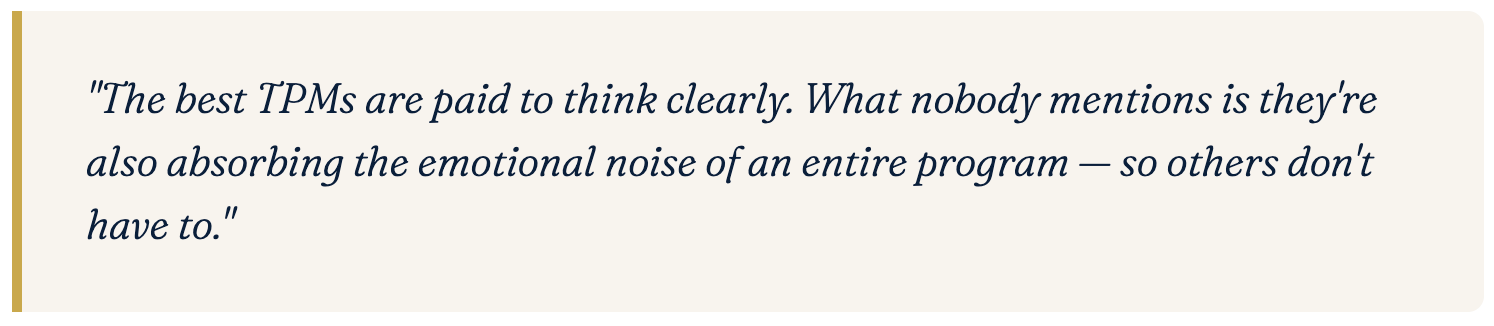
The cognitive load of program management is well-documented. Dependency tracking, risk management, cross-team alignment — those are hard. But they're the visible hard. The invisible hard is what happens in the ten minutes before a difficult leadership sync when you're deciding how much truth to surface. It's the way you recalibrate your tone halfway through a conversation because you can tell the engineering lead is already fried and one more question will snap the relationship. It's absorbing the VP's existential anxiety about Q4 and not letting it become your team's problem.
That's emotional labor. And it's not listed in the job spec.
The Five Invisible Loads TPMs Carry
Let me be specific. Because "emotional labor" can sound abstract. What I'm describing is concrete, daily, and cumulative.
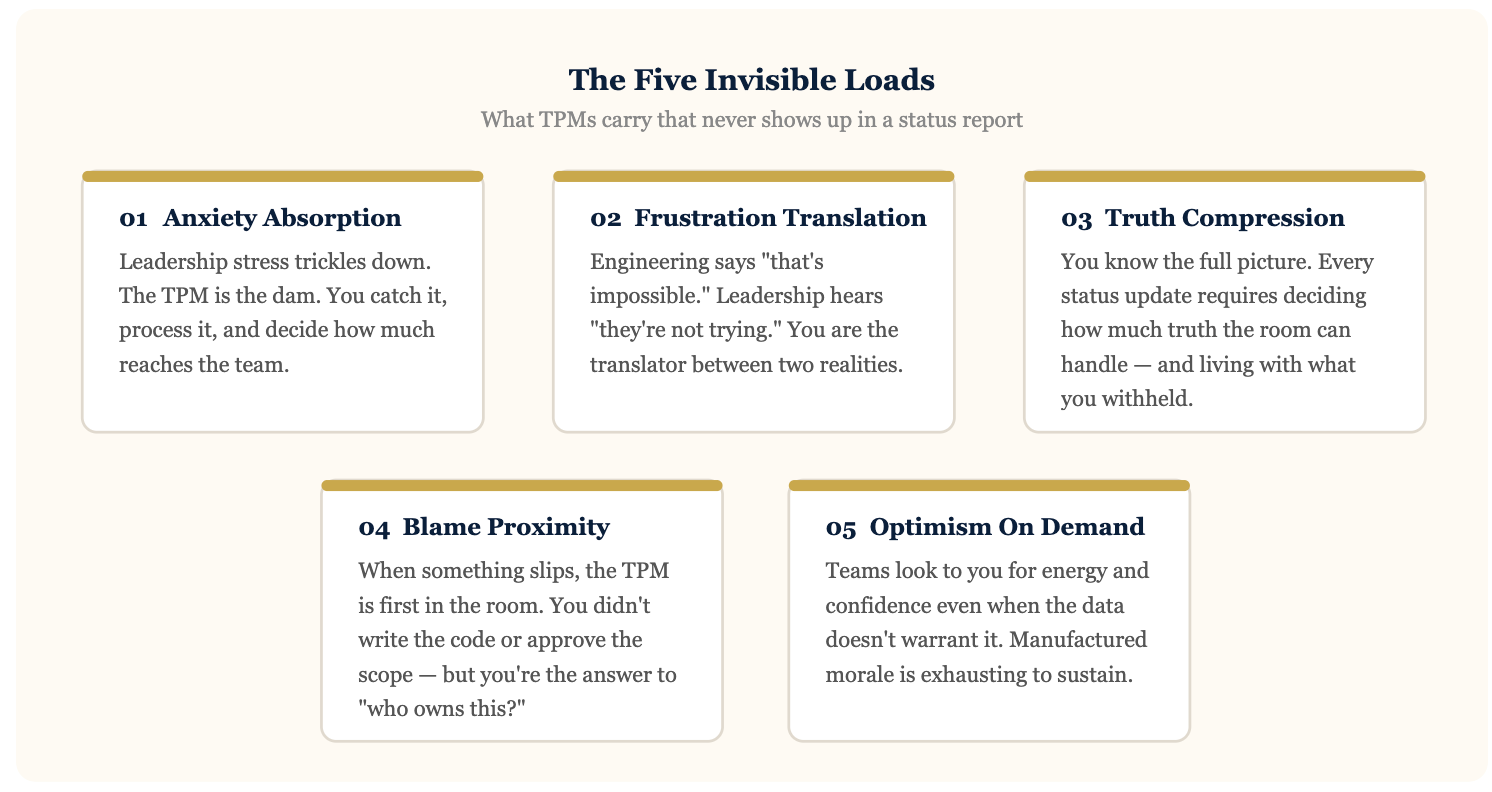
The five invisible loads that define the TPM experience — none of them appear in the job
Load 1: Anxiety absorption. Leadership is worried. The VP has a quarterly business review in three weeks and the program is amber. Their anxiety doesn't stay in the exec sync — it flows downward. The TPM is the first stop. You absorb it, you regulate it, and you decide how much of it reaches the team. If you let it through unfiltered, your engineers start writing defensive code and your PMs start padding estimates by 40%. So you carry it instead. Quietly.
Load 2: Frustration translation. Your engineering lead is furious. The product requirements changed for the fourth time in six weeks. They're not wrong. But if they say what they really think in the leadership forum, the relationship is damaged and the program is worse off. So you translate. You take their righteous anger and convert it into "the team has flagged that scope volatility is creating re-work overhead, and we'd like to propose a change freeze starting Monday." Same truth. Different temperature. That conversion has a cost.
Load 3: Truth compression. The TPM is almost always the person in the room who knows the most about the actual state of the program. The engineers know their component. The PM knows the product vision. The VP knows the business goal. You know all three — including the gap between what's being reported and what's actually happening. Every status update involves a decision: how much truth can this room handle right now? What do I surface, and what do I hold? Living at the intersection of what's known and what's shared is psychologically taxing in ways that are hard to articulate.
Load 4: Blame proximity. Something slips. A milestone is missed. An integration breaks two days before launch. The first question — before the postmortem, before the root cause analysis, before anyone looks at the dependency chain — is "who owns this?" And because the TPM's name is on the program plan, the answer is often: you. Even when the failure was an engineering decision, a product tradeoff, or an executive override you documented and escalated. You are close to the accountability and far from the authority. That asymmetry is its own weight.
Load 5: Optimism on demand. Teams read the room. And the room reads you. When the program is hard, people look to the TPM to know whether to panic. You have to project confidence that the path forward exists — sometimes before you've found it. Manufacturing that energy, day after day, takes something out of you that JIRA metrics will never capture.
The Person Who Knows the Truth — and Gets Blamed for the Gap

Here's the specific situation that breaks TPMs. And it happens more than anyone admits.
The program is in trouble. You know it. You've been flagging it — in your weekly status, in your risk log, in the executive summary. But the flags were phrased diplomatically because you didn't want to trigger panic or be seen as "the one who cried wolf." Now the risk has materialized. And suddenly the VP is asking: "Why didn't we know about this?"
You did know. It was in the document they skimmed. It was in the meeting they half-attended. It was in the update they marked as read.
But you're the one in the room. And you're the one who has to answer.
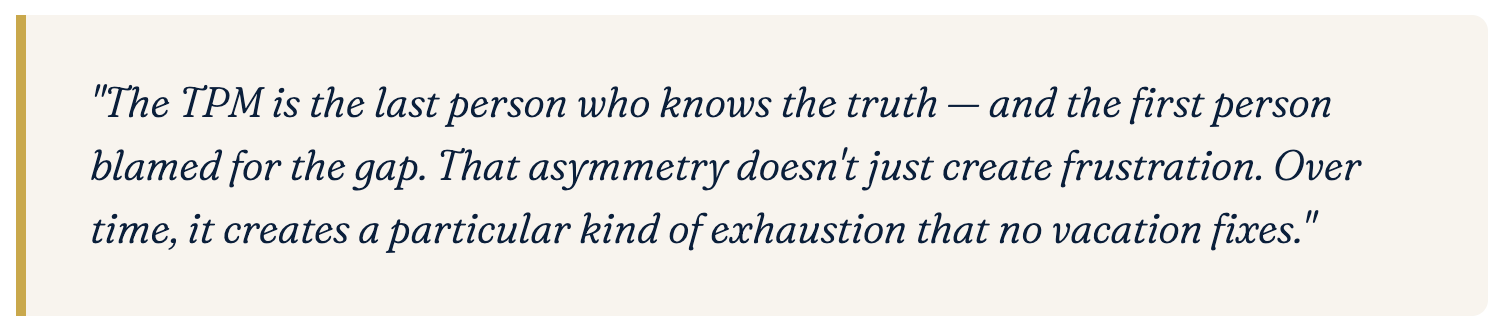
This is what I call the Truth Gap: the distance between what you knew, what you communicated, and what was heard. TPMs live in that gap
constantly. And the emotional cost of being simultaneously the most informed person in the program and the person held responsible for outcomes they don't control is significant. It produces a kind of low- grade, chronic vigilance — a state where you're always scanning for the next gap, always pre-loading the explanation, always one step ahead of the blame.
That state is exhausting. And it compounds over years.
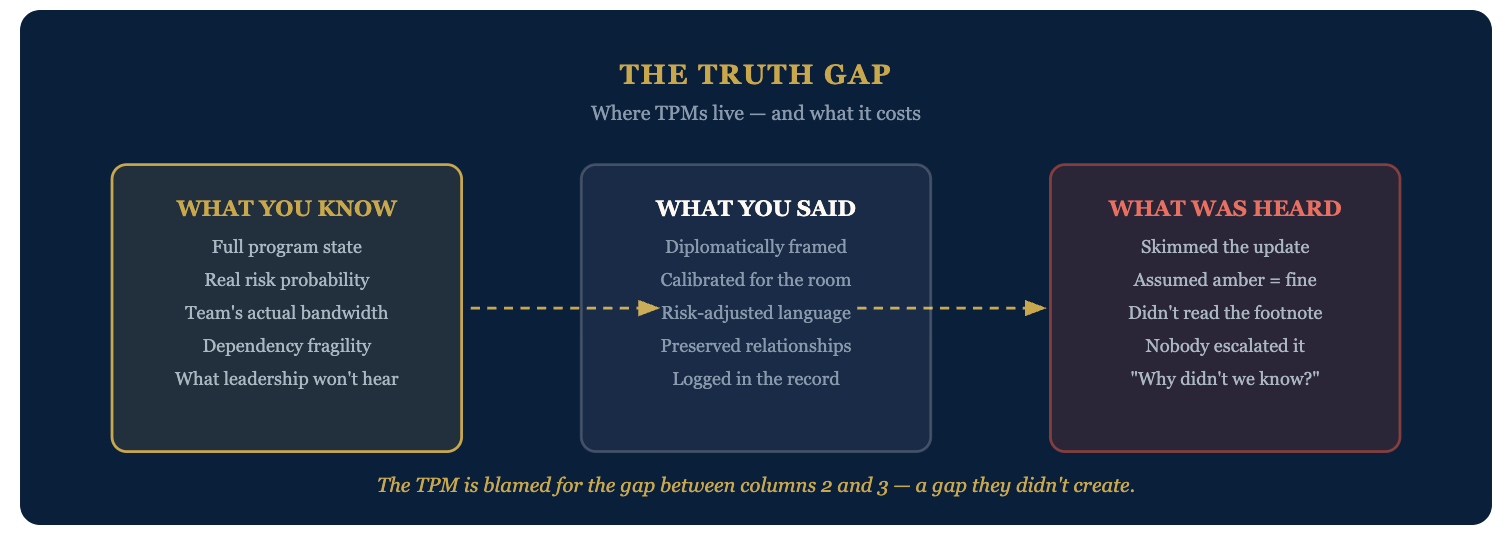
The Truth Gap — the asymmetry that defines TPM accountability
Why Nobody Names This
There are three reasons emotional labor stays invisible in the TPM profession — and all three make it harder to manage.
First: The job is coded as operational, not emotional. TPMs are supposed to be the rational center. The calm in the storm. The person with the spreadsheet and the framework. Admitting that the job has a profound emotional dimension feels like a confession of weakness — or worse, a disqualification from the role. So it goes unspoken.
Second: It doesn't fail loudly. When a dependency is missed, there's a broken build. When a milestone slips, there's a red in the status report. When a TPM is quietly burning out from emotional labor, the program keeps running — until suddenly it doesn't, and nobody can explain why the best person on the team asked to be moved to a different program.
Third: The people who benefit most have the least visibility.
Engineering leadership doesn't see the ten-minute conversation you had with the engineer who was about to quit the program. Product leadership doesn't see the way you reframed the executive's frustration into a solvable problem instead of a people problem. Your manager doesn't see the amount of emotional calibration that went into that difficult 1:1. They see outcomes. The labor that produces them is invisible by design.
What It Looks Like When It Accumulates
I want to describe the accumulation carefully, because it doesn't look like collapse. It looks like competence maintained at increasing cost.
It looks like the TPM who is still running excellent status meetings, but has stopped raising the harder risks because they've learned what gets heard and what gets managed away. It looks like the person who used to advocate hard in planning conversations but now nods, updates the doc,
and privately absorbs the consequence. It looks like the most experienced person on the program becoming, gradually, the quietest one in the room.
And eventually, it looks like them leaving. Not to a competitor. Not for a promotion. Just out — to something with less surface area. Less exposure. Less carrying.
I've seen this pattern more times than I can count. And every time, the organization loses and doesn't know what it lost, because what walked out the door was never on any metric.
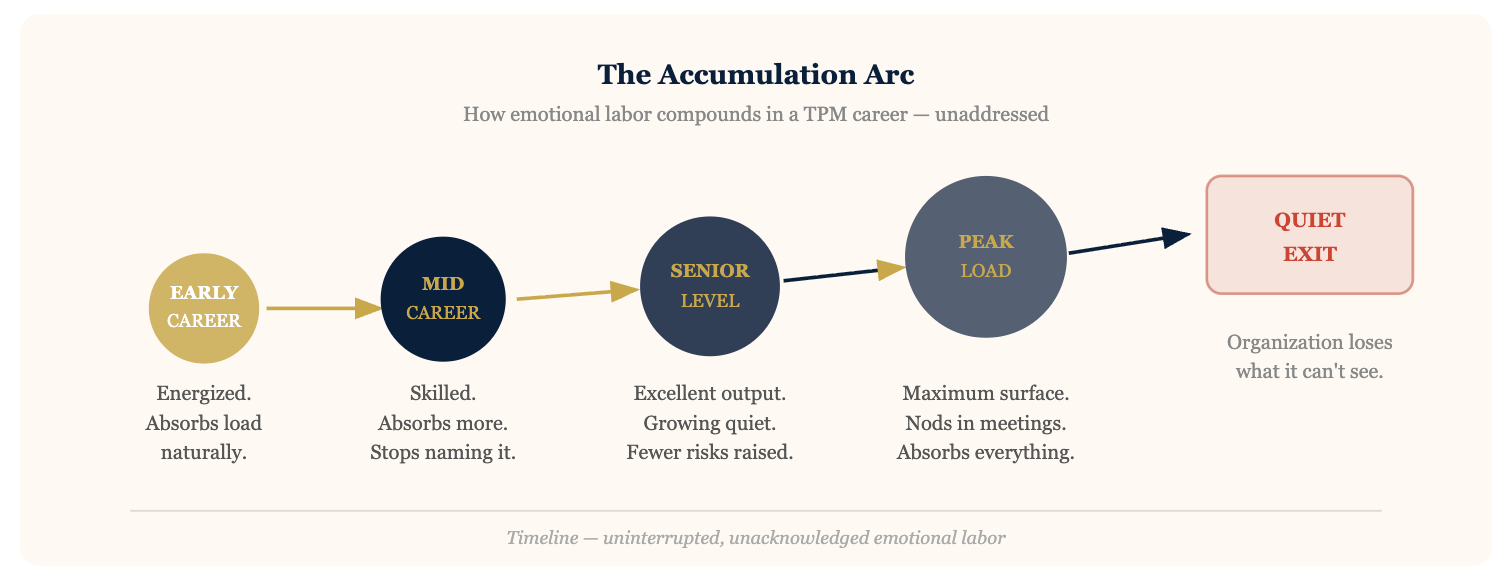
How unacknowledged emotional labor accumulates across a TPM career
What Actually Helps — Three Things That Work
I want to be careful here. This is not a wellness article. I'm not going to tell you to meditate or set better boundaries, as if the problem is personal discipline rather than structural invisibility. What I can share is what I've seen work — for myself and for TPMs I coach.
1. Name it explicitly, at least privately. The most damaging part of emotional labor is doing it unconsciously. When you absorb the VP's anxiety and carry it into the next three meetings, you're spending energy without knowing it. The practice of naming — "I'm holding the leadership anxiety right now, and I need to set it down before I talk to the team" — creates a gap between the labor and the consequence. It doesn't eliminate the work. It makes it visible to yourself, which is the first step toward managing it.
2. Find one person who sees the full picture. The structural isolation of the TPM role is real. You sit at the intersection of every team and belong fully to none. Most TPMs don't have a peer who understands the complete context of their work. Finding that person — a coach, a fellow senior TPM, a trusted peer in another org — and maintaining regular, honest conversation about what you're carrying is one of the most underrated practices in this profession. Not to vent. To surface. There's a difference.
3. Stop compressing truth until it disappears. I know why we do it. Diplomatic framing preserves relationships. It avoids triggering panic. It demonstrates maturity and judgment. But there is a cost to being the person who always finds the softer way to say the hard thing — which is that the hard thing never lands with its full weight, and you are left carrying the consequence of the gap. The skill is not whether to surface hard truths, but how to surface them clearly without catastrophizing. The goal is precision, not diplomacy. Those are different.
The Identity Trap Nobody Warns You About
Here's the part that makes emotional labor especially hard to put down: many TPMs have built their professional identity around being the person who holds it together.
It starts as a strength. You're reliable. You're the calm center. People know they can bring their worst problems to you and you won't collapse. That reputation is earned, and it matters. But over time, it becomes a trap — because the identity and the labor become indistinguishable. Saying "I'm exhausted by this" starts to feel like saying "I'm not good at this." So you don't say it.
I've coached senior TPMs who had internalized the carrying so deeply that naming it felt like a professional confession. Like admitting they weren't cut out for the level they were operating at. The opposite is true. The TPMs who can name their emotional labor — who can say "I absorbed a lot in that conversation and I need ten minutes before the next one" — are the ones who sustain at senior levels. The ones who can't name it are the ones who disappear quietly from the roles they were best at.
Being the person who holds it together is not a permanent contract. It's a choice you make, meeting by meeting. The difference between those two framings is the difference between resilience and burnout.
A Note to the People Who Manage TPMs
If you lead TPMs — if you're a Director, VP, or anyone whose programs depend on someone doing this work — I want to say something directly to you.
The TPM in your org who is most competent is probably also carrying the most invisible load. They're the one absorbing your anxiety when you go into a hard QBR. They're the one translating your frustration to the team in a way that doesn't break the relationship. They're the one who knows the full truth of the program and is making daily decisions about how much of it to surface and how.
That person is not inexhaustible. And the signs that they're approaching a limit are often the inverse of what you'd expect — not missed deadlines or poor communication, but increasing quietness, decreasing risk- raising, a subtle withdrawal from the advocacy they used to bring.
You do not need a new framework to address this. You need one question, asked genuinely: "What are you carrying that I'm not seeing?"
Ask it. Then listen without immediately problem-solving.
The Close
The TPM profession will keep producing excellent frameworks. RAID logs, RACI matrices, OKR alignment decks, risk registers. These tools matter. I use them. I teach them.
But the thing that actually holds programs together — the thing that converts chaos into clarity across a dozen competing stakeholders and a timeline that's always under pressure — is not a framework. It's a person who has decided, repeatedly and invisibly, to absorb the cost so the program can function.
That person deserves to have the work named. Not as a complaint. Not as a credential. Just as a fact: this is what is being carried, this is what it
costs, and this is why the best ones eventually leave if we don't build environments where the carrying is acknowledged and shared.
Nobody talks about the emotional labor of being a TPM.
Maybe it's time we did.
Which of the five loads hits closest to home for you? Drop it in the comments — I read every one.
Follow for more such insights around TPM x AI
Schedule 1:1 Consultation on Topmate
Real talk on TPM, AI, Leadership, real life stories and fun. No fluff. No corporate filter. Just
what actually works.
Michael, Kinjalk and 1,177 connections are subscribed
1,460 subscribers
Employee Shortages and Other Problems: Part Two, Lean Tools, Kinda
Leadership Reliability
PMS is not a Form; it’s a Philosophy: reimagining Performance for next year
Gerald Covella
Jason Haines
Weekly HR Insights
5 · 1 comment
Found this useful?
Book a 1:1 session to apply these frameworks to your specific situation — promotion prep, interview coaching, or career roadmap.
Book a Session →