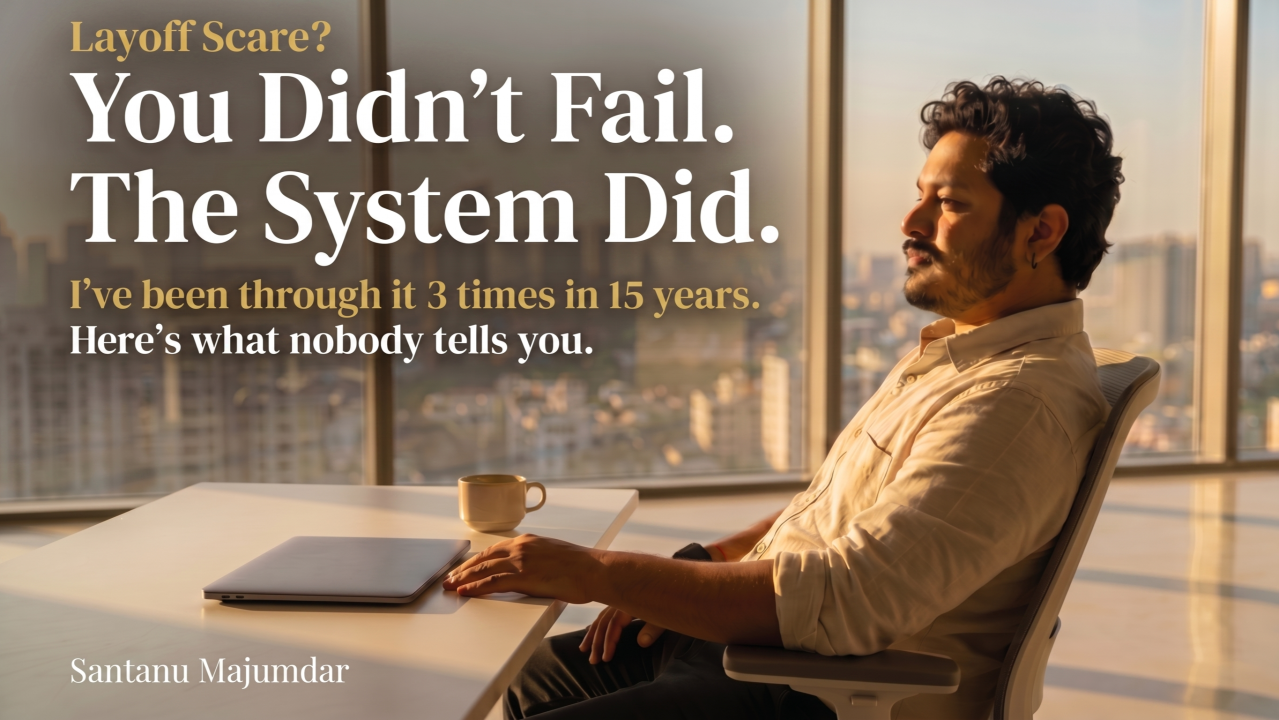
I've been through it three times in 15 years. Each time was different. Each time hurt. And each time — eventually — I came out the other side with something I didn't have before.
Let me tell you what actually happened to me. Not the LinkedIn version. The real one.
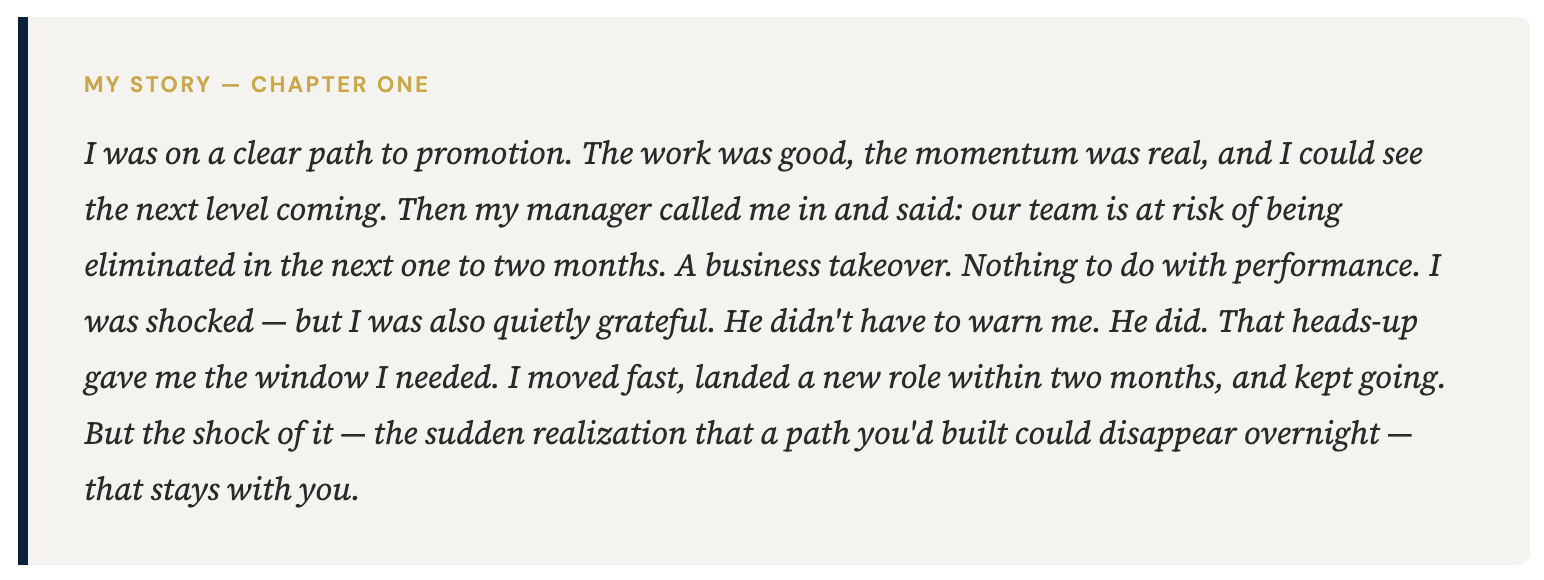
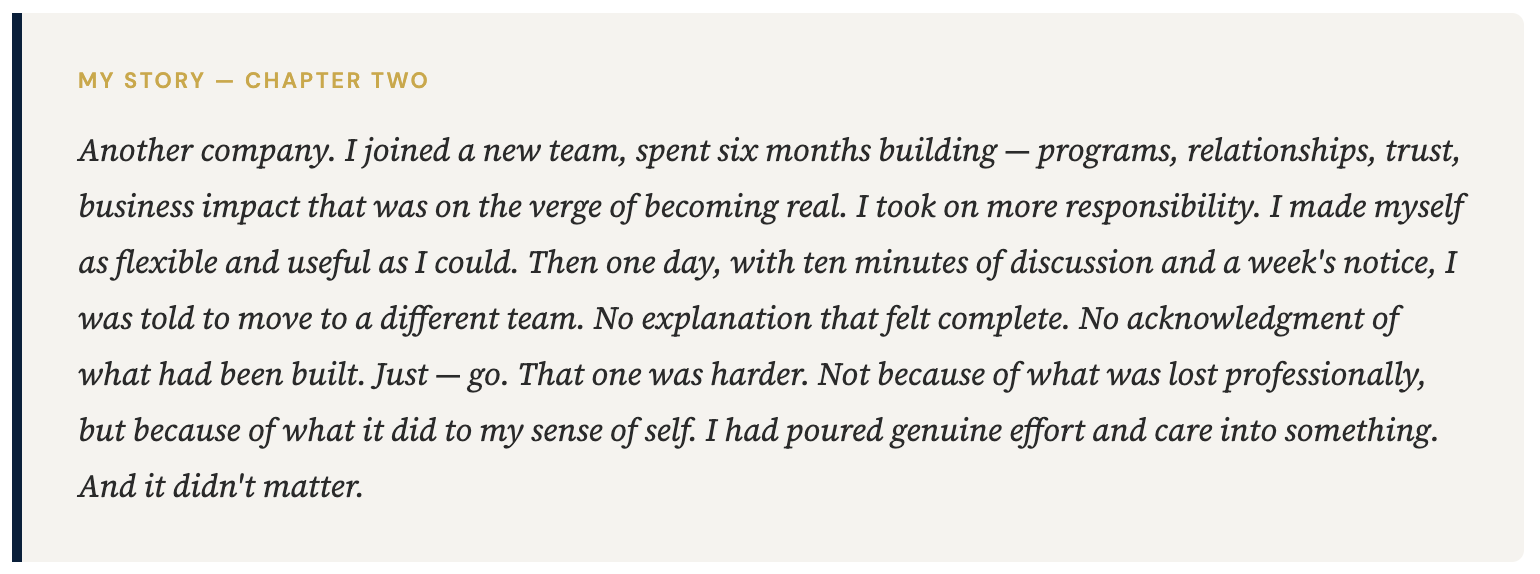
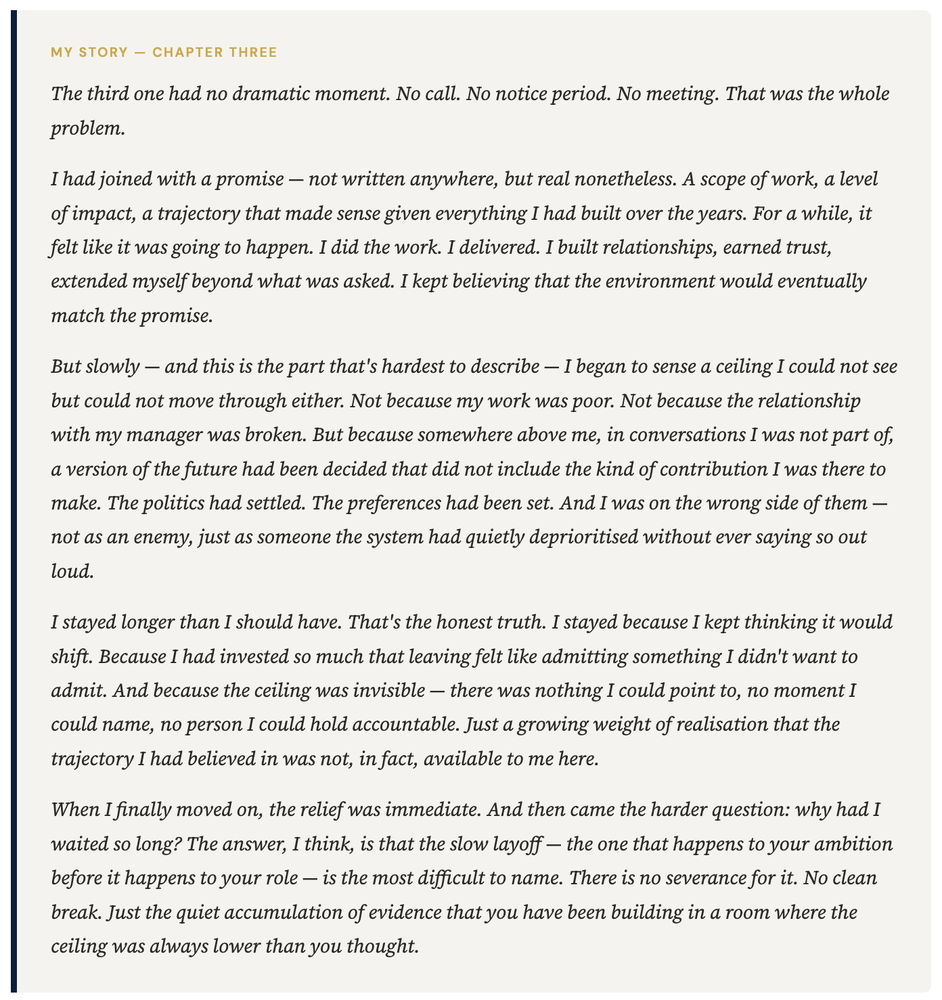
Three stories. Three different kinds of hard. And through all of them, the same feeling underneath: stress, demotivation, anxiety. I'm a human being. I felt every bit of it. There is no version of this that doesn't touch you — regardless of how senior you are, how experienced you are, or how many times you have been through it before.
But here is the one thing I kept coming back to, every single time: I can only control what is in my control. Worrying about decisions made in boardrooms, about org charts that shifted without my input, about ceilings I could not see and politics I could not influence — that energy was finite and precious. I chose, each time, to redirect it toward rebuilding myself instead.
That is what this article is about. Not just for people in technology. Not just for senior professionals. For anyone who has ever had the ground shift beneath them — suddenly or slowly, with a phone call or with silence. This world is vulnerable. The ground shifts. We should always be ready to move — not from fear, but from the knowledge that we have done it before and we can do it again.
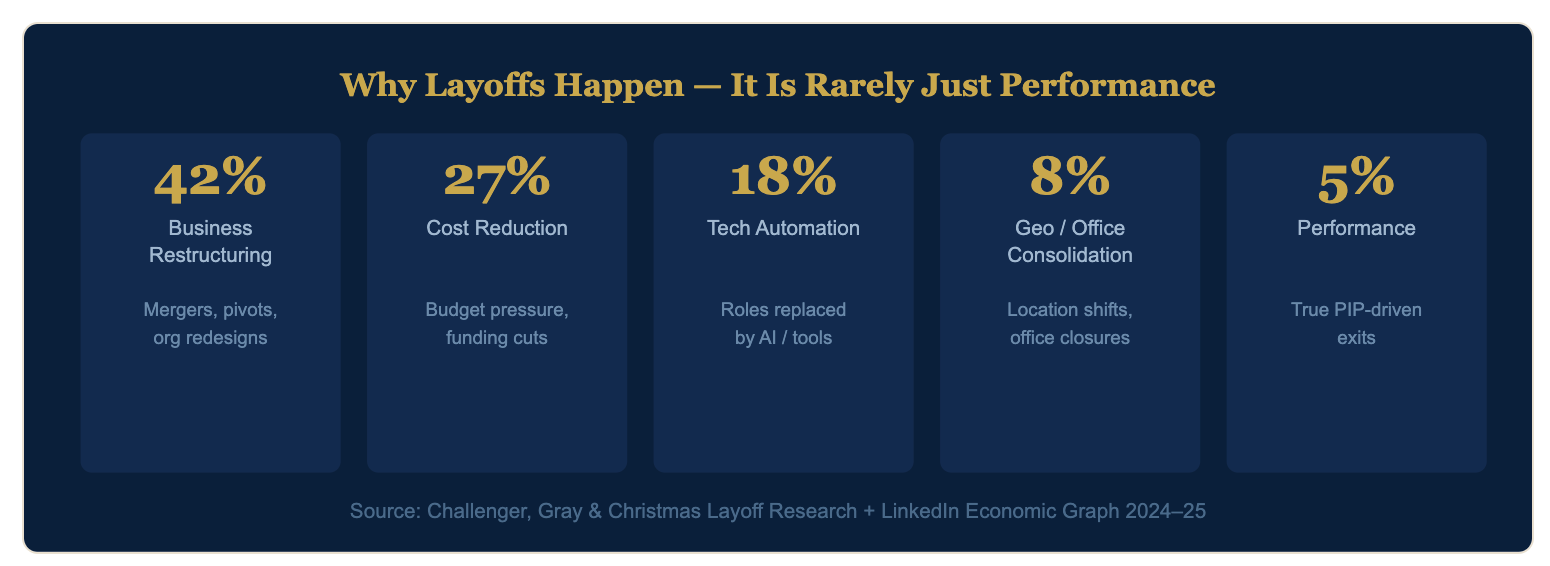
Performance is the smallest driver of mass layoffs. The system rarely makes it personal
— even though it always feels that way.
First, Tell Yourself the Truth: It Was Rarely About You
When I coach people through a layoff, the first thing I hear is some version of: "What did I do wrong?"
Let me be direct. According to Challenger, Gray & Christmas research, fewer than 5% of mass layoffs are performance-driven. The rest are structural: business pivots, cost targets, automation, geography changes, leadership transitions. The person in row 47 of a spreadsheet didn't make a mistake. A model decided row 47 was expendable. A takeover changed the org map. A new leader consolidated teams.
Naming this matters. Because if you walk into your next chapter carrying false guilt, it will distort every decision you make — how you negotiate, how you show up in interviews, what risks you take, how you value yourself.
You are not the layoff. The layoff happened to you.
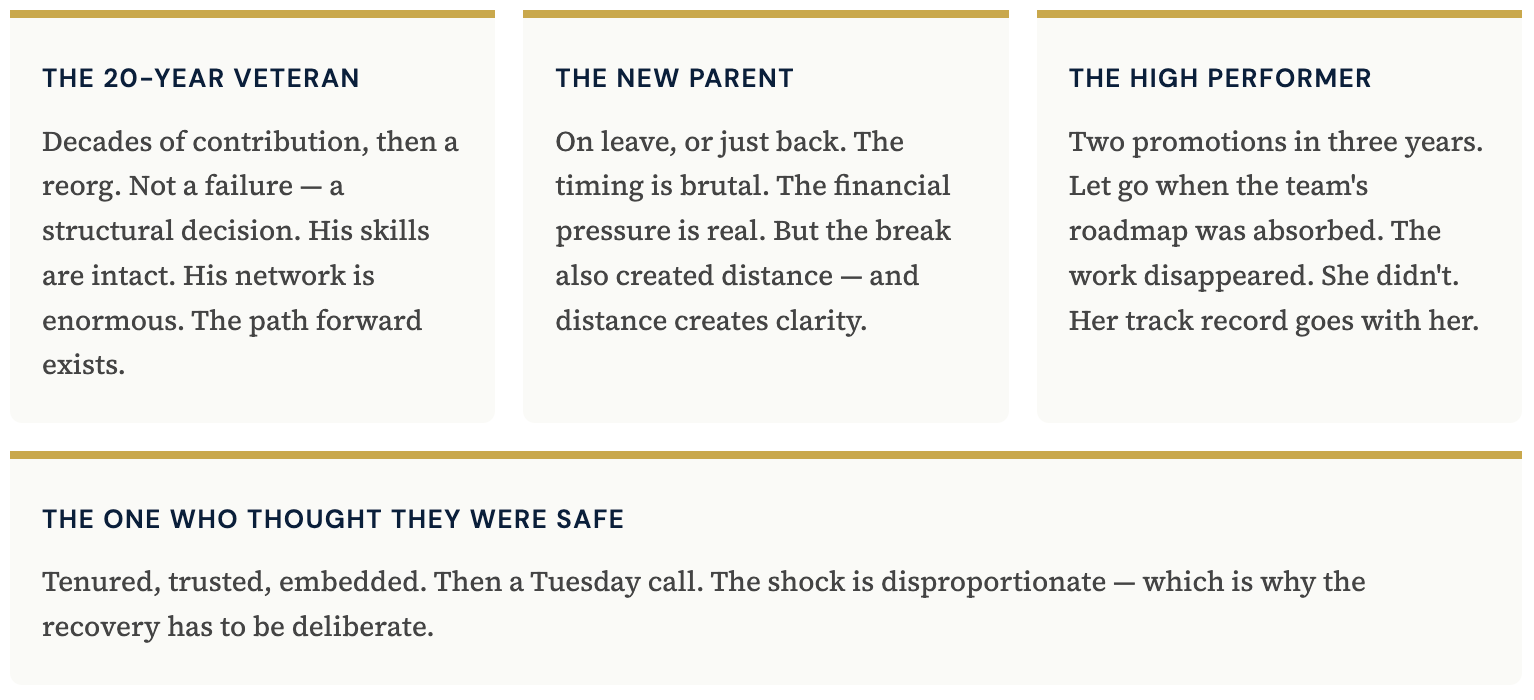

The Identity Crisis Nobody Talks About
Here is the wound that goes deeper than the finances, deeper than the job search, deeper than anything tactical: for most professionals, their job title is their identity.
"I'm a Senior TPM at —" fills a blank in your brain that defines how you introduce yourself at dinner, how you answer "so what do you do?", how you see yourself in the mirror on a Monday morning. That identity took years to build. The title gets taken in 30 minutes.
What happens next is an identity vacuum. And it's one of the least- discussed psychological realities of career disruption. You're not just looking for a job. You're looking for yourself again — minus the company name.
I've felt this. Twice, when the rug was pulled — I knew my skills were intact, knew my track record was real. But there's still a moment where you look at your blank LinkedIn tagline and the absence feels enormous. Not because the job was everything. But because you'd let it stand in for everything.
The question to sit with — and it is not comfortable — is: Who are you when you remove the company name from your bio?
What are your values? What kind of problems do you love? What do the people who know you best say you're actually good at, beyond the job title? The answers to these questions are more durable than any org chart. They are also the foundation of the next chapter — because the people who land well after a layoff are the ones who know what they're actually offering, not just what their last role was called.

The First 72 Hours
Calculate your real runway
Add savings, severance, partner's income. Divide by monthly burn. That number — 3 months, 6 months, 9 months — is your negotiating leverage. The longer the runway, the calmer the choices.
Separate needs from habits
Subscriptions, eating out, the premium gym — most of these can pause. Do a 30-minute audit. Cut discretionary spend 30–40% immediately. Not forever. Just until the next chapter is locked.
File for benefits immediately
Severance, unemployment, COBRA/health coverage. In most countries there is a window. Don't wait. This is money you earned. Use it without shame.
No big financial decisions in week one
No panic-selling investments. No taking a 30% pay cut because "security is an illusion." Give yourself 30 days before any irreversible financial move.
Know your severance terms completely
Non-competes, equity vesting cliffs, outplacement services — read everything. Ask HR questions in writing. These terms are more negotiable than most people realise.
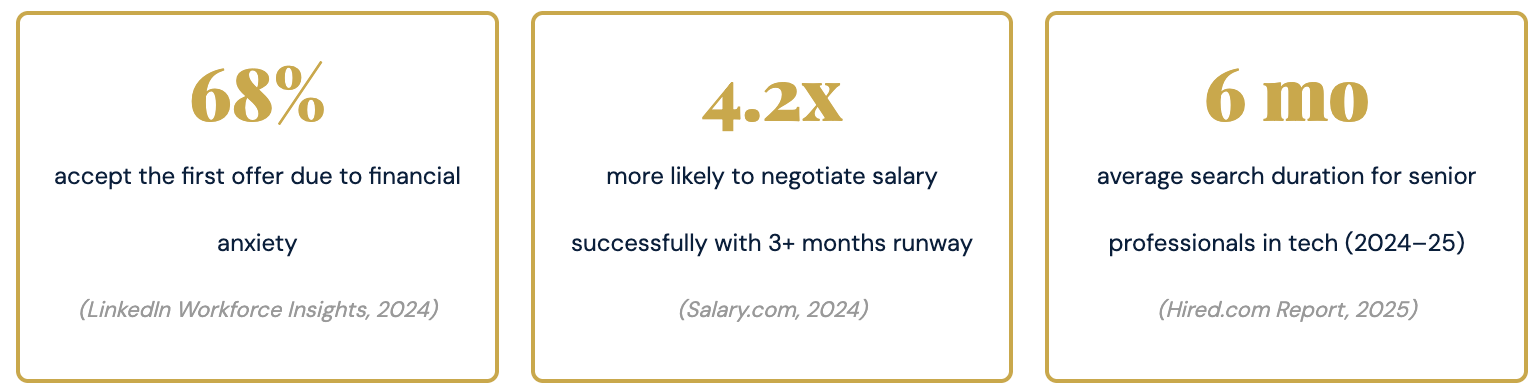
The reason to stabilise finances first is not money. It's psychology. When you are not afraid, you make better decisions. Financial stability is the platform on which everything else gets built.
The Emotional Reckoning — Don't Skip It
Layoff grief is real grief. Psychologists have mapped it — it follows the same arc as loss. Shock. Denial. Anger. Bargaining. Acceptance. Rebuilding.
Most people try to skip to the last step immediately. They update LinkedIn at 11pm the night of the layoff. They start sending CVs before they have slept. They are performing productivity as a way to avoid feeling what they need to feel.
I am not saying disappear for weeks. I am saying: give yourself the first 48–72 hours to actually feel it. Sit with the anger. Acknowledge the fear. Let yourself be sad about the team you won't see, the projects you'll never finish, the identity you built there. The second time it happened to me — moved to a new team with a week's notice after six months of real work — I didn't give myself that space fast enough. I went straight into action mode. And the weight of it showed up later, in ways I didn't expect.
Here's what I've seen in coaching: people who don't process the emotion carry it into interviews. It shows up as bitterness, over- explaining, defensiveness. Interviewers sense it without being able to name it. And it costs people roles they would have otherwise landed.
Your Body Is Processing This Too — Don't Ignore It
This is the section that gets left out of every career article. And it shouldn't be.
Stress lands in the body before it lands in the mind. Sleep breaks down. Appetite changes. The gym routine you had disappears because the structure that held it in place — the work schedule, the morning commute, the rhythm of a day — is suddenly gone. You sit at a laptop refreshing job boards at midnight and wonder why you feel worse each morning.
The research on this is unambiguous. Regular physical movement during periods of high psychological stress reduces cortisol, improves sleep quality, and measurably reduces symptoms of anxiety and depression. Not because exercise is a cure — but because your nervous system needs somewhere to put what it's carrying.
You don't need a training plan. Walk. Run. Do whatever you were doing before, even half as much. Protect sleep as if it is a deliverable — because it is. The quality of your thinking, your interview performance, your emotional regulation — all of it depends on rest that stress wants to steal.
And watch what you're consuming — not just food, but media. Doom- scrolling layoff news while you're already anxious is the equivalent of pouring fuel on a fire and being surprised it's hot. Curate your inputs. Your mental environment matters as much as your physical one.

Talk to the People Who Love You. Actually Talk.
I've seen this pattern repeatedly: someone is laid off, and for weeks they protect the people around them — spouse, parents, close friends — from the truth of how bad it feels. They say "I'm fine. I'm already applying. Don't worry."
That is isolation masquerading as strength.
The people who love you are not fragile. What they need — and what you need — is the truth of what you're carrying. Not so they can fix it. So you don't carry it alone.
And if you're not sure how to start that conversation, start with the simplest version of the truth: "I'm struggling more than I'm showing. I don't need you to fix anything. I just need you to hear me right now."
That sentence alone does more than most people expect.
Let your parents worry a little. It's how they love you. Denying them the chance to show up for you is its own quiet loss. Call the friend who will listen without advice. Sit with your partner without the performance of "I've got this." You don't have to have it. Not yet.
The data on social support during career transitions is consistent: people with strong support systems return to employment faster, accept better offers, and report substantially higher wellbeing throughout the process. Connection is not soft. It is structural.
Spend Time With Yourself — The Part Most People Fear
A layoff is an invitation. A brutal, uninvited, completely unwelcome invitation — but an invitation nonetheless. To ask questions you haven't had the bandwidth to ask.
What do I actually want? Not what does my resume say I should want. Not what does the market say I should chase. What do I want?
What parts of my last role gave me energy? Which drained me every single day? If I could redesign my work life — not optimise it, redesign it — what would I keep and what would I throw out?
These are not luxury questions. They are the most important career questions you will ever answer. And most of us never answer them because we are too busy. A layoff creates the space. Use it — even if it's uncomfortable. Especially because it's uncomfortable.
Journal. Walk without headphones. Sit with the discomfort of not knowing. Some of the most important decisions I've seen come not from
frantic action but from a few quiet weeks of honest self-examination. You are not just a job title. A layoff has a way of temporarily confusing those two things. Solitude is how you remember who you actually are.
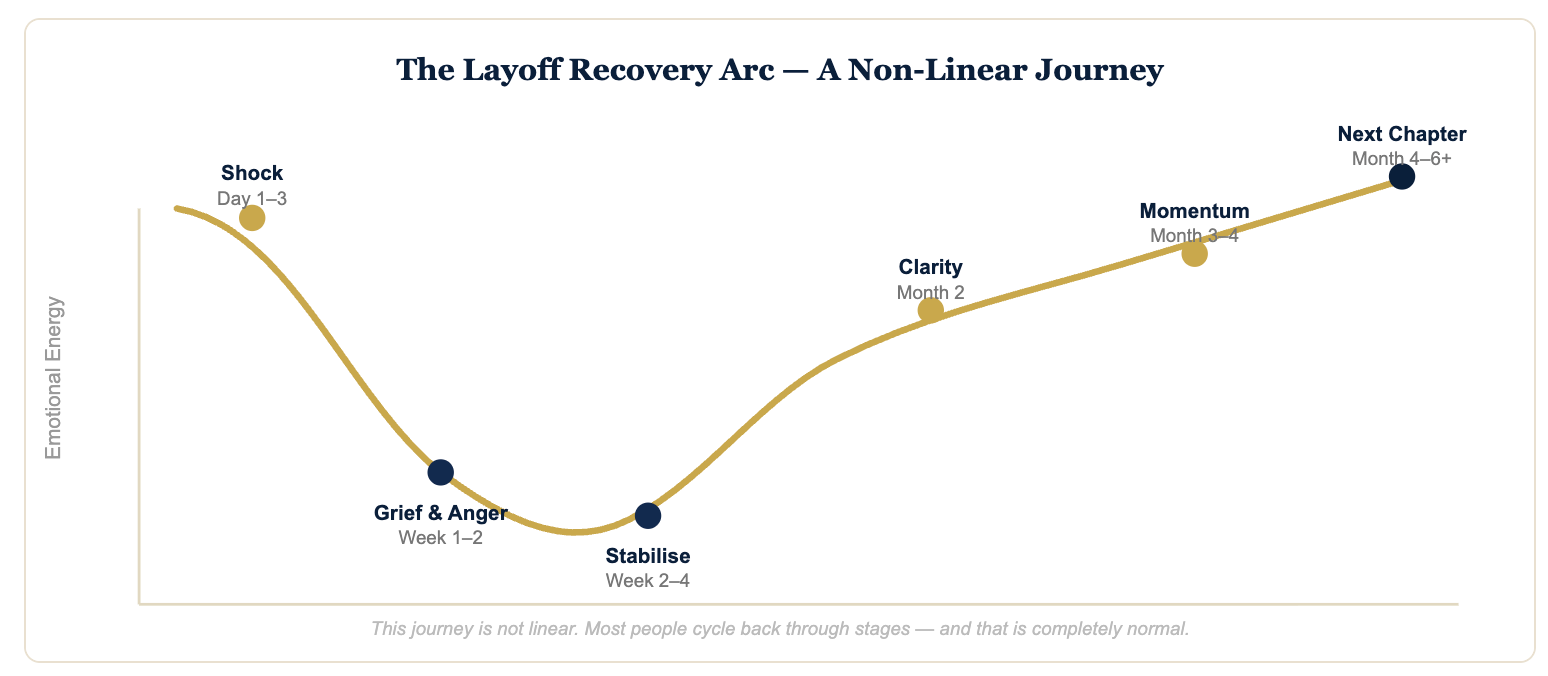
The recovery arc. Trying to skip grief doesn't remove it — it defers the cost to later, often
at the worst possible moment.
Manage the Politics — Because People Are Watching
How you handle a layoff publicly becomes part of your professional brand. I've watched people burn bridges in the first week — angry posts, venting in shared channels, reviews written from a place of raw pain. And I've watched those same people regret it when a reference or a referral got complicated six months later.
You are allowed to be angry. Be angry with your journal, your therapist, your closest friends. Don't broadcast it while the wound is fresh.
What you can say publicly, with dignity: "After [X years] at [company], I'm exploring what's next." Clean. No narrative. No bitterness. The people who need the full story will hear it privately.
Also: reach out to former colleagues proactively. Not to job-hunt — to stay connected. The referrals that come from people you've worked with closely are the highest-converting leads in any job search. Relationships don't maintain themselves. The best time to nurture your network was before you needed it. The second best time is right now.
The Mental Models That Actually Hold Up at 2am
Abstract advice sounds good but collapses under pressure. These are mental models I've tested — in my own transitions and in coaching others through theirs.
The Narrator Shift
Your brain will tell you a story: "I failed. I'm not good enough. Nobody will want me." That's your threat system — it's trying to protect you by preparing you for the worst. Consciously write a different story: "A business decision affected my role. My skills, relationships, and track record are intact. I am in transition, not in freefall." The story you repeat to yourself determines the energy you carry into every conversation.
The 10-Year Test
Ask: will this moment define my career in 10 years? Almost certainly not — unless you respond in a way that damages your reputation. The people you admire most have versions of this story. Most of them don't lead with it because the next chapter became the story instead.
Control the Controllables
This one I come back to constantly. You cannot control the fact that the layoff happened. You can control: your financial decisions, how you process the emotion, how you show up in conversations, the skills you build, the relationships you invest in. I kept asking myself — what is in my control right now? Then I put my energy there. Only there. It sounds simple. It is the hardest practice I know.
The Inventory, Not the Identity
Write down everything you have actually done. Projects shipped. Problems solved. Numbers moved. Teams built. People you developed who went on to do exceptional things. The title got taken. The work is still yours. Nobody can lay off what you have built, what you know, or who you have become.
Busy Is Not the Same as Better
This is the trap that catches high-achievers specifically. You fill every waking hour with job applications, LinkedIn updates, online courses, networking calls, certification prep. It looks like hustle. It is sometimes avoidance wearing hustle's clothes.
Frantic activity creates the sensation of progress without the reality of it. I've watched people send 200 applications in a month and land nothing — not because the market was bad, but because the applications were generic, unfocused, and driven by fear rather than clarity. The person who applies to 30 well-targeted roles after genuine reflection about what they want almost always outperforms the person who fires off 200 in panic.
Pace yourself. Recovery has a rhythm. You cannot sprint through grief any more than you can sprint through sleep. Build structure into your day — a consistent start time, blocks for applications, blocks for learning, blocks for rest. Treat yourself like a person you're responsible for, not a productivity machine you're trying to restart.
Build What Makes You Undeniable — Then Ask for Help
Now the tactical. I've put it here deliberately — after the emotional, relational, and mental work — because skills built from fear often get built in the wrong direction.
Audit First, Learn Second
Don't consume courses because learning feels like progress. Before spending time and money on any certification, answer: what specific gap is this closing? What roles require it? What changes in how I'm perceived if I have it? The skills worth investing in are the ones that either open roles that didn't exist for you before, or make you the obvious choice in conversations already happening.
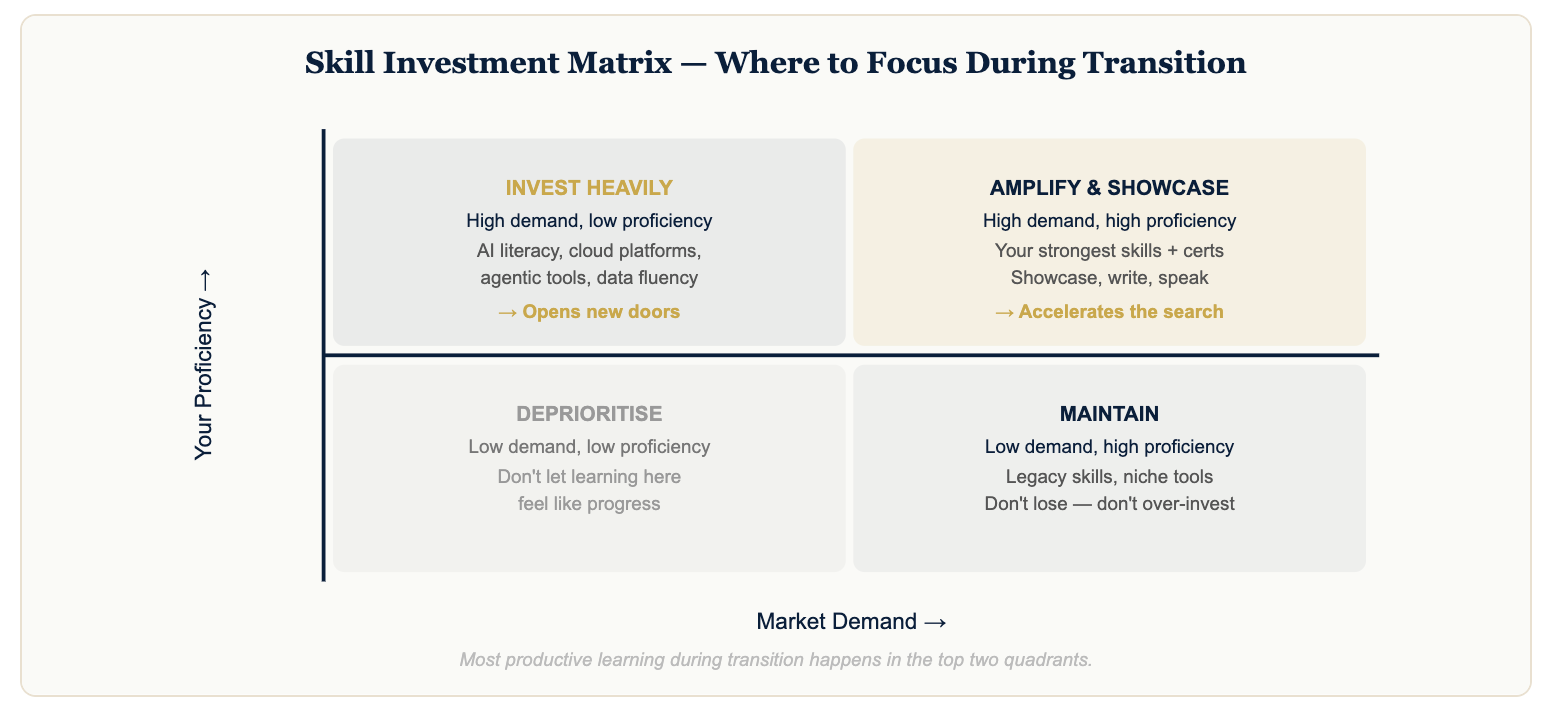
Focus skill investment where market demand meets your growth edge — not where
anxiety points.
Ask for Help Without Shame
Asking for help is not weakness. It is the most efficient thing you can do. The best leaders I know built their careers on networks of people they helped and who helped them. A layoff is not the moment to suddenly become self-sufficient in isolation.
But Here Is Something Nobody Warns You About
When you go through a layoff, you will quickly learn who in your network means what they say.
Some people will appear. They will send the message, leave the comment, say all the right things — "I'm here for you," "Let me know how I can help," "Let's catch up soon." And then, when you follow up, when you actually reach out and say — yes, I could use that conversation — they disappear. The message goes unread. The calendar invite never comes. The silence is loud.
I have been through this. It stings in a way that is hard to describe — not because you needed anything grand from them, but because the gap between the offer and the follow-through reveals something about the relationship you thought you had. You realise some people perform support publicly without intending to deliver it privately.
Notice it. Name it to yourself. And then — keep your distance from those people. Not with bitterness. Not with a dramatic exit. Just quietly, clearly, adjust your understanding of who they are. That knowledge is useful. It tells you exactly where not to invest your trust or your energy going forward.
But — and this is the part that matters most — do not let those people stop you from reaching out to everyone else.
Because for every person who performs and disappears, there is someone else — often someone you least expected — who shows up fully. Who takes the call. Who makes the introduction. Who sits with you in the discomfort without trying to fix it. Who remembers, three weeks later, to check back in. Those people exist. You will only find them by continuing to reach out.
Pulling back completely because some people let you down is one of the most expensive mistakes you can make in a transition. It feels like self-
protection. It is actually self-isolation. And self-isolation, during a period that is already hard, makes everything harder.
Asking for help does not make you small. It makes you honest about what you need and brave enough to say it. That is not weakness — that is exactly the kind of strength that gets people through hard things.
Learn to read the room quickly. Spend your energy on the people who show up, not on chasing the ones who don't. And keep reaching out — because the right people are out there, and they are waiting to be found.
What If It Takes Longer Than You Expected
Most articles end before this part. I'm not going to do that.
Month four. Month five. The runway is shrinking. The responses have slowed. You've had two final rounds that didn't go your way. The optimism of the first few weeks has worn thin and the anxiety has a different quality now — quieter, heavier.
This is where most people break. And it is also where the most important decisions get made.
First: a prolonged search is not evidence that you were wrong about your value. The tech job market in 2024–25 has been the most difficult in a decade. Senior roles take longer. The average search for experienced professionals is six months — not six weeks. That is not failure. That is the market.
Second: when it takes longer, the support structures matter more, not less. Don't go quiet on your network. Don't stop moving physically. Don't let the bad weeks convince you that all the weeks will be bad.
Third: use the time to do something you're proud of. Write. Volunteer. Consult on a project. Build something small. The goal is not to perform productivity for LinkedIn — it's to keep your sense of agency alive. Agency is the antidote to helplessness. And helplessness, left unchecked, becomes the thing that is actually hardest to recover from.
The next chapter is not determined by how long the search takes. It is determined by who you are when you walk into the room at the end of it.
The Thing Nobody Tells You
I know this is a dangerous sentence to write while you're in the middle of it. I'm not dismissing the pain.
But I've been through this three times. And I've watched enough people come out the other side to say it plainly: some of the most pivotal, generative chapters in people's careers began with a call they didn't want.
The person who finally left the company she'd outgrown — she wouldn't have left without the push. The engineer who discovered he actually wanted to build his own thing — he wouldn't have believed he could without the crisis forcing the question. The program manager who spent 12 years climbing one ladder and realized, only in the gap, that she had been climbing the wrong wall.
Clarity is a luxury. Crisis delivers it for free.
This world is vulnerable. It will shift beneath you — sometimes with warning, sometimes without. We should always be on our toes. Not from fear. From readiness. From the knowledge that our value is portable, our skills are real, and our ability to rebuild is something no org chart can take.
You will come back. Every single person who does the work — the inner work as much as the outer work — comes back.
A Summary Framework: The 8-Layer Recovery
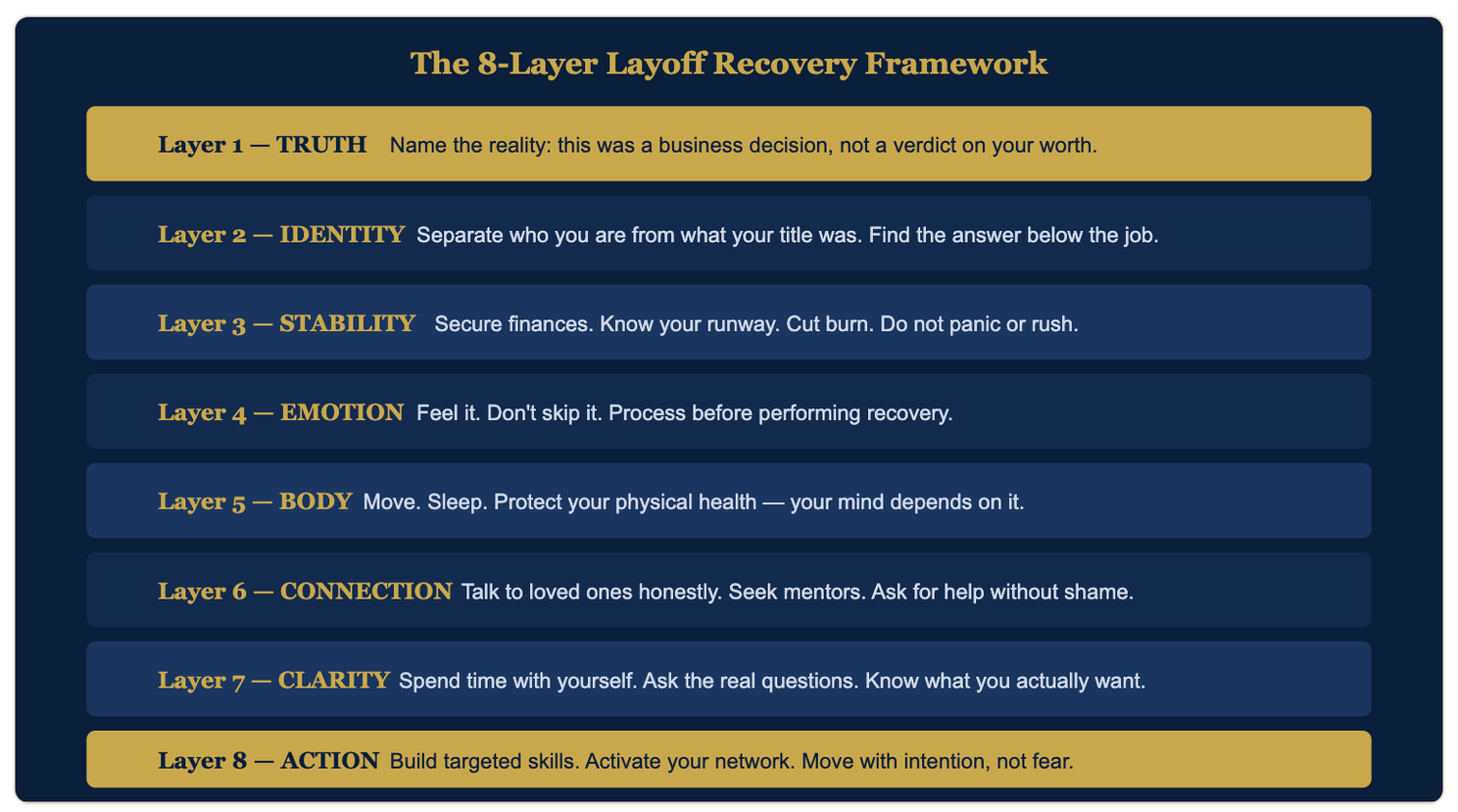
Each layer creates the conditions for the next one to work. Action without the earlier
layers is just noise.
If you're reading this in the middle of one — or if you've been through it — which layer was the hardest for you? And what got you through it? I'd genuinely love to hear your story in the comments.
If this helped, here's how to go deeper:


Real talk on TPM, AI, Leadership, real life stories and fun. No fluff. No corporate filter. Just
what actually works.
Michael, Kinjalk and 1,177 connections are subscribed
1,460 subscribers
🌱 The Art of Beginning Again: Renewal After the Layoff
Fear of a Layoff: From Unease to Intentional Action
Layoff Radar: How to Spot the Red Flags and Get Ahead Before It Hits
Raghu's Friday Thoughts
Amanda Clark
Cleantech & Digital Grid
Found this useful?
Book a 1:1 session to apply these frameworks to your specific situation — promotion prep, interview coaching, or career roadmap.
Book a Session →