
Most people memorize the 16 Leadership Principles before their Amazon interview. The best TPMs never stop living them. Here's how to build the mental wiring that turns principles into instincts — and why every serious organization should be paying attention.

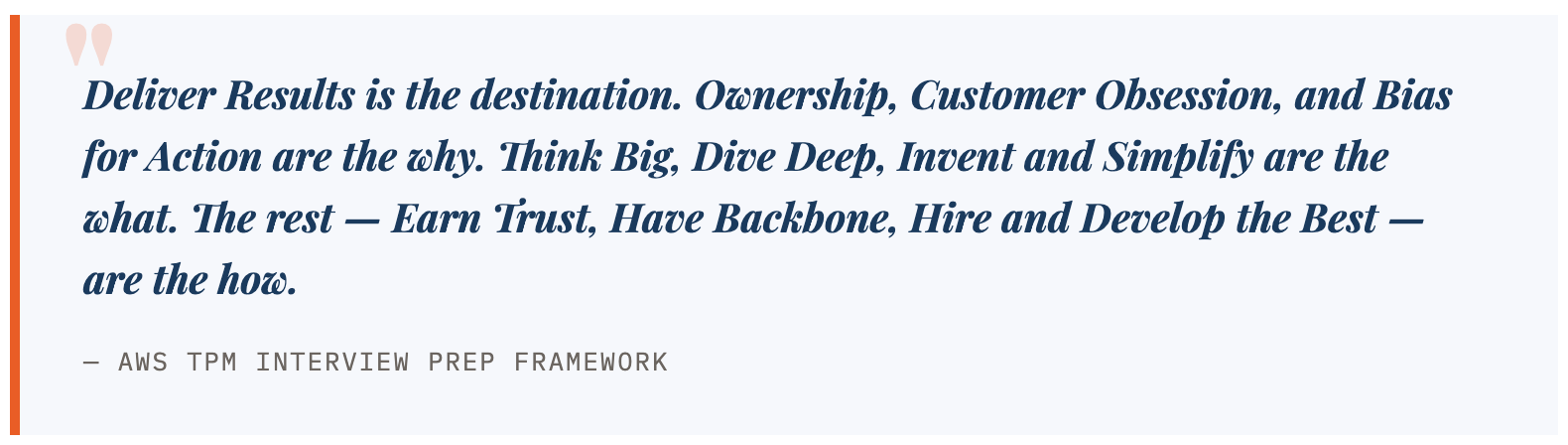
I'm going to tell you something that took me years to figure out: Amazon's Leadership Principles are not interview preparation material. They're not a checklist. They're not a culture deck. They are a decision-
making operating system — and if you're a TPM who treats them as anything less, you are leaving enormous leverage on the table.
I've run programs at LinkedIn, Amazon, and Citrix. I've mentored engineers becoming TPMs and TPMs growing in their ladder. The single biggest variable that separates good TPMs from the ones that operate at a completely different altitude? It's not their system design knowledge. It's not their stakeholder list. It's the quality of their mental model.
This article is my attempt to give you that model — built around Amazon's 16 Leadership Principles, mapped to the specific decisions, tensions, and moments that define the TPM role.
01 / Why Most TPMs Get the LPs Wrong
Ask any TPM about Amazon's Leadership Principles and they'll give you a clean answer. Ask them which LP they invoked in their last program review and you'll get silence.
That gap — between knowing and applying — is the real problem. The LPs are not a vocabulary test. They're a live decision framework. Jeff Bezos engineered them the same way Amazon engineers its supply chain: with the same intentionality, the same desire for consistency at scale, and the same expectation that they'd operate without a manager in the room.
When a senior Amazon TPM faces a late-breaking scope change from a VP, they don't think "should I escalate?" They think: Have Backbone. They don't think "should I understand the downstream impact?" They think: Dive Deep. The LP is the first language, not the translation.
That's the mental model shift I want to help you make.
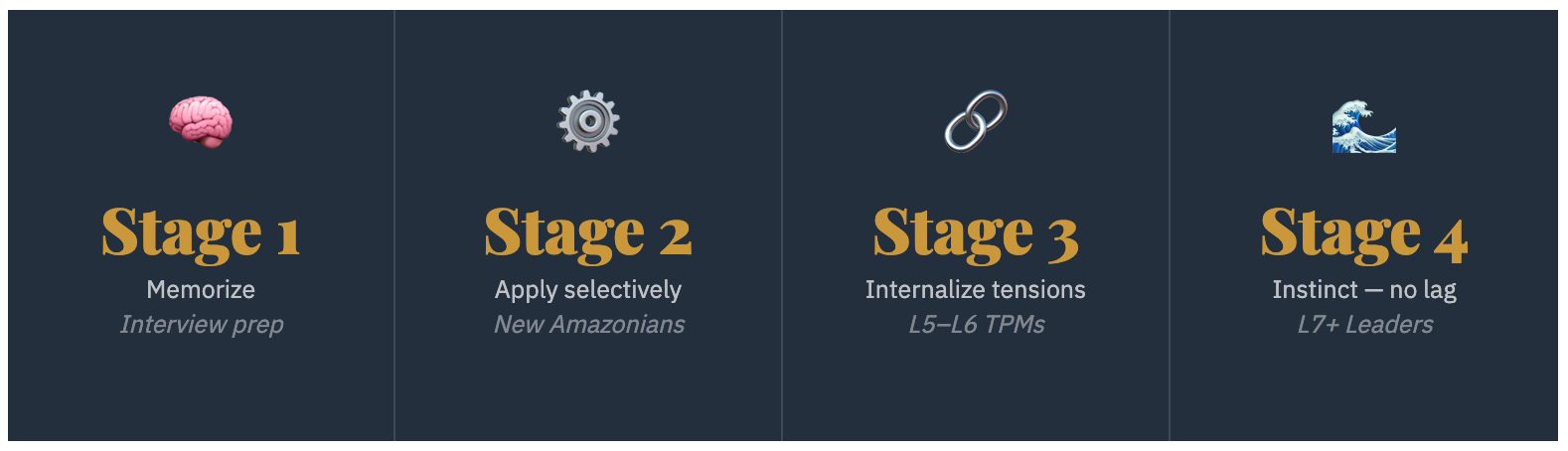
Most TPMs live between Stage 2 and Stage 3. The goal of this article is to get you firmly into Stage 3 — and give you a glimpse of what Stage 4 looks like from the inside.
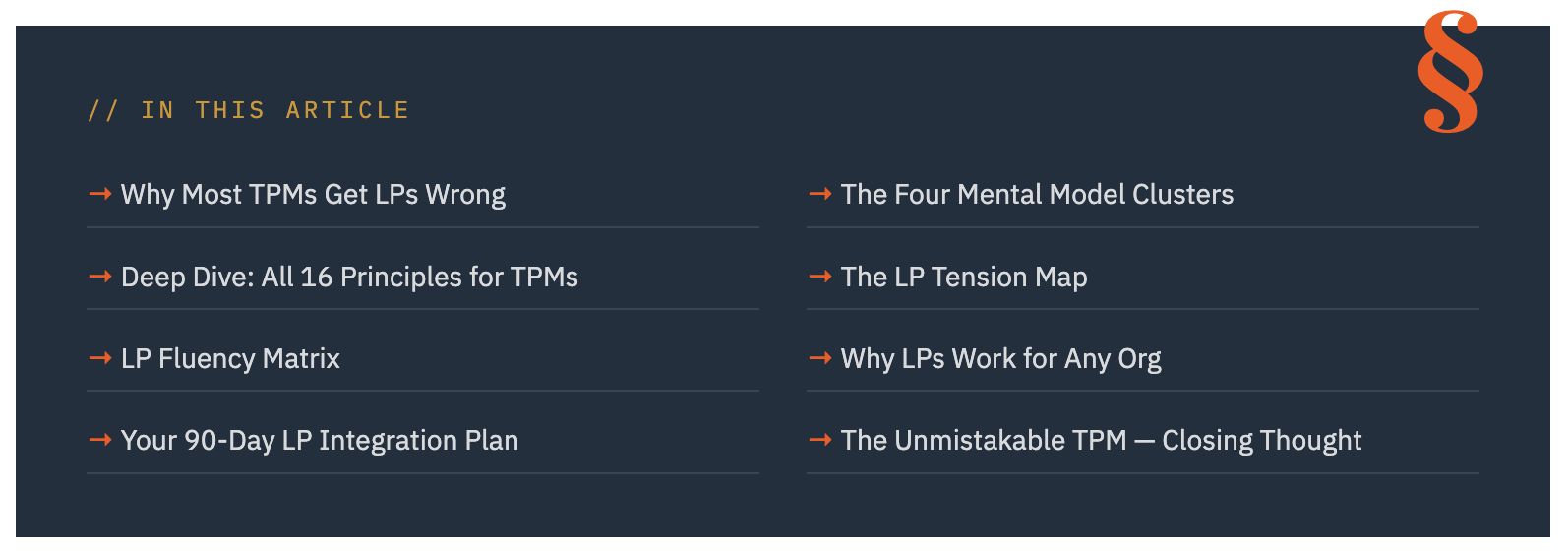
02 / The Four Mental Model Clusters
Sixteen principles is a lot to hold in working memory during a heated program review. So I group them into four clusters, each representing a different "mode" of TPM thinking.
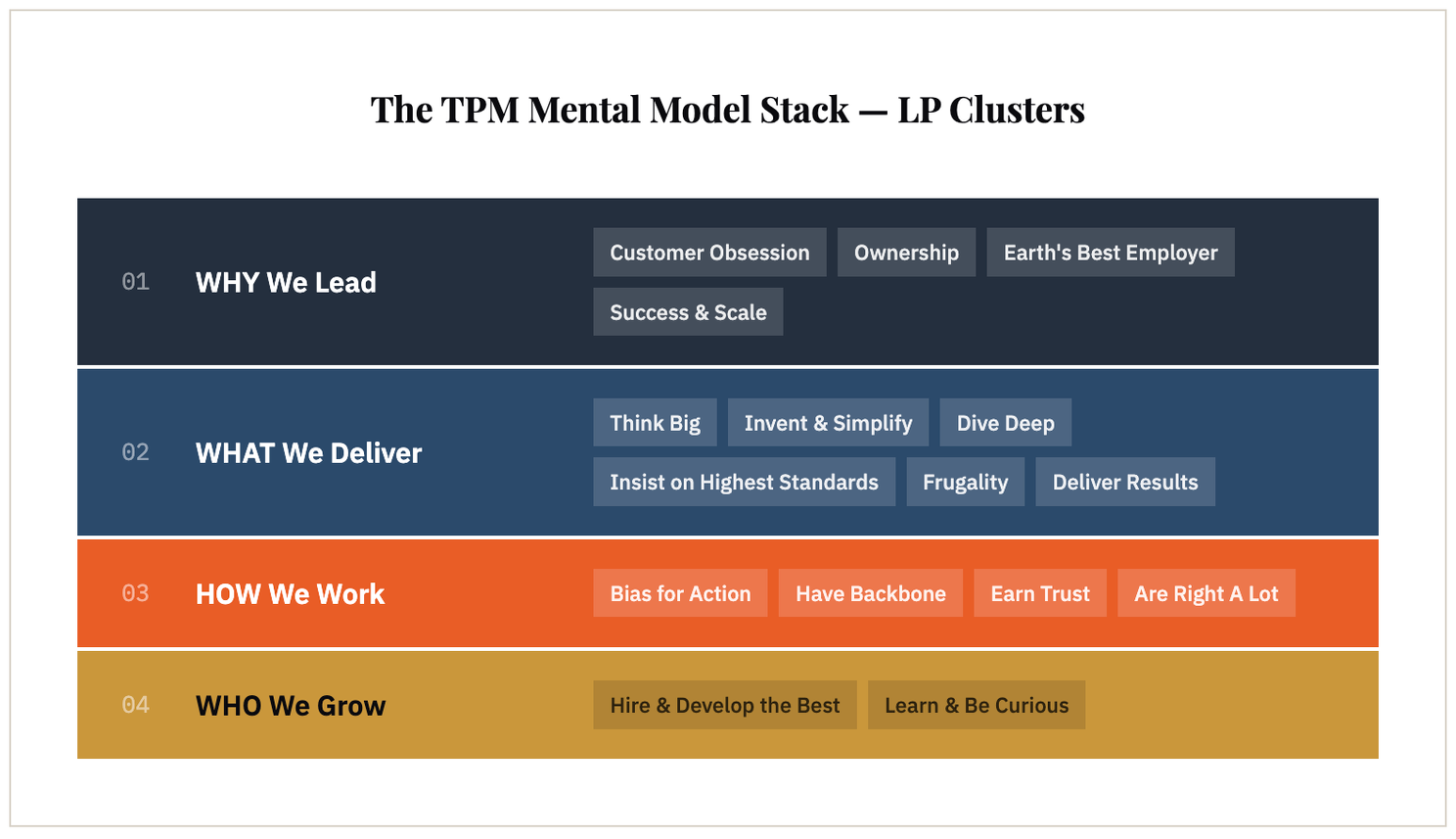
When you approach any program challenge, run it through these four layers in order. Start with WHY — are you solving for the right stakeholder? Move to WHAT — are you aiming high enough and grounded enough? Check HOW — are you moving fast, earning trust, challenging bad decisions? Finally, WHO — are you leaving the team better than you found it?
03 / Deep Dive: All 16 Principles Through the TPM Lens
Here's each principle — not as a definition, but as a live operational question a TPM should be able to answer. Each block also includes a TPM-specific translation drawn from my experience running programs across Amazon Advertising, LinkedIn, and AWS-adjacent teams.
Cluster 01 · WHY We Lead

"Leaders start with the customer and work backwards."
Over 90% of Amazon's new features in 2024 were developed based on customer feedback. That number isn't accidental — it's what happens when an entire organization genuinely starts with the problem, not the solution. As a TPM, you are often the last line of defense between an engineering team building something technically impressive and a customer who actually needed something useful.
The "working backwards" discipline — starting with the press release before writing a line of code — isn't bureaucracy. It's forcing function. It forces the question: who exactly is the customer, what exactly is their pain, and is what we're building the answer?
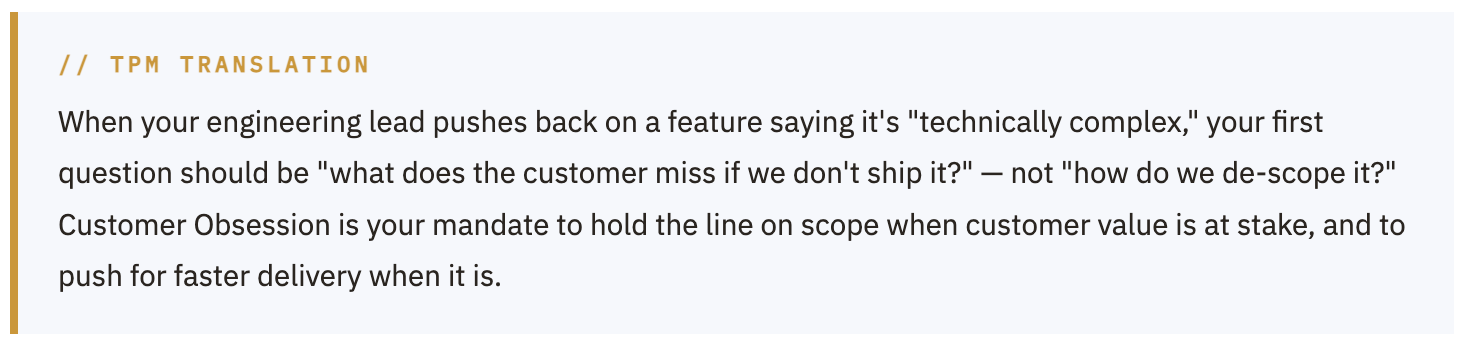

"They act on behalf of the entire company, beyond just their own team. They never say 'that's not my job.'"
This one is why TPMs exist. The role sits at the intersection of engineering, product, legal, finance, and operations. Nobody owns the seams. TPMs own the seams. Ownership in the LP sense means you can't hide behind organizational boundaries when a program is going sideways. If the contractor attrition on a dependent team is going to blow your timeline, that's your problem to surface, escalate, and mitigate — even if they report to a different VP.
AWS's ownership principle has driven 23% YoY growth precisely because long-term investment decisions get made by people who think like owners, not ticket-closers.

Cluster 02 · WHAT We Deliver

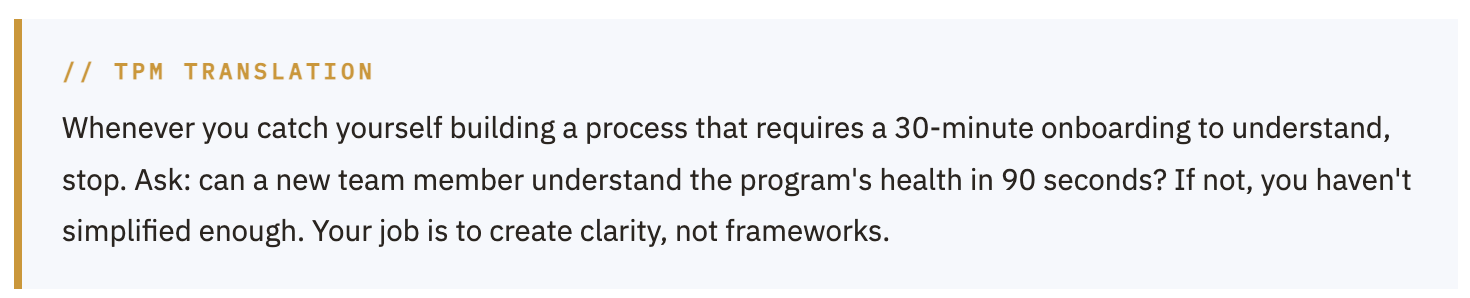
"Not invented here" is not a valid objection. Complexity is never a feature.
The TPM who builds a 47-tab Excel tracker and calls it a program management system is not being rigorous. They're hiding behind complexity. The best TPMs I've worked with can explain the entire program status, its risks, and the path forward in one page. That is not simplification — that is invention. Simplicity is the harder engineering problem.

"They seek diverse perspectives and work to disconfirm their beliefs."
This is not about confidence. It's about calibration. Amazon empowers leaders with a high degree of autonomy — and that autonomy is only valuable if the judgment behind it is sound. Being Right A Lot means you
actively seek out the data point that proves you wrong before someone else finds it.


"Many people may think these standards are unreasonably high."
This is where the Amazon TPM earns their reputation — or doesn't. Insisting on the highest standards means you don't let "good enough for this sprint" become "good enough, period." It means pushing back on a launch when the failure mode isn't fully understood, even if the program is behind schedule. It means your status report doesn't say "mostly on track" when two critical paths are amber.


"Thinking small is a self-fulfilling prophecy."
TPMs are execution-focused by nature. That's appropriate and necessary. But execution without vision is just task management. Think Big as a LP asks you to hold two things simultaneously: the detailed plan in front of you and the future state you're building toward. When you're managing a platform migration, "Think Big" is the question: in 18 months, what does this platform make possible that was impossible before?
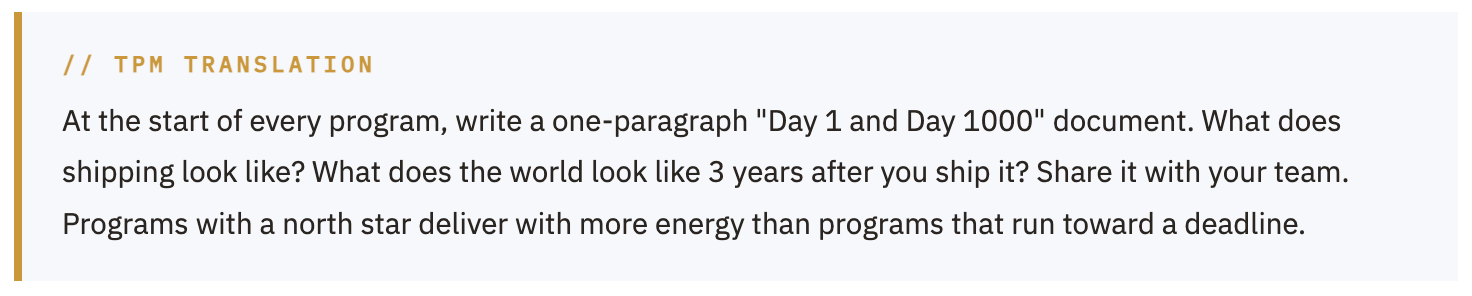

"Many decisions and actions are reversible and do not need extensive study."
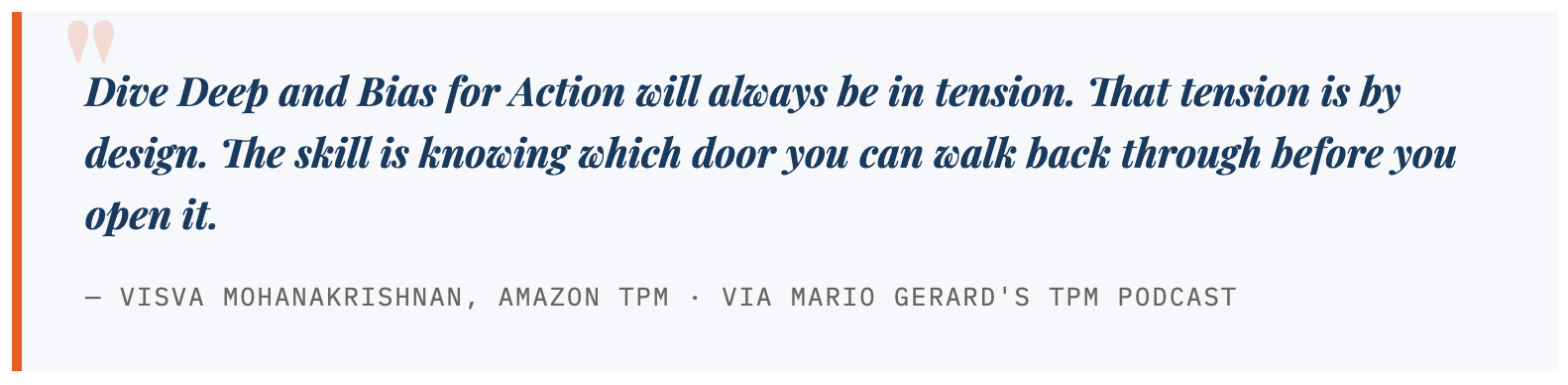
Amazon distinguishes Type 1 decisions (irreversible, go slow) from Type 2 decisions (reversible, go fast). Most decisions TPMs face are Type 2. Most TPMs treat them like Type 1. The result: analysis paralysis dressed
up as diligence. Bias for Action doesn't mean recklessness — it means knowing which door you can walk back through.
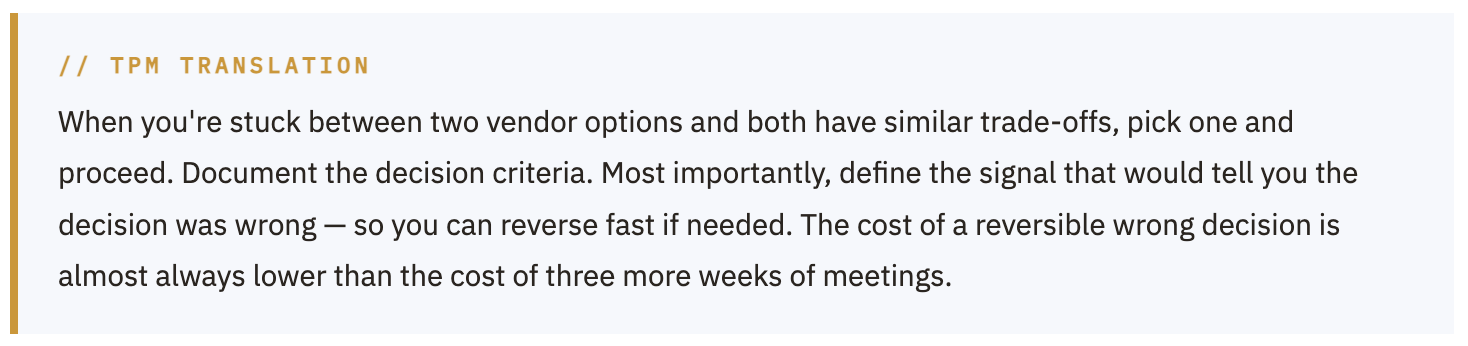

"Constraints breed resourcefulness, self-sufficiency and invention."
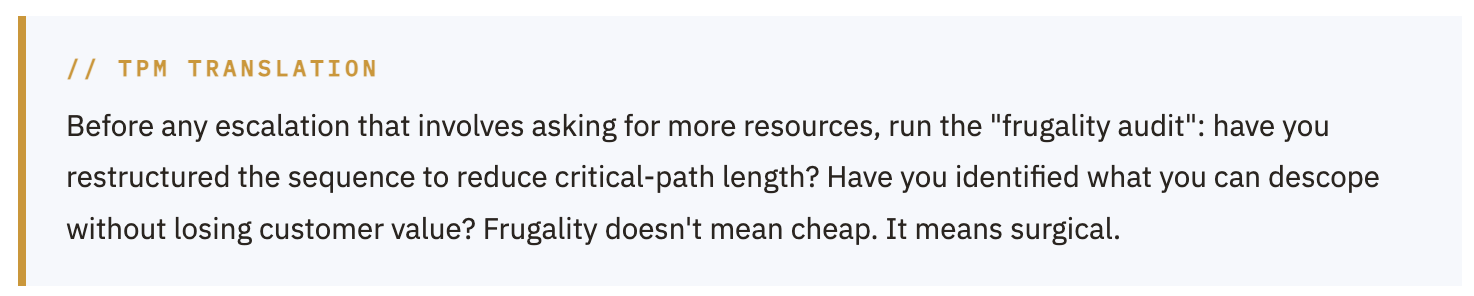
There are no extra points for growing headcount. TPMs who always ask for more engineers, more budget, more time are not managing programs — they are managing wish lists. The constraint is the design space. Your job is to find the path through it, not around it.

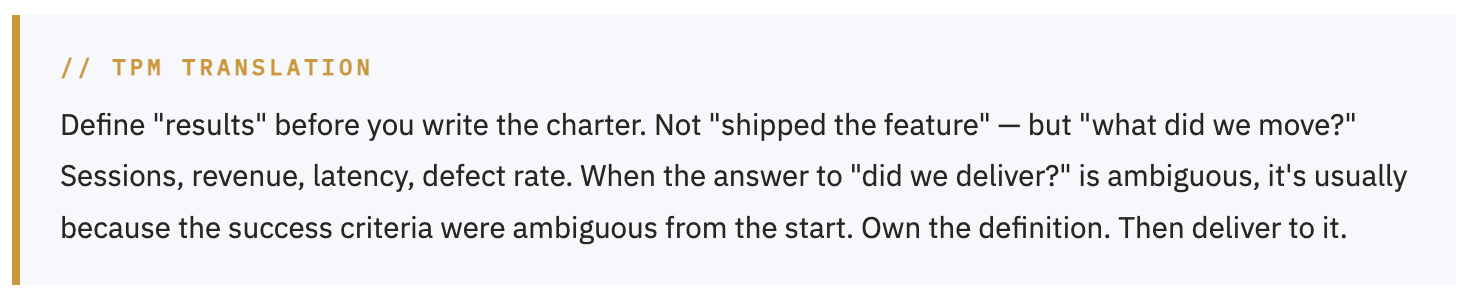
"Despite setbacks, they rise to the occasion and never settle."
This is the only LP that shows up on every page of a TPM's performance review. Everything else exists to make this happen. A TPM's credibility is built on their delivery track record — not their deck quality, not their JIRA hygiene, not their stakeholder relationships alone. At the end of the day: did the program land?
Cluster 03 · HOW We Work

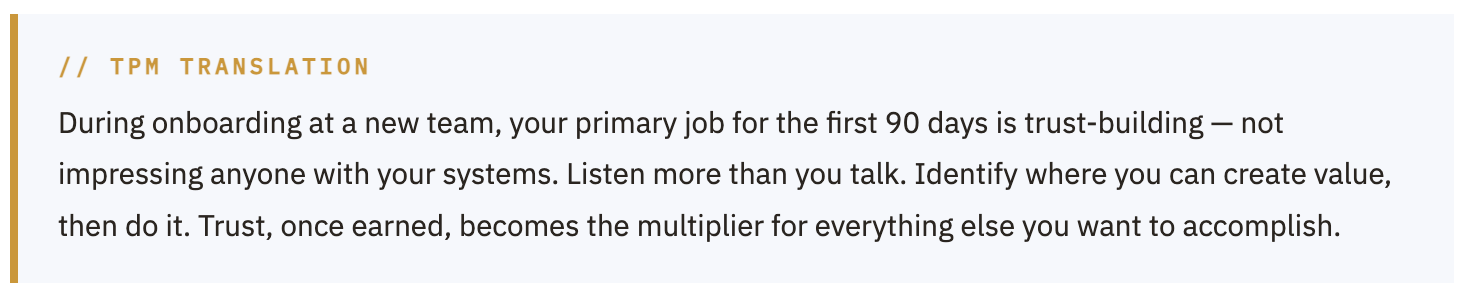
"They are vocally self-critical, even when doing so is awkward or embarrassing."
TPMs have no direct authority. Their entire effectiveness is a function of earned trust — with engineers, PMs, legal, finance, and leadership. Trust is built through transparency, not storytelling. The Amazonians who earn the deepest trust are the ones who raise the red flag before the situation is unrecoverable, who say "I was wrong about the timeline estimate" before they're asked.

"Leaders are skeptical when metrics and anecdote differ. No task is beneath them."
This is the LP that separates TPMs from program coordinators. When the dashboard says green and the engineer on the team looks worried, you dive. You read the system design. You walk through the data model. You pull up the actual dependency SLA, not the summary your stakeholder gave you. The metric and the anecdote tell you different things — your job is to find out which one is lying.

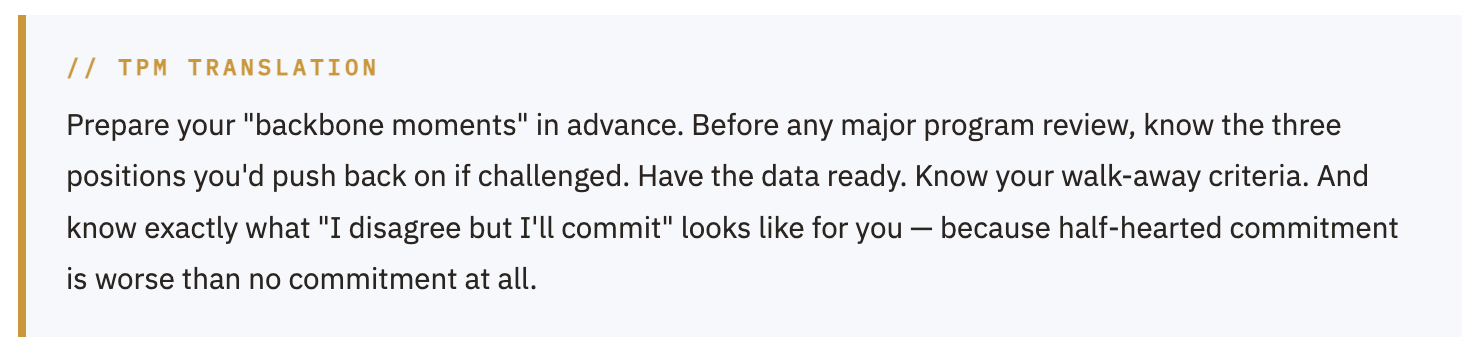
"Leaders do not compromise for the sake of social cohesion."
This might be the hardest LP to live. Disagreeing with a VP about a launch date in a room full of stakeholders is uncomfortable. Doing it with the data to back you up, while remaining respectful and open to being overruled, and then committing fully once the decision is made — that's what this LP actually asks for. It is not stubbornness. It is integrity with a clean resolution mechanism.
Cluster 04 · WHO We Grow

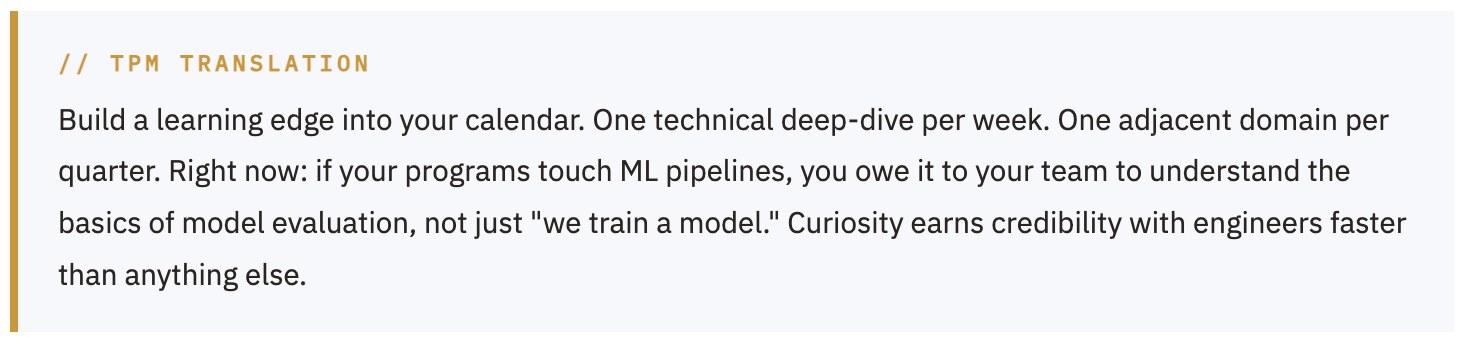
"Leaders are never done learning and always seek to improve themselves."
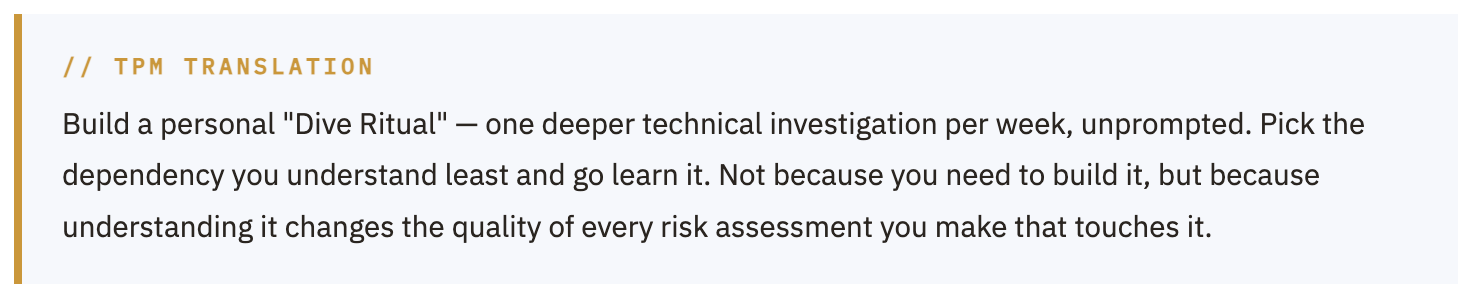
The half-life of technical knowledge in this field is shorter than most people admit. A TPM who knew Kafka well in 2018 and hasn't kept up knows something significantly different from what the field knows today. Curiosity isn't a personality trait at Amazon — it's a professional requirement. The most impactful TPMs I've met are the ones who read engineering blogs, stay curious about adjacent domains, and genuinely enjoy being the least-informed person in a room of experts.

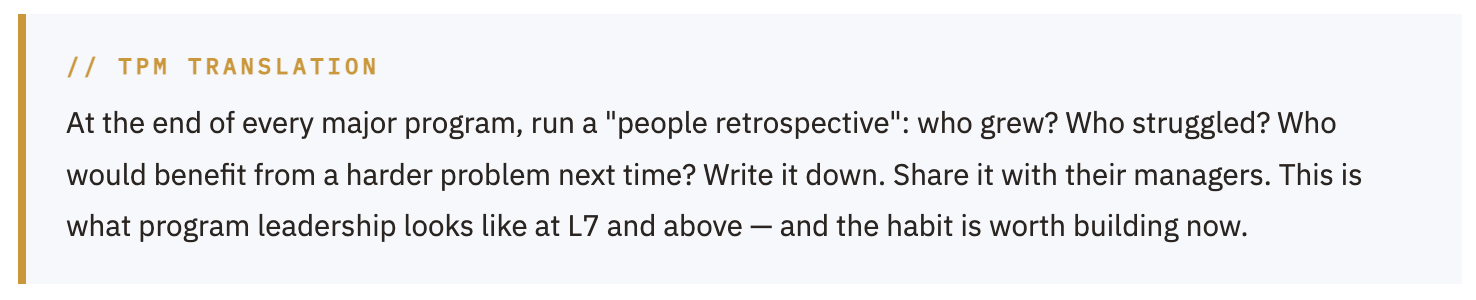
"Leaders develop leaders and take seriously their role in coaching others."
The best TPMs leave teams stronger than they found them. This is the LP most people think doesn't apply to them because they don't have direct reports. Wrong. As a TPM, you influence who gets promoted through your feedback, who gets stretch opportunities through your project assignments, and what "good" looks like through your behavior under pressure. You are always developing the people around you — whether you're intentional about it or not.
04 / The LP Tension Map — Where Most TPMs Get Stuck
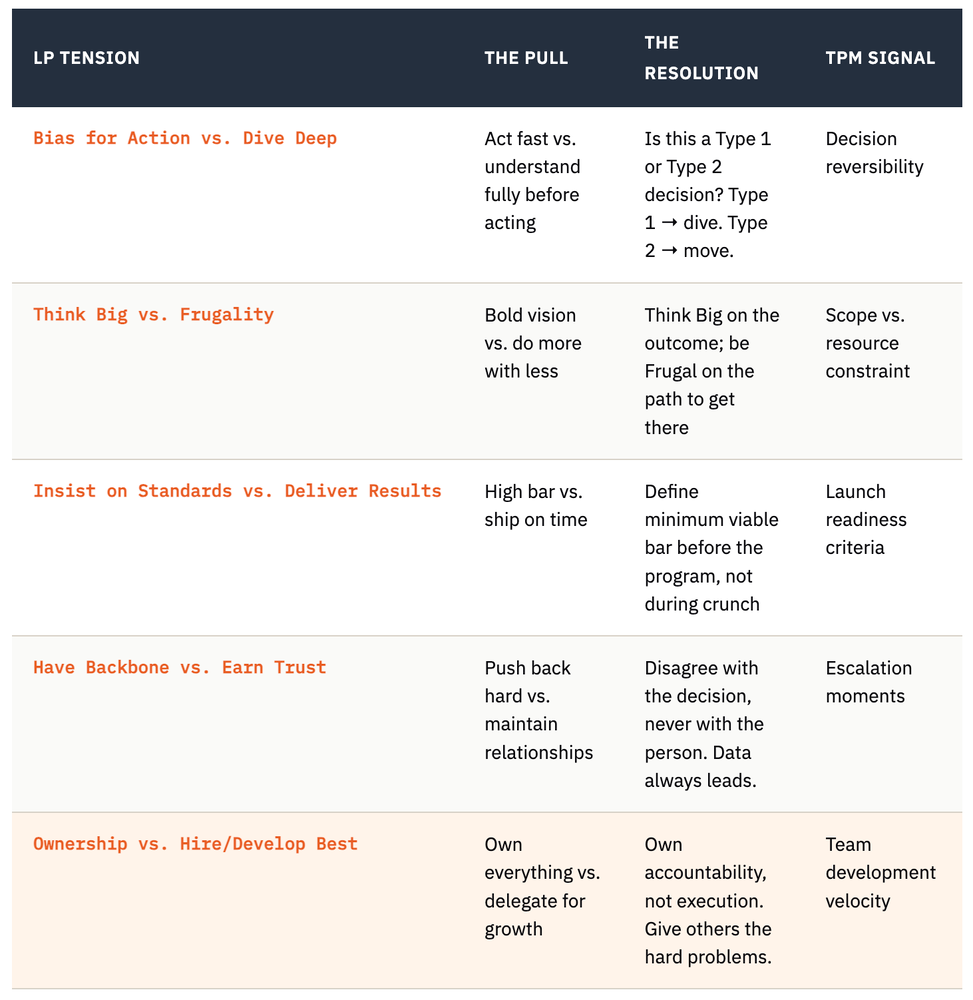
The LPs are not a harmonious set of axioms. They pull against each other in real programs, and that tension is intentional. Understanding where the friction lives is the mark of a mature LP practitioner.
The Five Core LP Tensions Every TPM Must Navigate
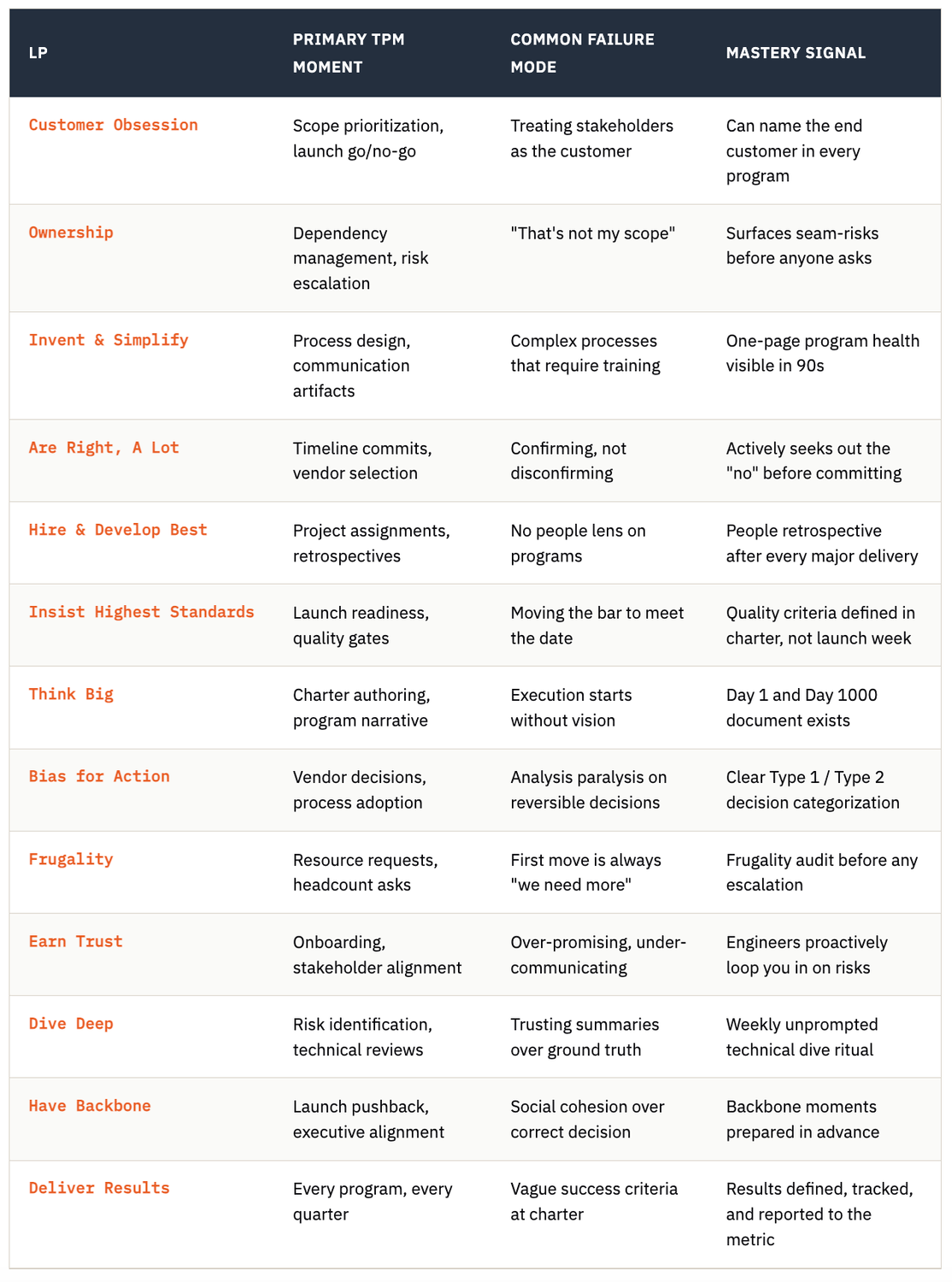
05 / LP Fluency Matrix for TPMs
Here's how to score yourself honestly. For each cluster, rate your current fluency and identify the specific program moment where each LP shows up.
06 / Why These Principles Work for Any Organization Serious About Growth
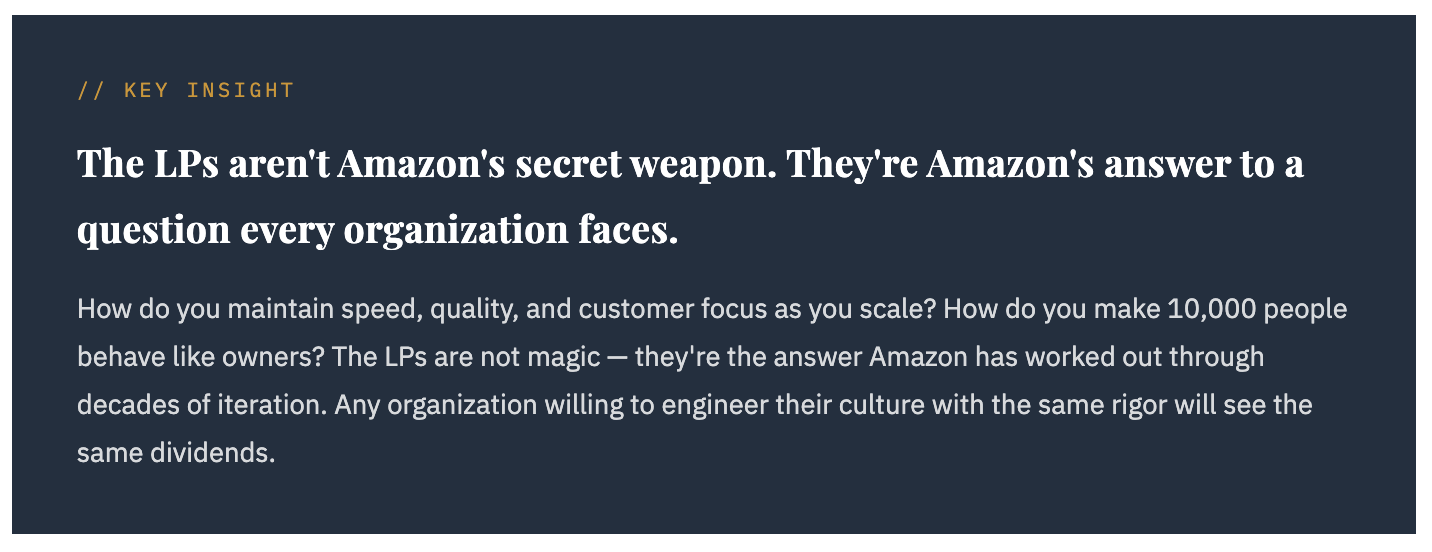
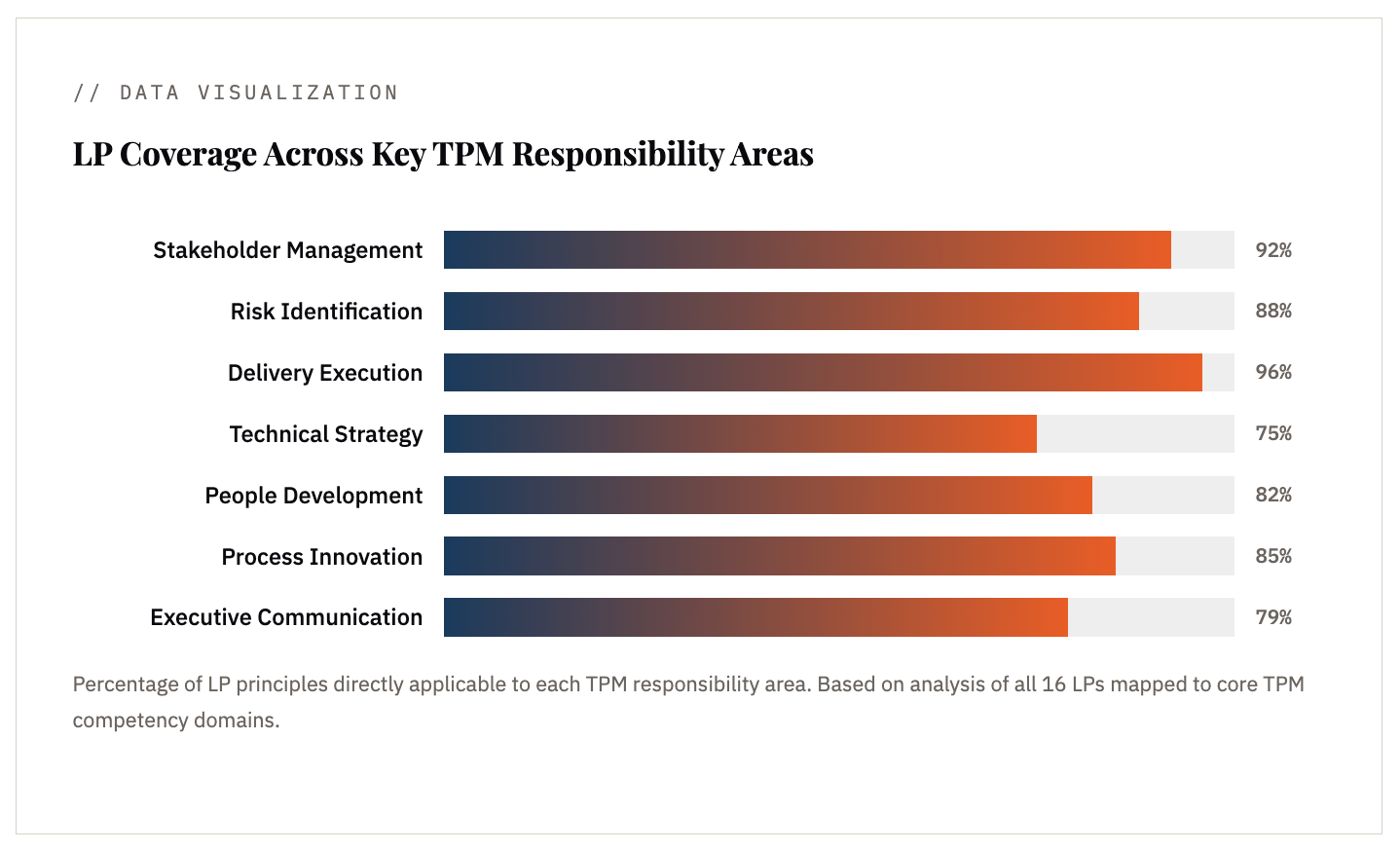
Amazon built its 16 LPs to operate at scale — millions of decisions made every day by people who can't always ask a manager. That's not a problem unique to Amazon. That's the problem of any organization that grows past the point where the founders can be in every room.
Bezos's leadership principles represent an effort to engineer culture with the same intentionality the company engineers its supply chain — and that intentionality is what makes them universally exportable.
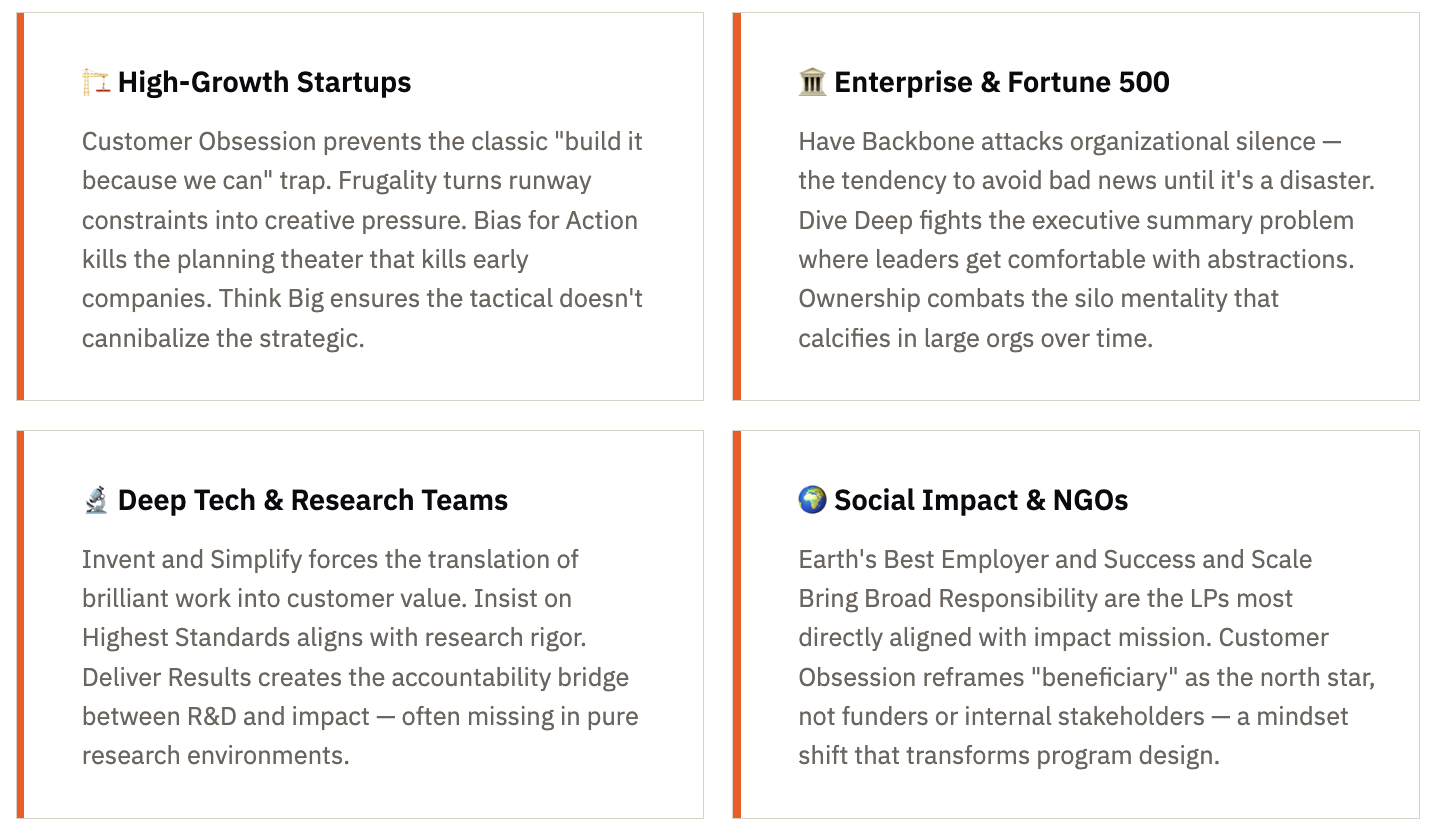
Here's how different organization types map to the same framework:
07 / Your 90-Day LP Integration Plan
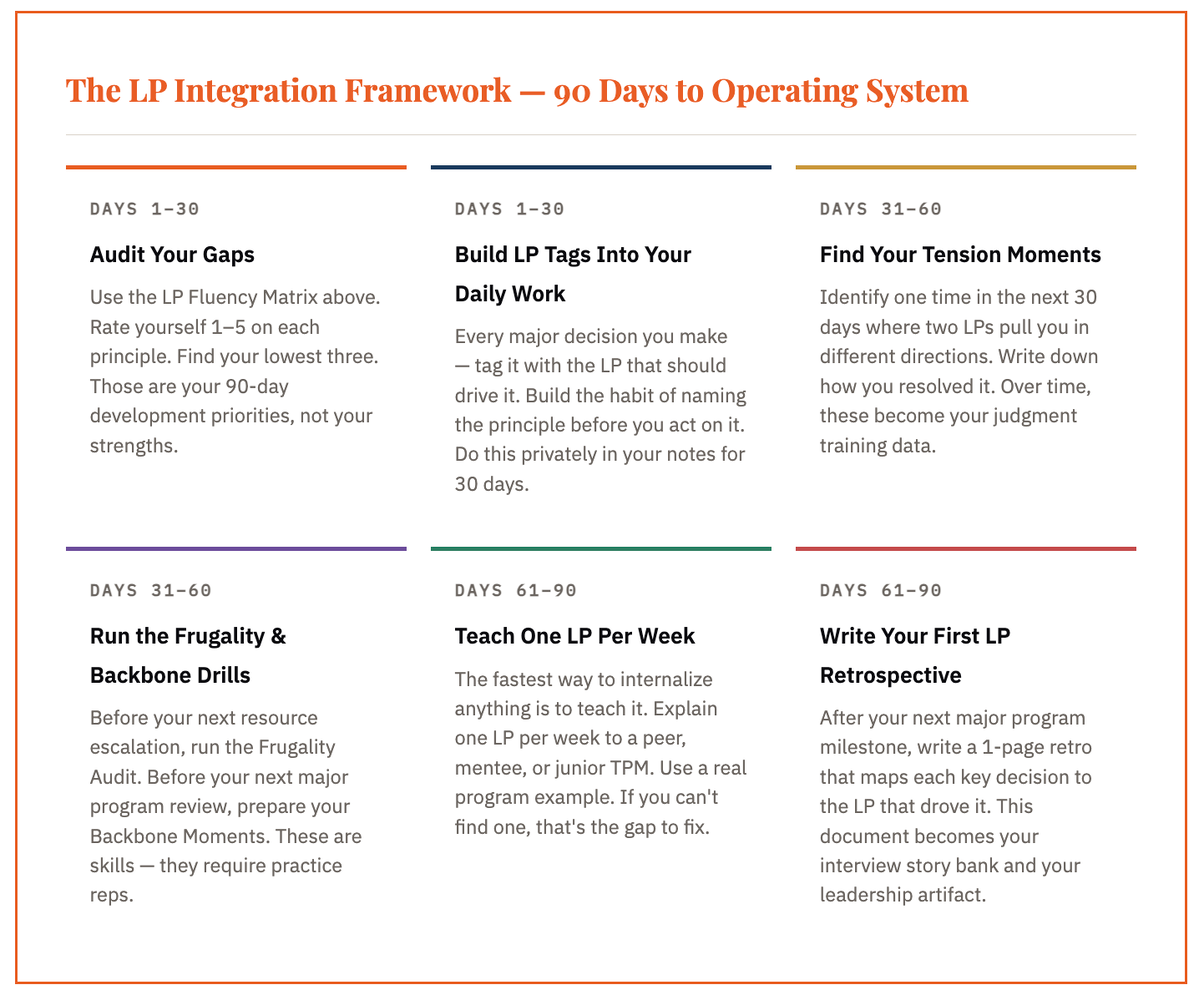
Reading this article is Stage 1. Here's Stage 2 — a concrete plan to move from understanding to instinct over the next 90 days.
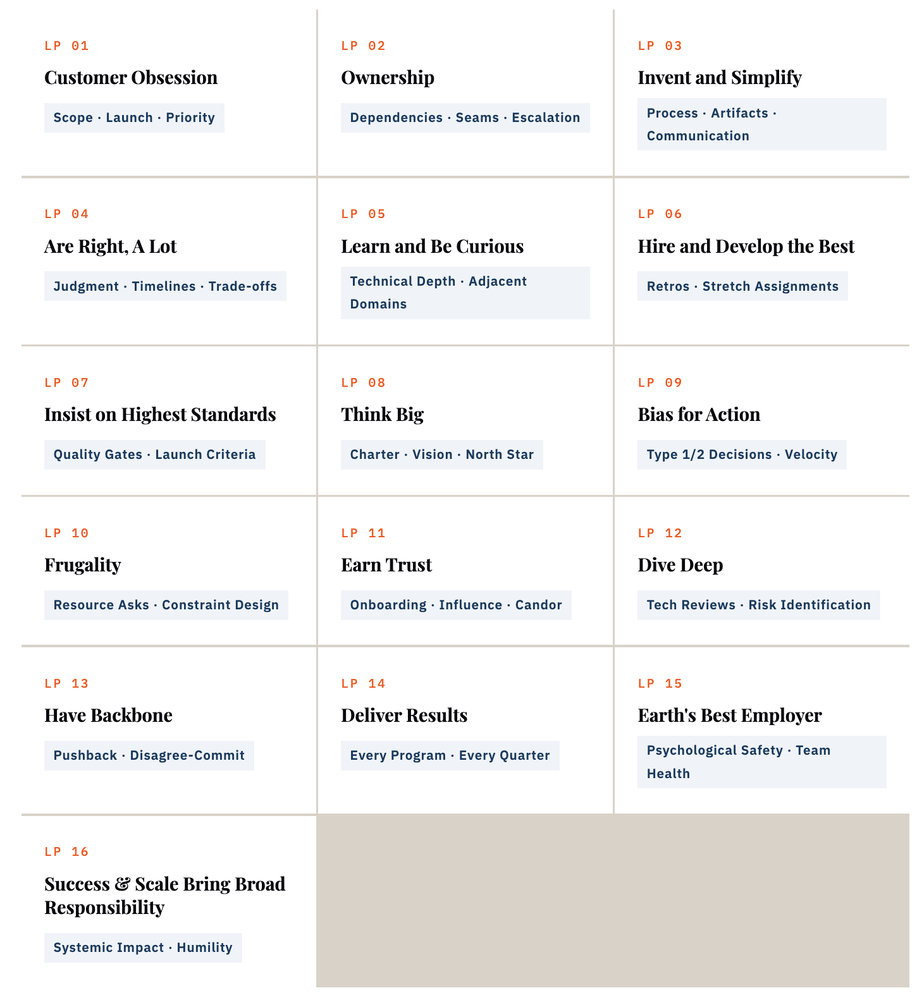
08 / All 16 Principles — Quick Reference for TPMs
09 / The Unmistakable TPM
There's a version of this role where you are a glorified project manager with a technical vocabulary. You track RAIDs, you run standups, you color-code JIRA boards. You deliver programs. That is a job.
There's another version where you are a force multiplier — the person who sees around corners before anyone else, who holds the line on quality when everyone else is exhausted, who earns the trust of a staff engineer in week two and turns that trust into 20% faster delivery for the next six months. That is a career.
The difference between those two versions isn't experience. It's mental model.
Amazon's 16 Leadership Principles, internalized — not memorized — give you a decision-making framework that operates in real time, under pressure, without a playbook. They don't tell you what to do. They tell you how to think.
I've been running programs for over a decade across some of the most complex technical environments on the planet. In my experience, the LPs that matter most to the TPM role aren't the ones that feel comfortable. They're the ones that feel like friction: Insist on Highest Standards when the team is exhausted. Have Backbone when the VP is impatient. Dive Deep when the summary looked fine.
That friction is the job. The LPs are the grip.
10 / Five Things to Take With You
The LPs are a decision-making OS. Apply them to live situations, not just interview stories.
Group the 16 into four clusters: WHY, WHAT, HOW, WHO. Run every major program decision through all four.
The tensions between LPs (Dive Deep vs. Bias for Action; Think Big vs. Frugality) are features, not bugs. Your judgment lives in how you navigate them.
Earn Trust is the foundational LP for every TPM. Without it, none of the others scale. Build it on day one and protect it always.
The LPs aren't Amazon-specific. They are the answer to the universal problem of how to make organizations think and decide at scale. Import them wherever you go.
For more on this, subscribe to Unblocked — my weekly newsletter for TPMs who lead at scale. Next in Unblocked: Will AI Kill The TPM Role? Have you thought about it?
For 1:1 mentorship and coaching, I'm on Topmate
Real talk on TPM, AI, Leadership, real life stories and fun. No fluff. No corporate filter. Just
what actually works.
Michael, Kinjalk and 1,177 connections are subscribed
1,460 subscribers

What Matters to Me in a Position
My Take on Amazon's 14 Leadership Principles
Your principles?
Nathan Blackham
Mustafa Tuncer
Philip Gollucci
37 · 8 comments
11 · 1 comment
About Accessibility Talent Solutions
Select Language
Questions? Visit our Help Center.
Professional Community Policies
Careers Marketing Solutions
English (English)
Manage your account and privacy Go to your Settings.
Ad Choices Advertising
Privacy & Terms
Sales Solutions Mobile Small Business
Recommendation transparency Learn more about Recommended Content.
Safety Center
LinkedIn Corporation © 2026
Found this useful?
Book a 1:1 session to apply these frameworks to your specific situation — promotion prep, interview coaching, or career roadmap.
Book a Session →