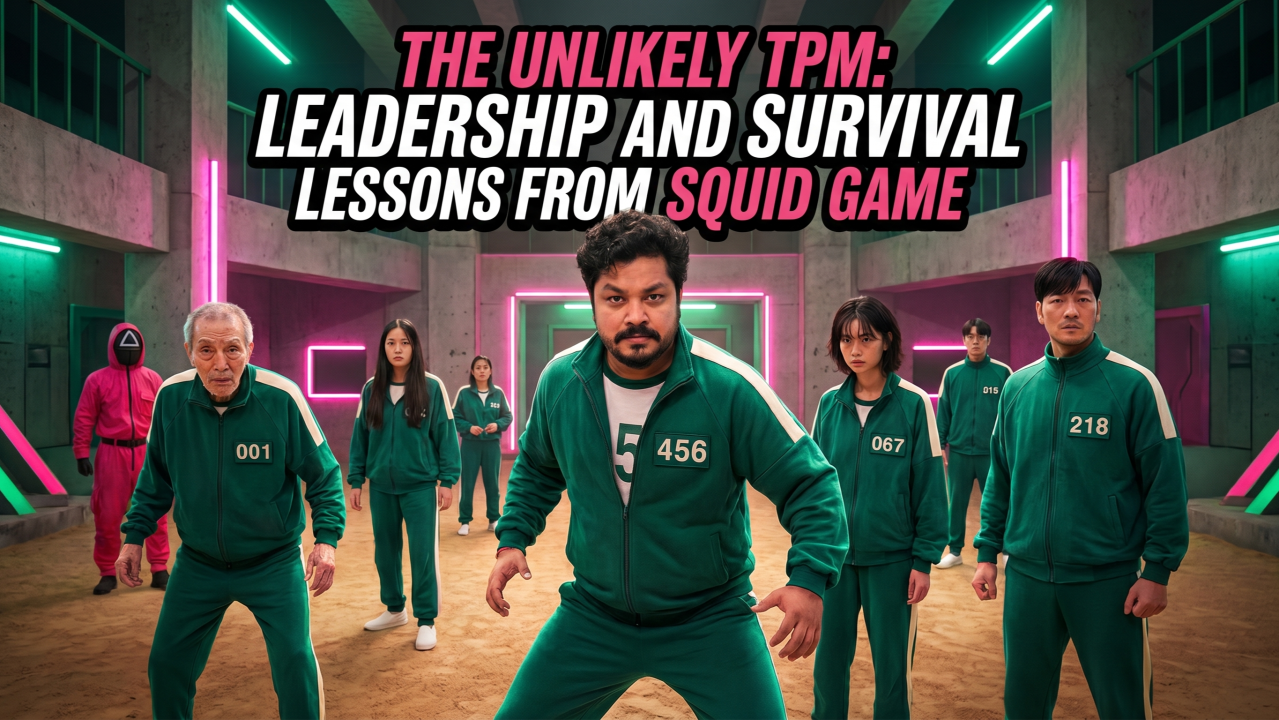
What a brutal Korean survival drama reveals about program execution, stakeholder pressure, and the moral weight of leadership decisions.
🔥 The Game You Never Agreed to Play
456 desperate players. Six lethal games. One winner.
And a system so perfectly designed, you almost miss the horror of it — because the rules are clear, the deadlines are real, and failure is final.
The first time I watched Squid Game, I thought it was about desperation and survival. The second time, I recognized something uncomfortable: I'd seen this environment before. Not with guns and glass bridges — but in boardrooms, sprint planning sessions, and executive reviews where the wrong answer could end careers.
The stakes in our programs aren't lives. But the pressure, the ambiguity, the compromises people make under it — that part is real.
This article isn't a recap of the show. It's a forensic look at what the games reveal about how we lead, how we build systems, and how we behave when the pressure is high enough that our values get tested.
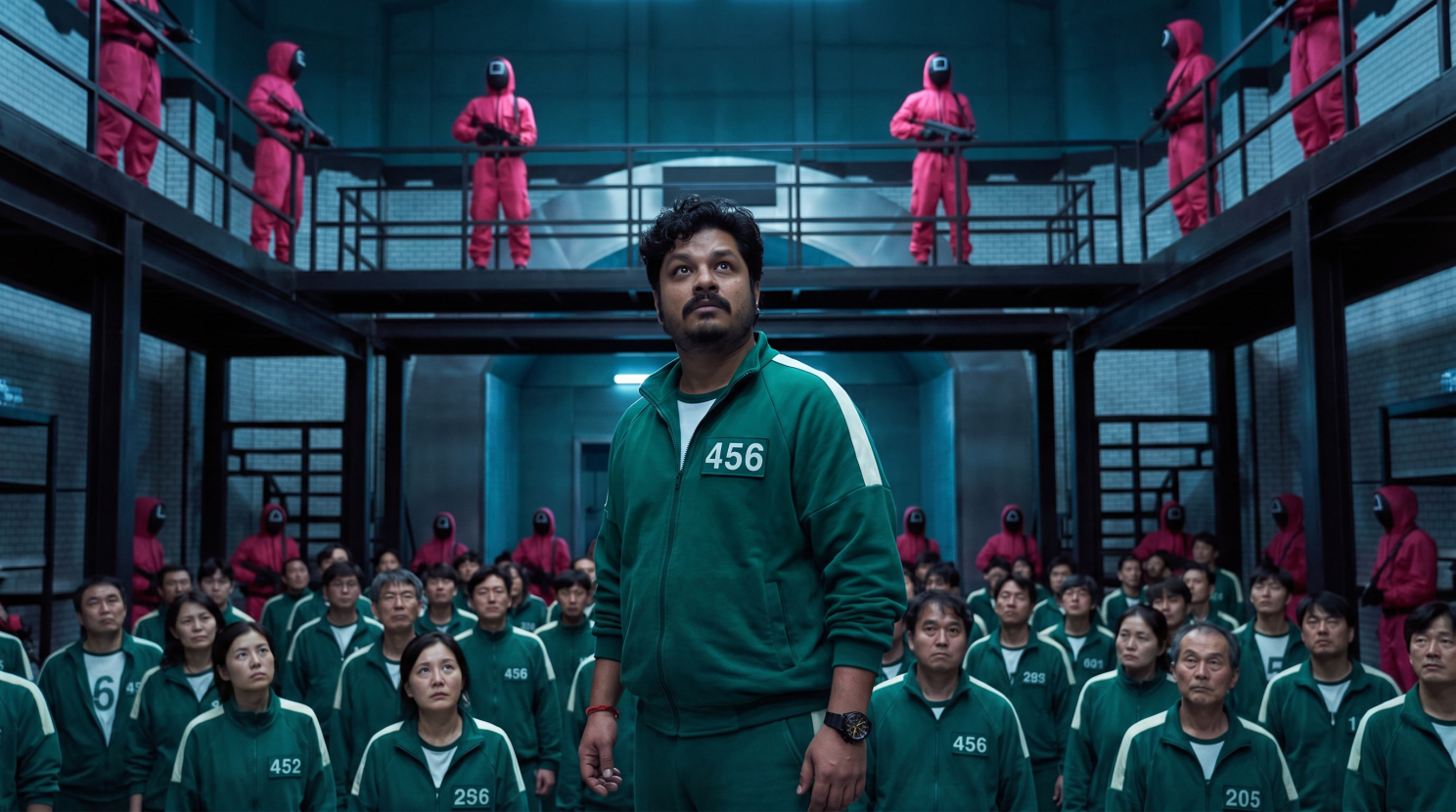
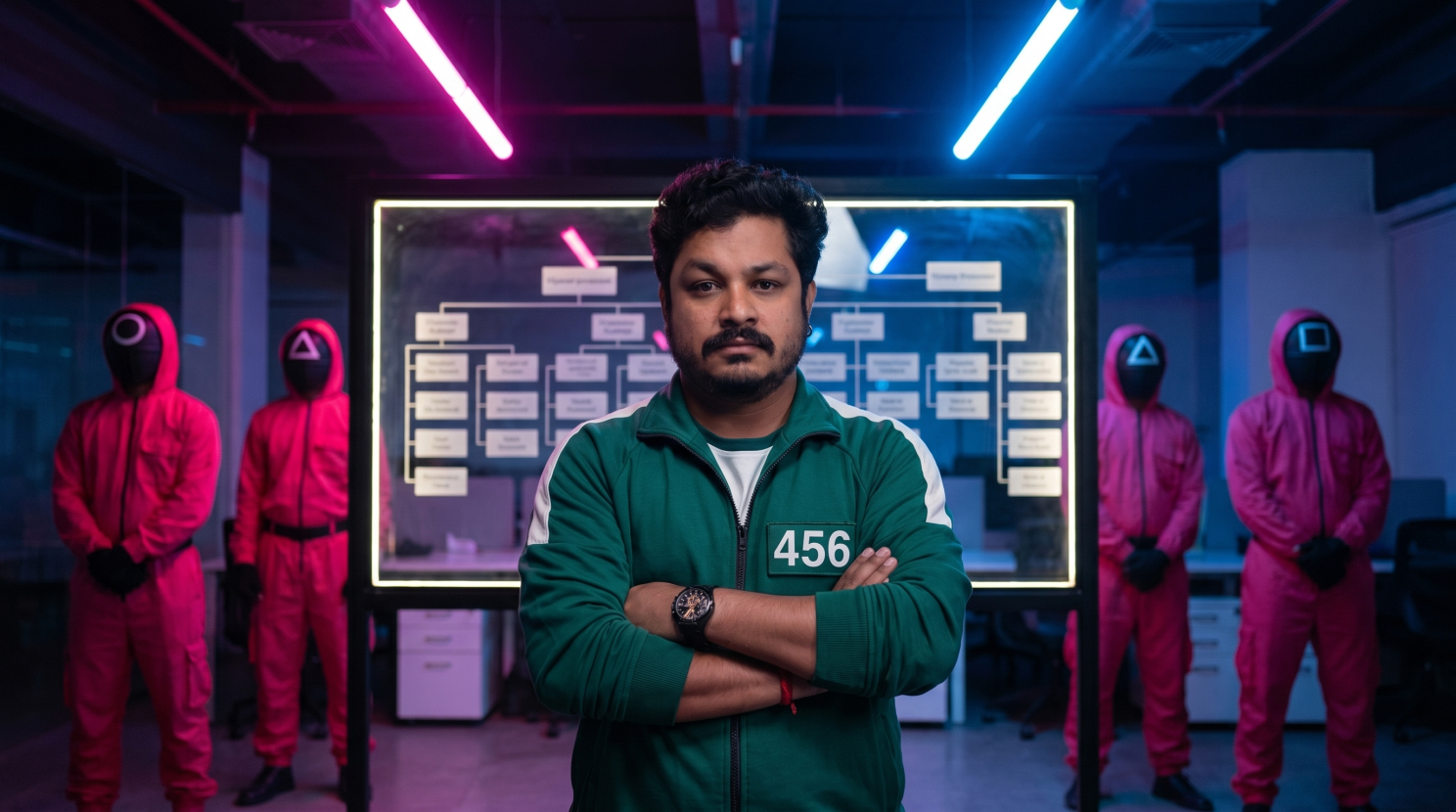
The arena floor: where execution happens, consequences are immediate, and information only flows one way.
🎭 The Game Environment = Your Program
Let's map this carefully, because the parallels aren't surface-level.
In Squid Game, players enter a system they don't fully understand. Rules are withheld until the last moment. Alliances form and collapse. Resources are scarce. The people at the top — the Front Man, the Host, the VIPs — are operating on entirely different incentives than the players.
Sound familiar?
Think about the last large-scale program you managed. How much of the system did your engineers actually understand at kickoff? How many dependencies were invisible until they weren't? How many stakeholders were watching from a distance, making judgments with incomplete context, but with full authority over your program's fate?
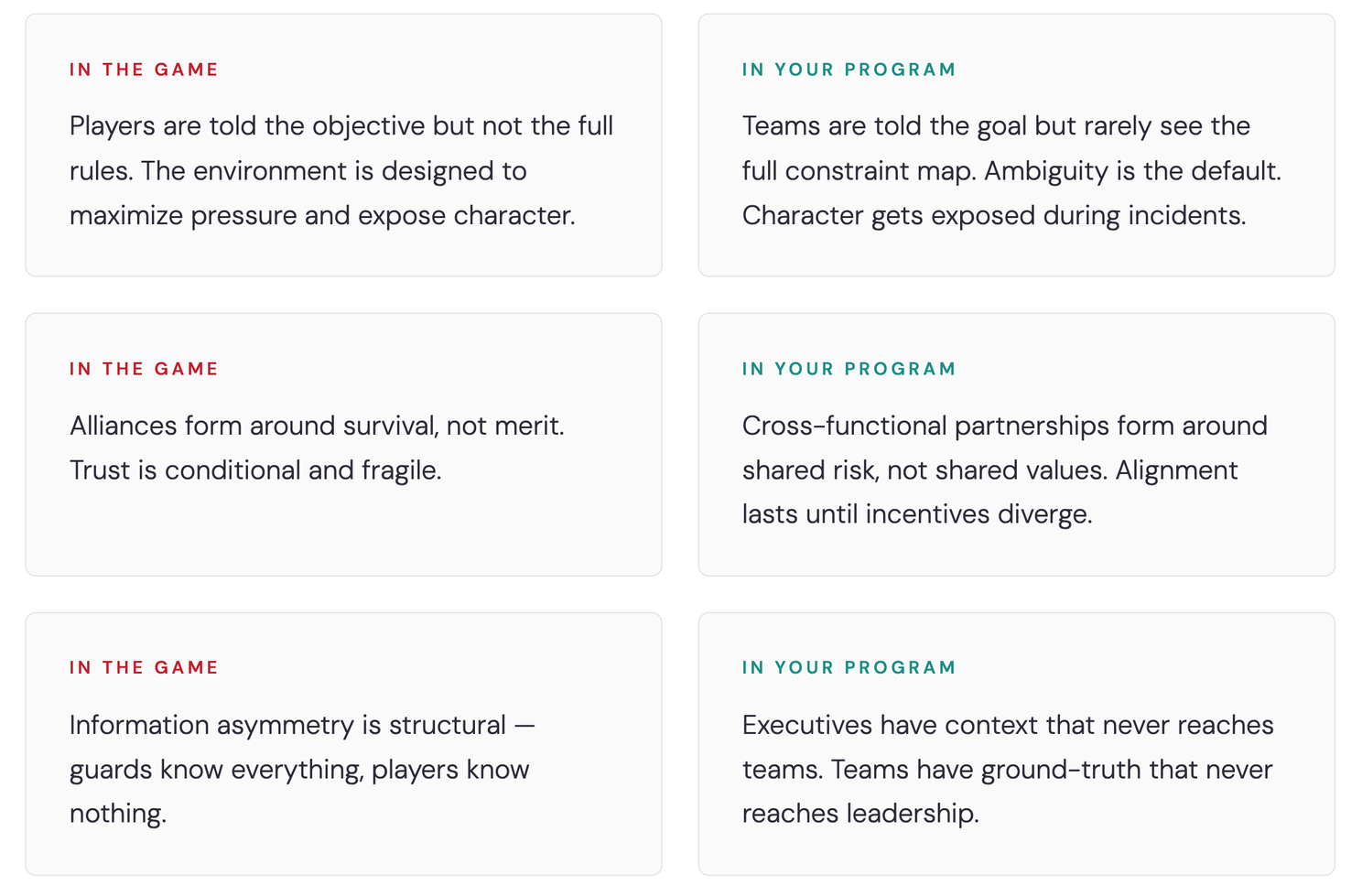
The environment isn't fair. It was never designed to be. Your job as a TPM isn't to wish it were different. It's to build enough clarity, trust, and structure that your team can operate effectively inside it.
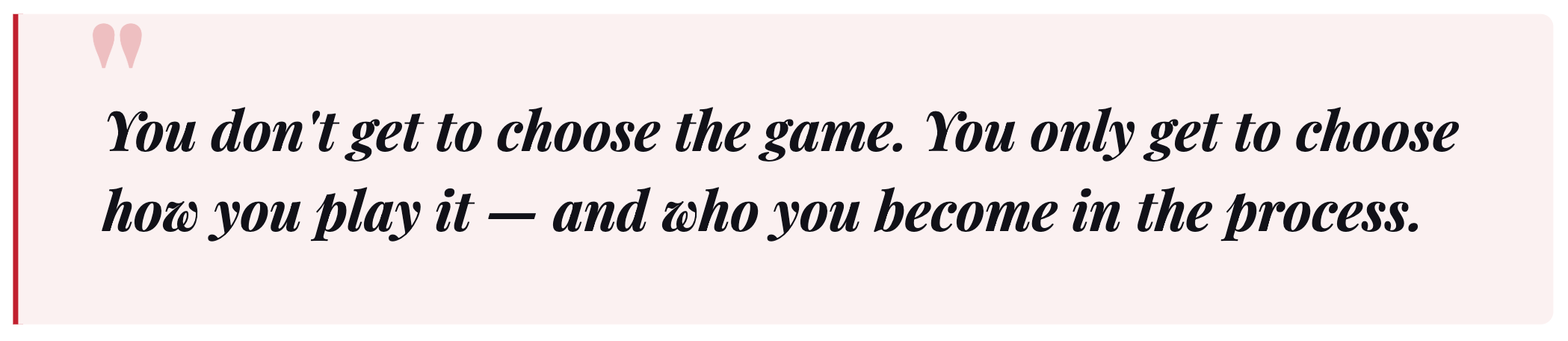
🧩 Character-Driven Leadership Lessons
The show's real power is its characters. Each one makes a different set of choices under the same pressure. That's what makes it useful — not the games, but the people inside them.
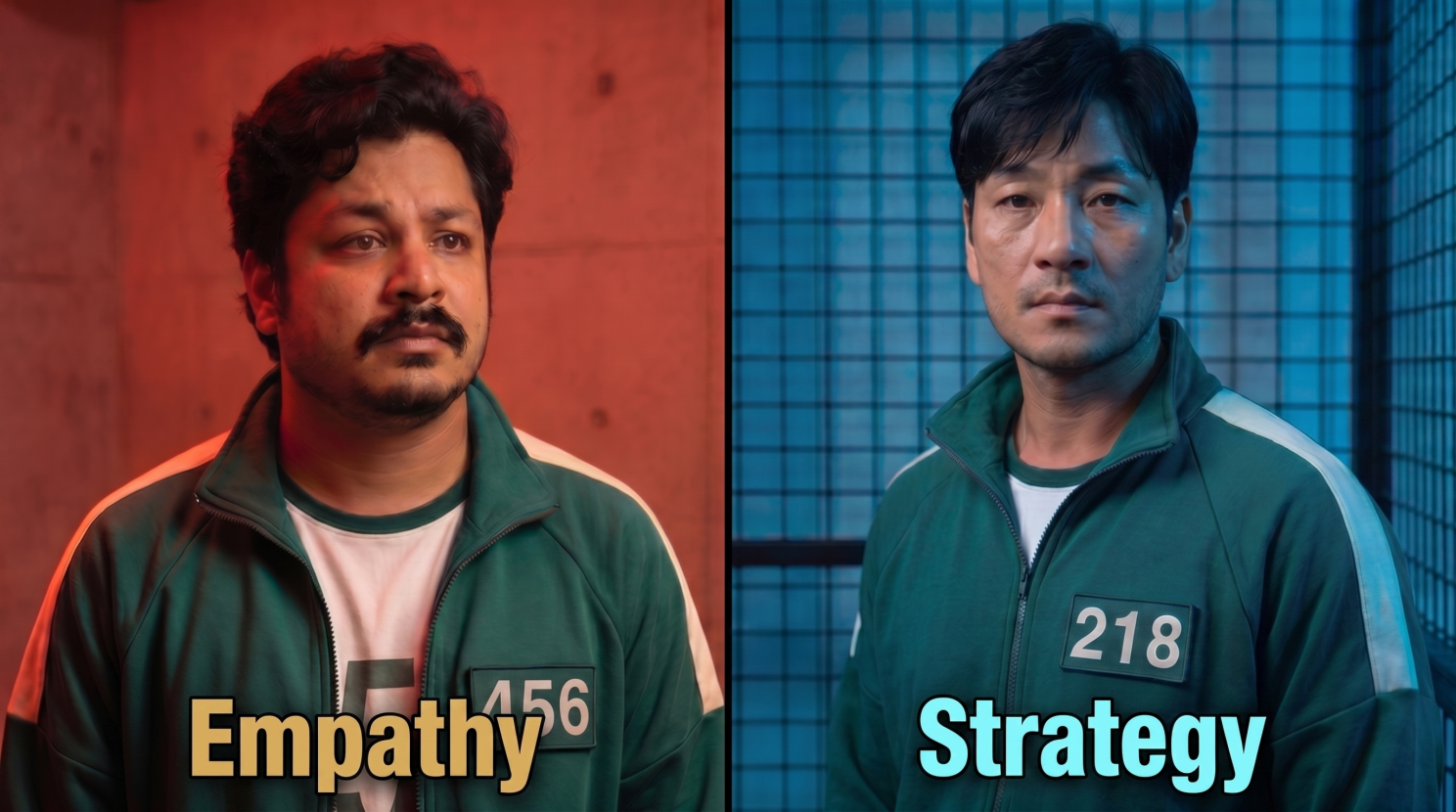
Two kinds of intelligence. Two different answers to the same impossible question.
Character 01 : Seong Gi-hun - The Leader Nobody Voted For
Gi-hun isn't the smartest player, the most strategic, or the most physically capable. What he has is an almost stubborn refusal to detach from the human cost of his decisions. He cries. He questions. He keeps people alive when it's inconvenient to do so.
Leaders who optimize entirely for delivery at the expense of the people delivering it don't lose right away. They lose slowly, in the form of attrition, quiet disengagement, and a team that stops telling them the truth.
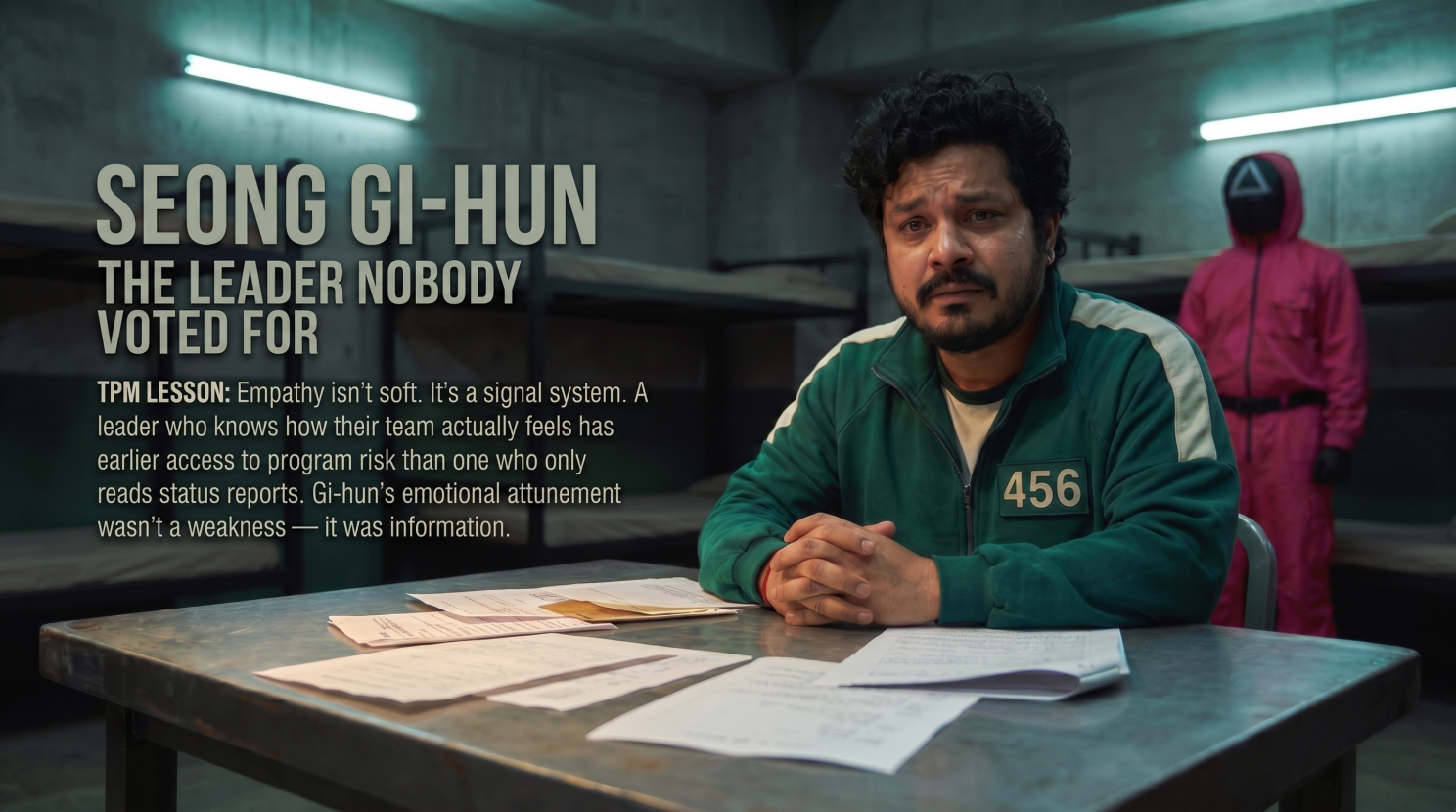
Character 02: Cho Sang-woo - The Brilliant Optimizer Who Lost the Plot
Sang-woo is the one everyone expected to win. Seoul National University. Futures trading. A mind built for optimization. And that's exactly what he did — he optimized. For himself. Incrementally, one justification at a time, until choices he'd never have made in week one felt reasonable by week five.
This is the slow drift that kills high-performance teams. It rarely starts with one catastrophic decision. It starts with a small compromise that
gets rationalized. Then another. Then the rationalizing becomes the culture.
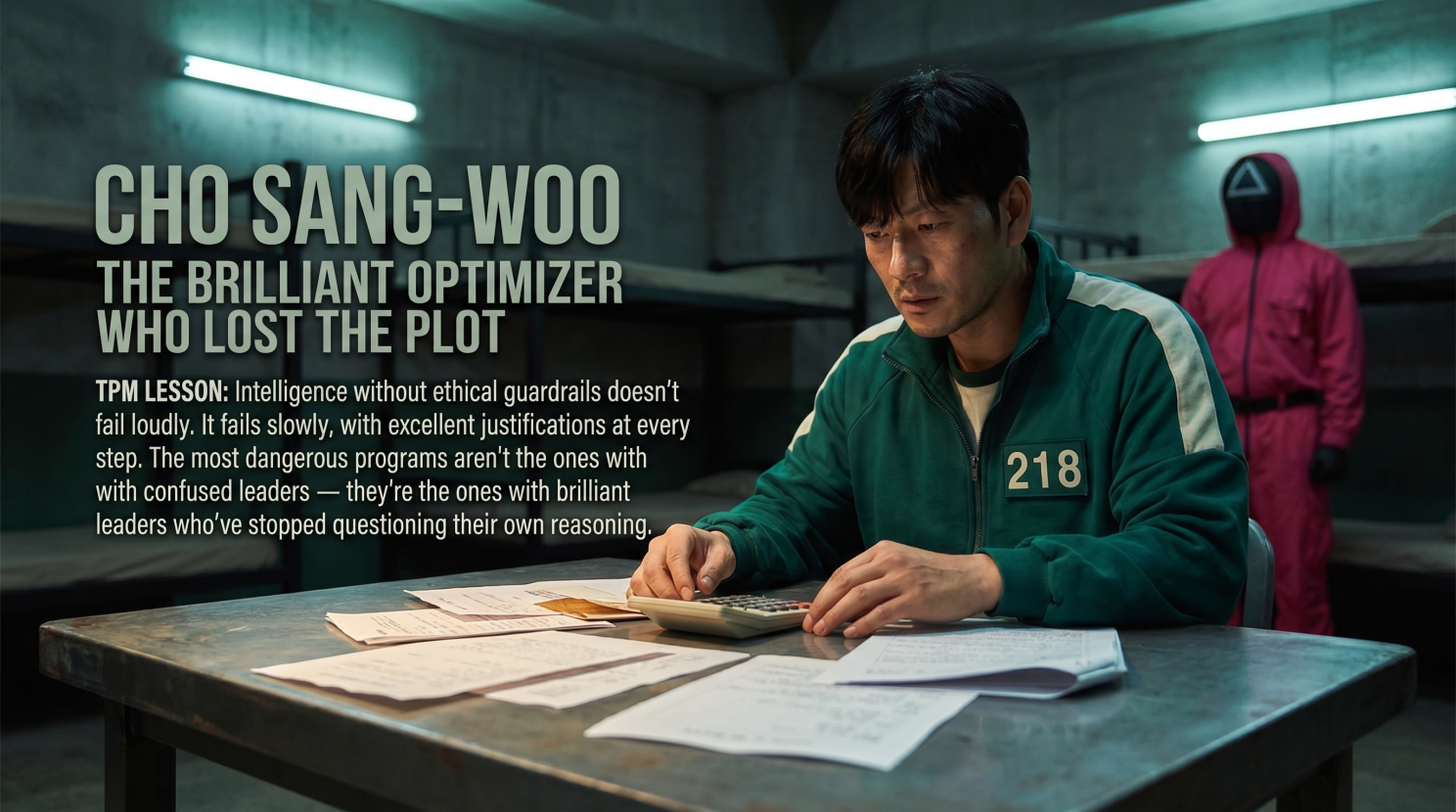
Character 03: Kang Sae-byeok - The Quiet Executor
She doesn't form alliances until she has to. She doesn't announce her capabilities. She observes, maps the terrain, identifies the constraints others haven't noticed, and executes with precision when the moment arrives. She's the player who understood the glass bridge before anyone else — because she'd been watching.
Character 04: The Front Man - The System Architect Who Became the System
He was a police officer once. He entered the games to expose them. At some point, he stopped. He became the person who enforces the rules he once opposed — not because he stopped caring, but because he started believing the structure itself was more important than the question of what it was built for.
This is what happens to leaders who confuse governance with purpose. Who protect the process long after the process stopped serving anyone.
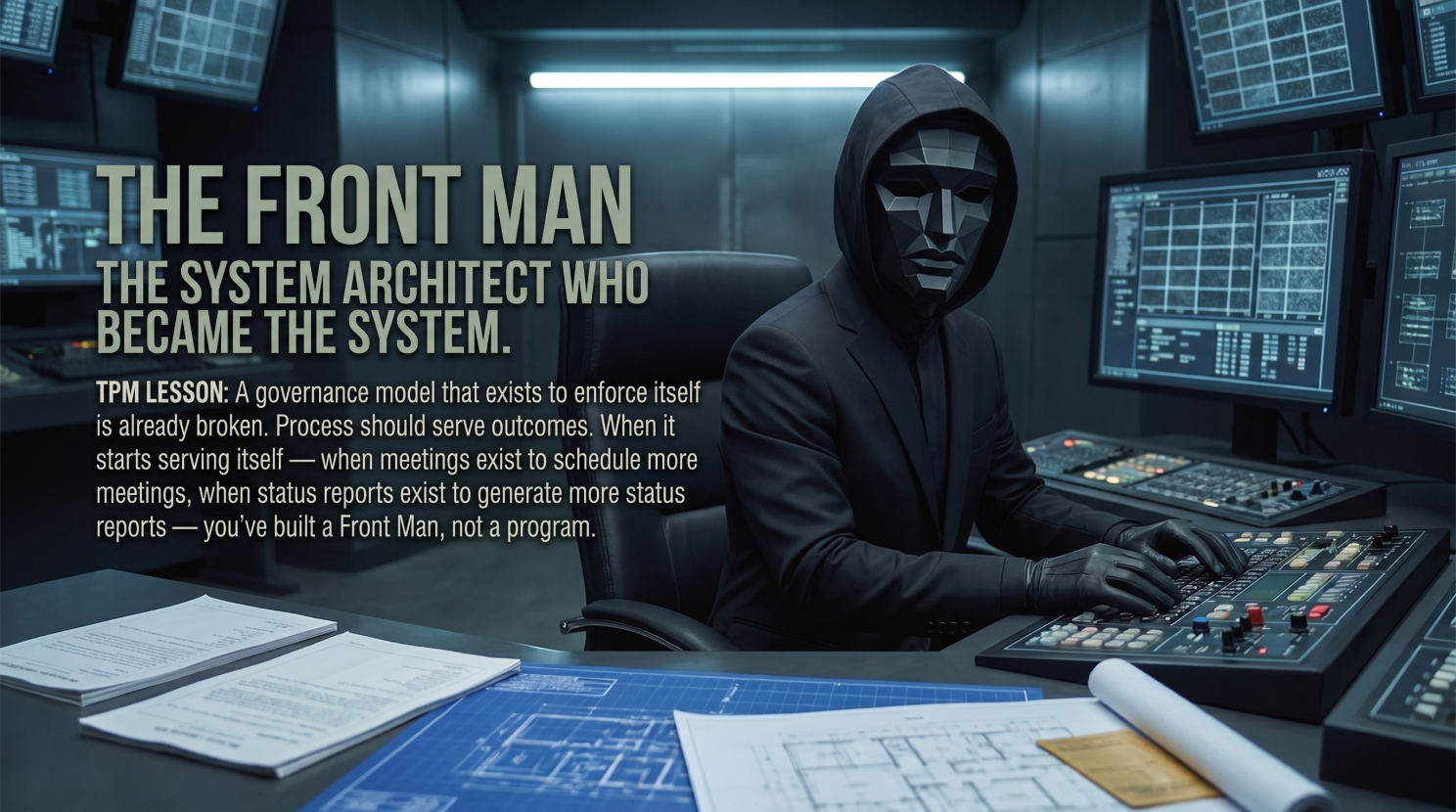
Character 05: Oh Il-nam (Player 001) - The Stakeholder Who Forgot What the Stakes Were
The Host designed the system. He also participated in it, for entertainment — because he'd been so removed from consequence for so long, he could no longer feel the weight of what he'd built. He genuinely didn't understand why anyone would find it cruel.
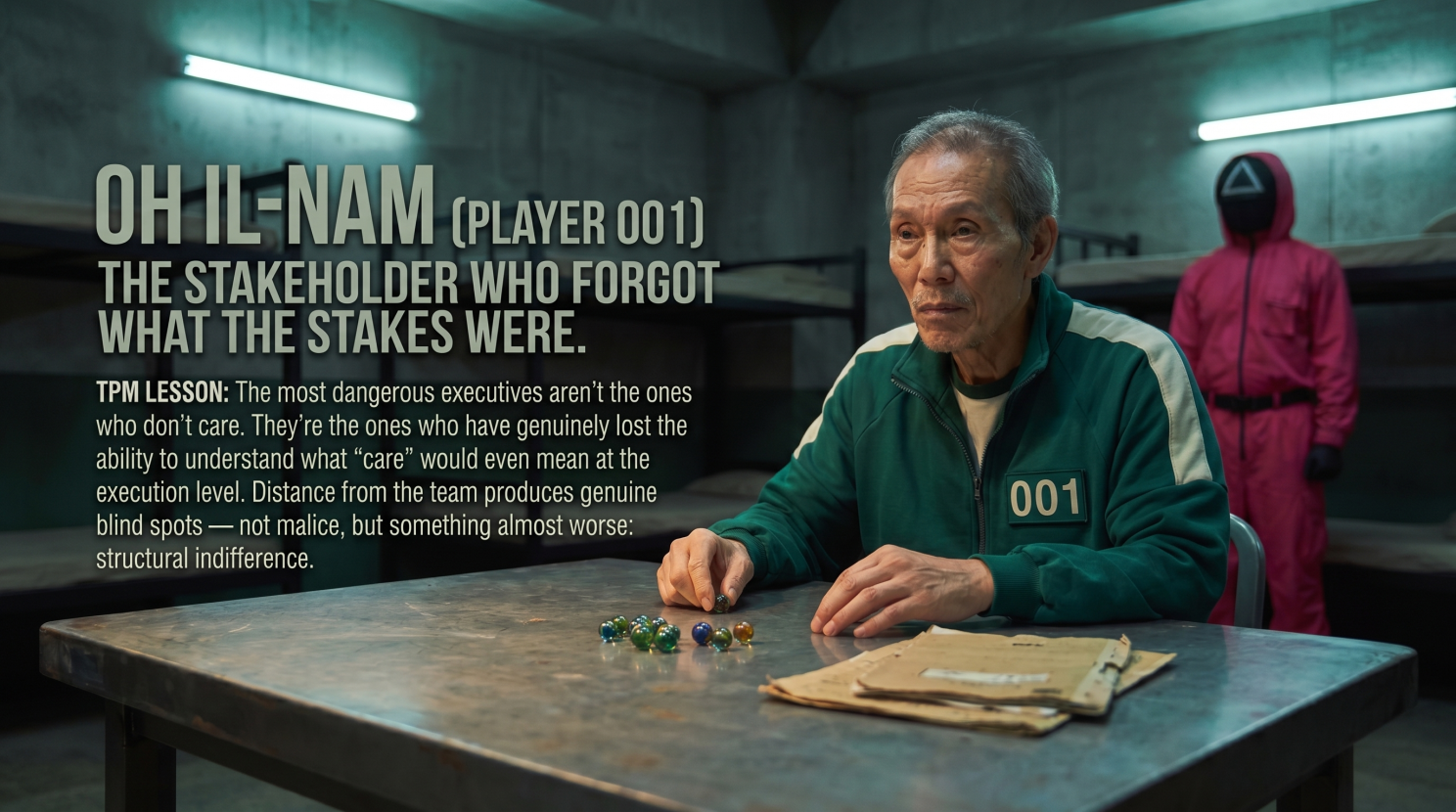
Power without proximity. Judgment without context. This is stakeholder misalignment at its most extreme.
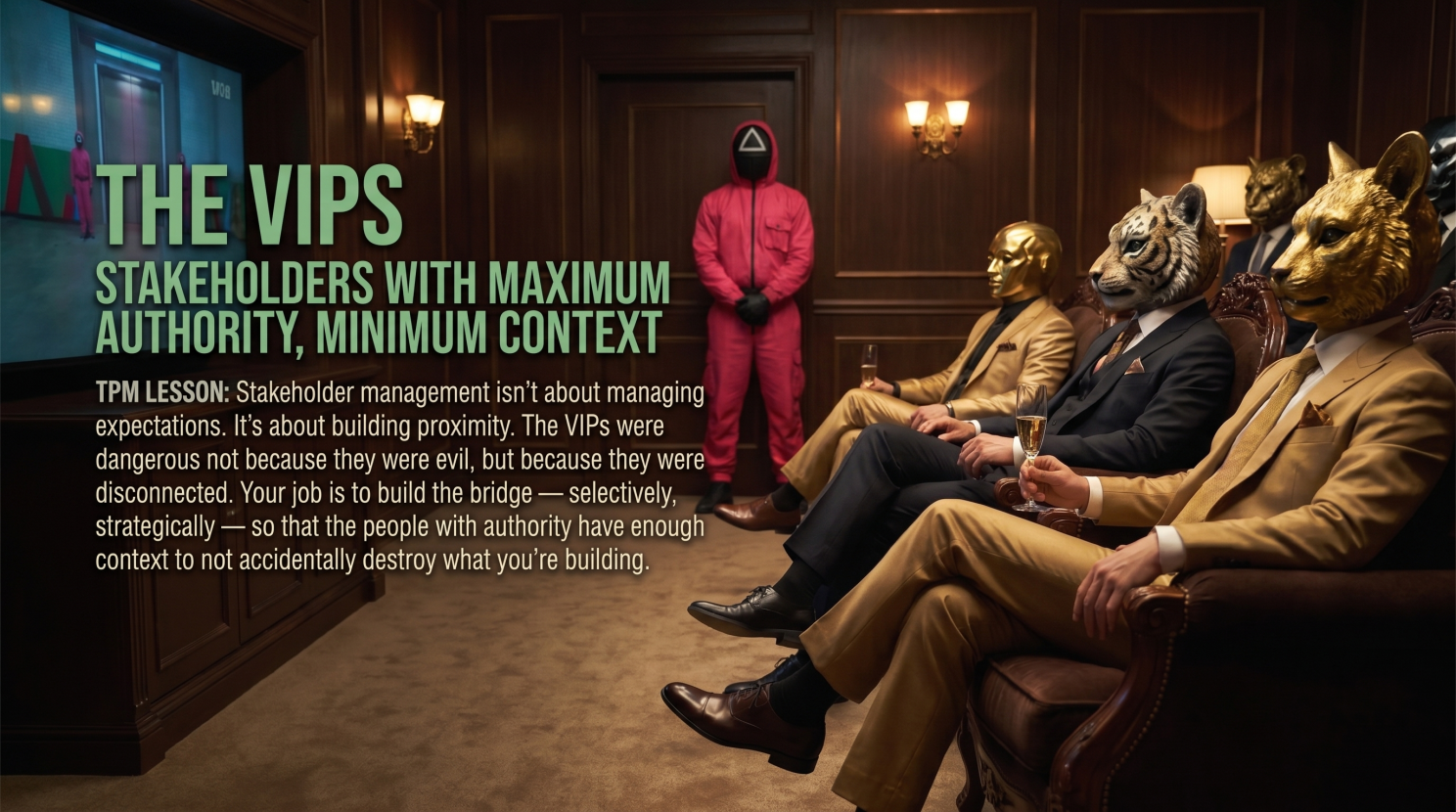
Character 06: The VIPs - Stakeholders With Maximum Authority, Minimum Context
They've placed bets. They have strong opinions about outcomes. They cannot name a single player. They are entirely insulated from the cost of being wrong. And yet — their preferences shape the design of every game.
This is a description of every executive review I've ever attended where the leaders asking the hardest questions have never seen the data room, never talked to the engineers, and leave before the next item on the agenda.
⚙️ The TPM Parallels That Actually Matter
Let me be specific. These aren't metaphors for their own sake.
Managing ambiguity
Every game in Squid Game starts before players understand what they're really being asked to do. Red Light, Green Light looks simple. It isn't. Your programs do the same thing — the true scope of a dependency, a technical debt problem, or an organizational constraint doesn't reveal itself until you're already in motion. The competency isn't eliminating ambiguity. It's building a team that can absorb it without freezing.
Risk visibility
Sae-byeok mapped the honeycomb shape through observation. Players who picked circles died last. Players who grabbed stars died first. The risk was always in the data — it just required someone willing to look before acting. Most programs have the same problem: the signals are there, buried in retros, in Slack threads, in the comments nobody reads on design docs. The TPM's job is to surface those signals before they become incidents.
Decision-making with incomplete data
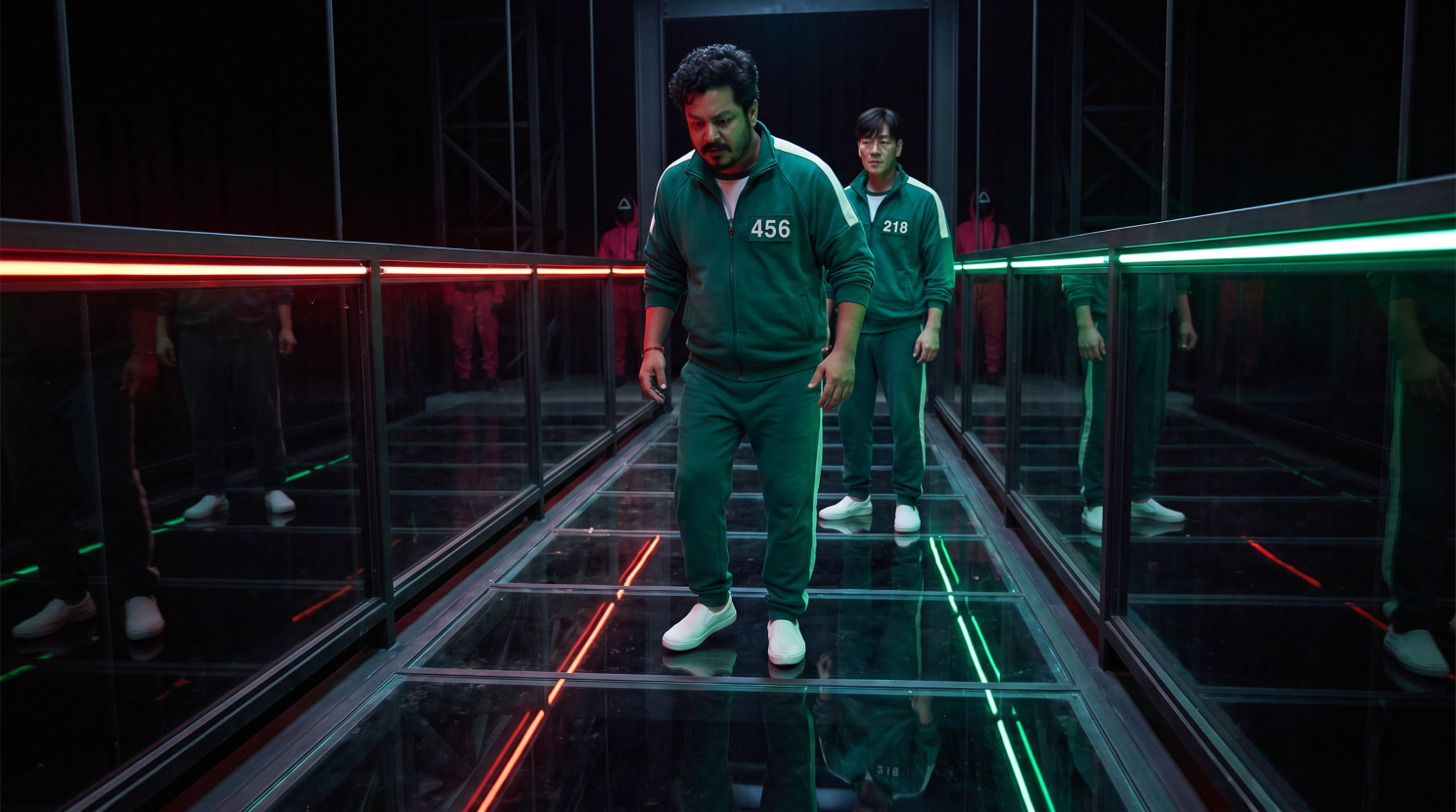
Nobody on that glass bridge knew which panel was tempered glass. They had probability, observation, and a fireworks technician's educated guess. Programs run the same way. Waiting for certainty is a strategy — just usually not a good one. Bias for action, with explicit acknowledgment of what you don't know, is how you make a 70% decision responsibly.
Ethics vs. delivery pressure
Sang-woo's arc is a slow-motion study in what happens when you keep choosing delivery over principle, one small exception at a time. I've seen this in programs. The launch date becomes sacred. The people it was supposed to serve become abstract. What starts as "we'll fix it in the next sprint" becomes "that's just how we work now."
🎥 The Moments That Should Stop You Cold
Cinematic Insight I: The real game wasn't survival. It was decision-making under moral pressure — and nobody realized that was the test until they'd already failed it.

Cinematic Insight II: Every system eventually reveals what it was designed to optimize for. Not what it claimed to optimize for. What it actually does when no one's watching.

Cinematic Insight III: The guards wore masks so the players couldn't humanize them. Leaders who hide behind org charts do the same thing — and wonder why no one tells them the truth.
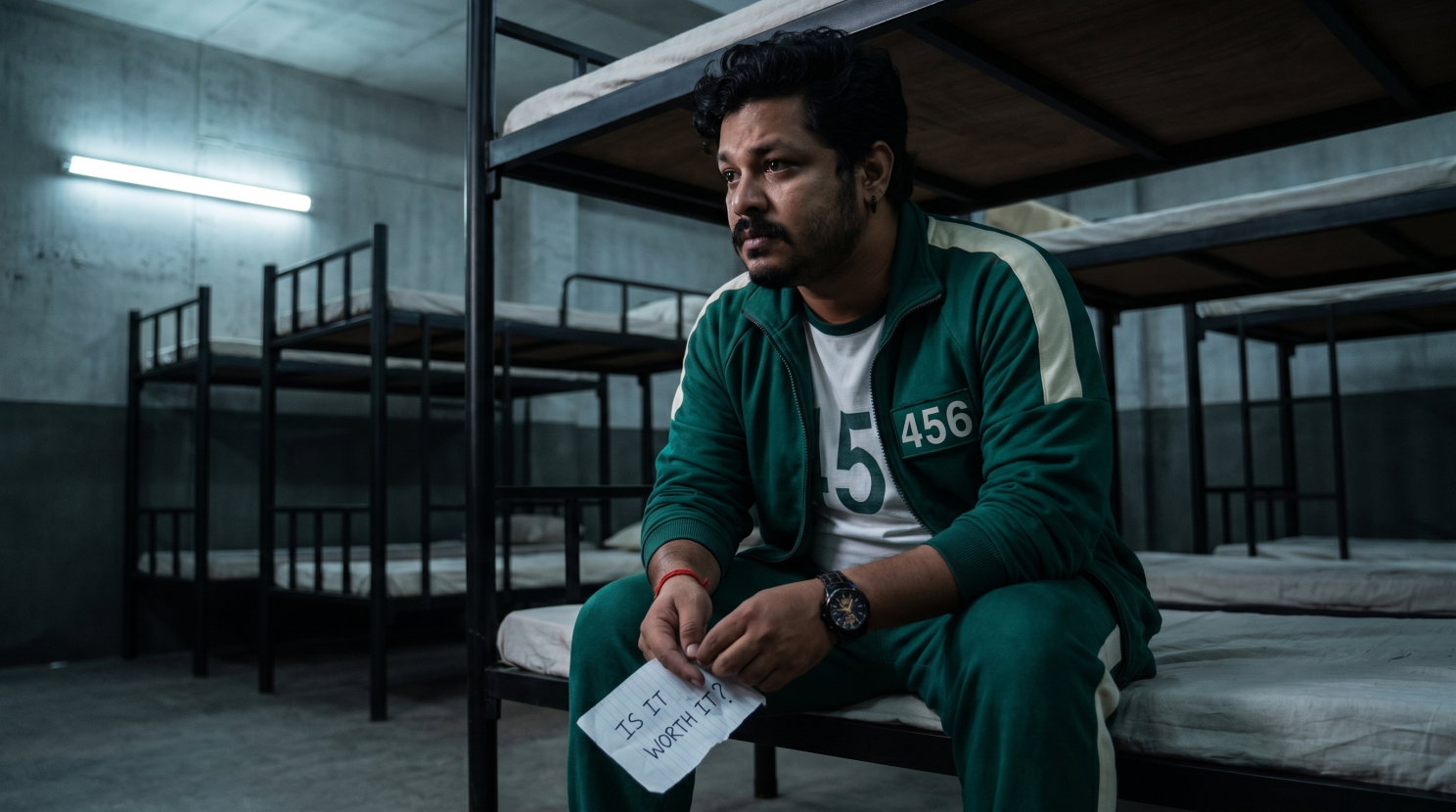
Cinematic Insight IV: Gi-hun won because he refused to stop asking whether winning was worth it. That question — inconvenient as it was — kept him human when the system was designed to strip that away.
The glass bridge: a perfect metaphor for production decisions, go/no-go calls, and resource trade-offs made with incomplete data.
📊 Leadership Principles, Tested Under Pressure
Here's where I want to be honest: leadership principles are easy to write. They are hard to hold onto when a program is on fire, an executive is losing confidence, and your team is exhausted.
Squid Game is useful precisely because it shows what happens to those principles under extreme pressure. Here's what holds up — and what doesn't.
Ownership
Player 001 owned the system because he built it. That's not ownership — that's authorship. Real ownership means staying accountable for the consequences of what you've built, even when those consequences are uncomfortable. Most leaders stop there.
Earn Trust
The players who formed genuine alliances — not transactional ones — survived longer and made better decisions. Trust isn't declared in a team charter. It accumulates through small moments of choosing the team over self-interest, consistently, before it's tested at scale.
Dive Deep
Sae-byeok watched the honeycomb game for five minutes before touching her candy. Sang-woo calculated marble game permutations before revealing his strategy. Diving deep isn't about gathering more data — it's about asking a better question than the person next to you.
Bias for Action
The glass bridge fireworks technician took the first step. That's not recklessness — that's having the most relevant expertise in the room and using it. Bias for action without expertise is just noise. With it, it's leadership.
Think Big
Gi-hun, at the end of season one, books a flight back to Korea instead of going to his daughter. He's choosing to go back into the system he survived — not because it's safe, but because he's the only one who knows what's inside it. That's what thinking big actually looks like: choosing the harder scope because no one else can.
Deliver Results
The game has one winner. Programs don't. Building a culture that only celebrates the person at the top — while treating execution contributors as interchangeable — is how you build a Squid Game, not a team. Results matter. So does the shape of how you got there.

Winning isn't the same as succeeding. Surviving a program launch isn't the same as building something worth shipping.
💡 What TPMs Should Actually Do Differently
Enough narrative. Here's what I'd actually change on Monday morning.
Build a pre-mortem practice before every major phase gate.
Not "what could go wrong" — that's too abstract. Ask: "If this phase fails in six weeks, what was the first signal we ignored?" Then go find that signal now. It exists. You're just not looking for it yet.
Map your information architecture like the Front Man mapped the arena.
Who sees what? What reaches leadership, what doesn't, and why? Most programs have terrible information architecture — not because people are hiding things, but because nobody designed the flow. Design it explicitly.
Identify your Sang-woos early — and build in friction.
Every high-performing team has someone who is so effective at optimizing that they will optimize past the constraints you care about if left unchecked. That's not a character flaw — it's a systems design problem. Build in review loops that surface ethical drift before it compounds.
Create structured access for your VIPs before they have strong opinions.
The time to give executives context isn't during an escalation. It's before they've formed a narrative that will be hard to update. Build regular, low- overhead touchpoints that give them signal without overwhelming them — or they'll fill the vacuum with assumptions.
Protect the Sae-byeoks on your team — actively.
The quiet observers who map dependencies nobody else sees, who surface risks three sprints before they land — they often get talked over in standups and underrepresented in visibility. Build forums where their signal gets heard. They're doing the most important work on your program.
Audit your process for Front Man drift annually.
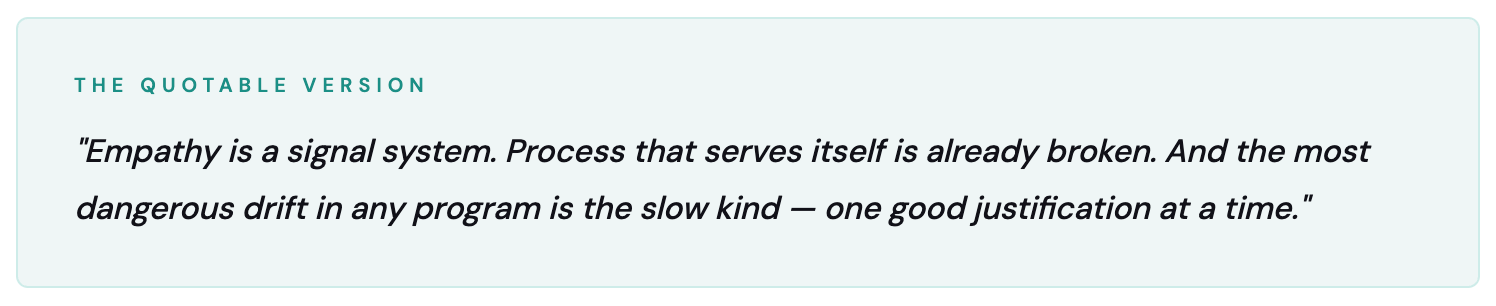
Take every recurring meeting, every status report, every governance checkpoint, and ask: what decision does this enable? If the answer is "it enables itself" — cut it. Process that exists to justify process is governance theater. It burns your team's time and trust simultaneously.
Name your ethical lines before a launch, not during one.
Sang-woo's drift was possible because he never pre-committed to where he wouldn't go. Teams that define their constraints in advance — what they won't ship, what quality bar they won't compromise, what they'll escalate even when it's uncomfortable — make better decisions under pressure, because those decisions were already made.
Ask the Gi-hun question in every retrospective.
"Did we win in a way we're actually proud of?" Not just: did we ship on time, did we hit the metric. Did the team feel like the right things were prioritized? Delivery without integrity is just a schedule you hit.
For more like this, subscribe to Unblocked — my weekly newsletter for TPMs who lead at scale. Next in Unblocked: Lets deep dive into TPM interview at Amazon
For 1:1 mentorship and coaching, I'm on Topmate
Real talk on TPM, AI, Leadership, real life stories and fun. No fluff. No corporate filter. Just
what actually works.
Michael, Kinjalk and 1,177 connections are subscribed
1,460 subscribers
Starvation, magic squares, and other troubles that rhyme
The Vicious Culture of Crunch
Fork Scene in Squid Game Season 2: A Dark Symbol of Ruling by Distraction
Mouhsine Adnani محسن عدناني
Newstone
Faiza Majid
5 · 8 comments
Found this useful?
Book a 1:1 session to apply these frameworks to your specific situation — promotion prep, interview coaching, or career roadmap.
Book a Session →