
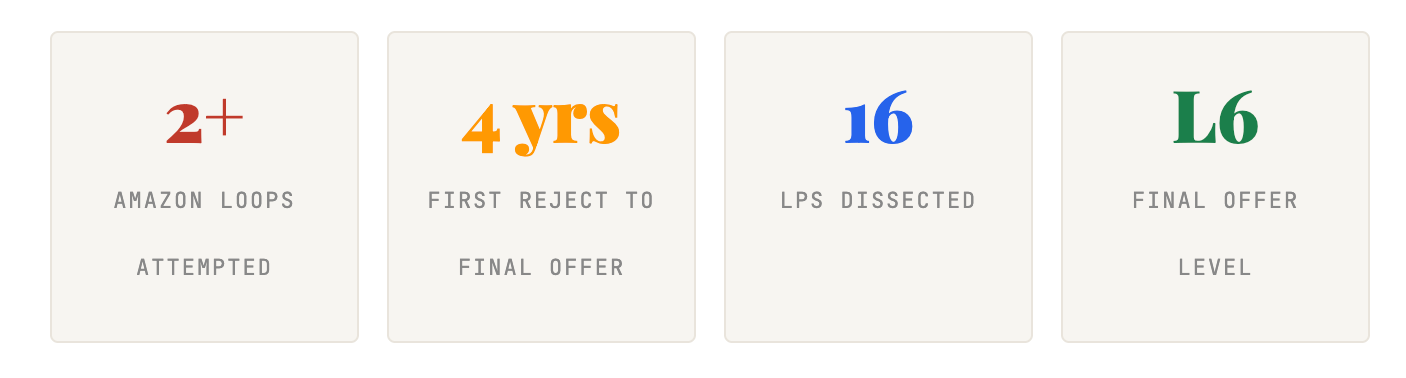
What four years, close to three loops, and a lot of honest reflection taught me about cracking the Amazon — and big tech — TPM interview.
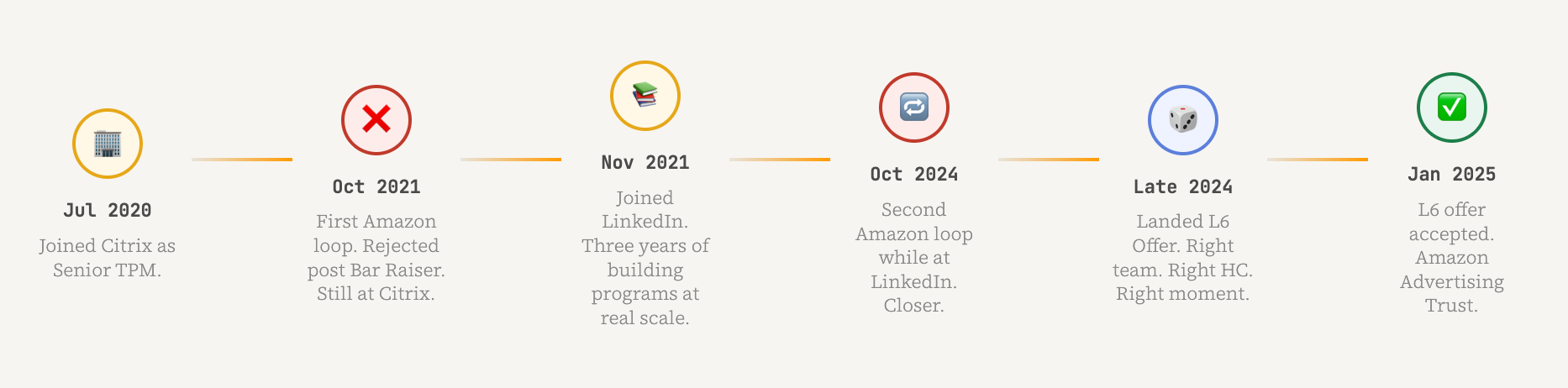
October 2021. I was in Citrix when the Amazon recruiter called with the debrief. She was kind about it — they always are. "Strong signal on some leadership principles, but the Bar Raiser had concerns about your ownership examples." I thanked her, hung up, and sat in my car for a while. Bangalore traffic outside. Eleven years of engineering and program management behind me. A decade of solving hard problems across Oracle, Cisco, Citrix, LinkedIn. Amazon had looked at all of that and said no.
What stung more than the rejection itself was the specific reason. Ownership. The one principle I would have bet my career on. I had written out stories for every LP. I had practiced STAR until I could recite the format in my sleep. I had done the preparation that every guide says to do. And a Bar Raiser — someone I would never meet again — had
spent 45 minutes with me and concluded that my ownership examples were not strong enough. I spent the next week replaying every answer, trying to find where it had gone wrong. I did not find it. Not yet.
A month later I joined LinkedIn as a Senior TPM. Over the next three years I led some of the largest platform programs of my career — programs that moved session metrics at scale, re-architected infrastructure that millions of users touched daily, drove compliance work that spanned ten thousand people across a global org. I got better at the actual job. What I had not yet learned was how to translate what I was doing into the specific language that Amazon's interview system is designed to surface. That gap almost cost me a second loop in 2024. This article is about closing it — for you, before it costs you what it cost me.
01 / Before the Loop: Getting the Interview
Most prep guides start at "once you have the loop scheduled." That assumes the hardest part is already done. For many TPM candidates, getting the loop is the first real challenge.
Is Your Resume Calibrated to the Right Level?
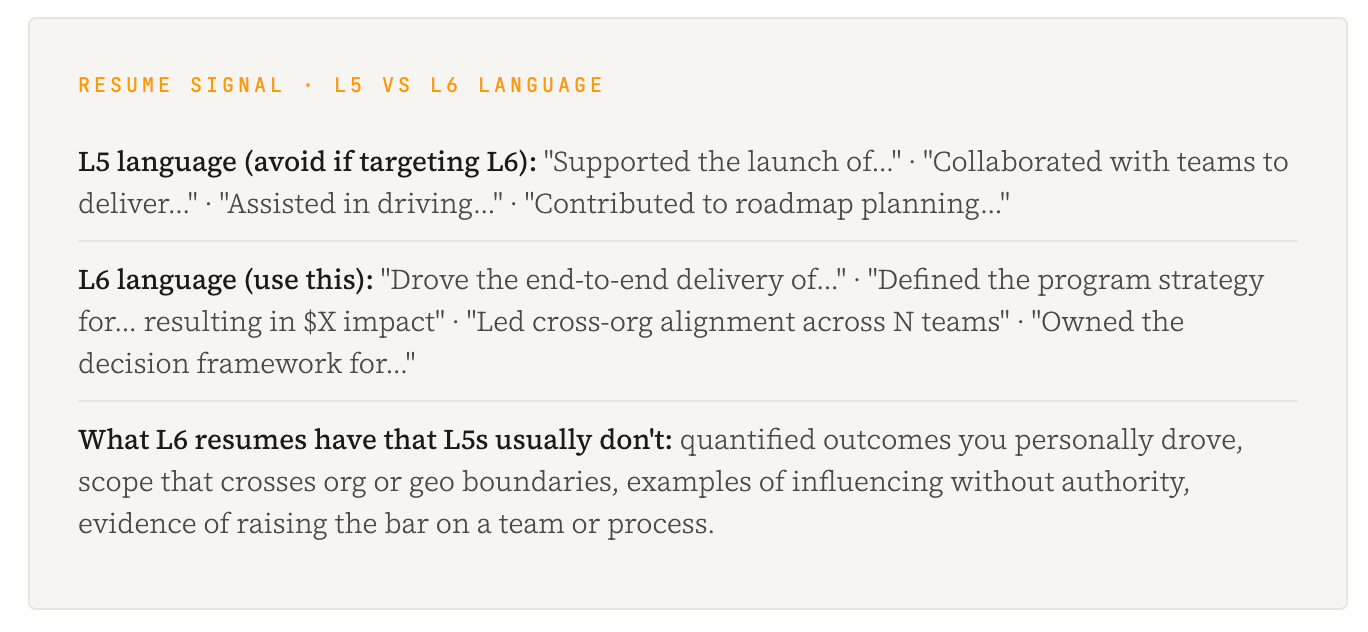
Amazon screens resumes against a level. The recruiter decides L5 vs L6 before you talk to a single interviewer. If your resume reads like an L5 — solid delivery, team player, execution-focused — you will get an L5 loop regardless of your actual experience. The difference between an L5 and L6 resume is not length or title. It is scope language and outcome ownership.
How to Get a Recruiter's Attention
Cold applications through the Amazon jobs portal have a low conversion rate for senior TPM roles. The roles that matter — the ones with strong teams and good managers — often get filled through internal referrals or direct recruiter outreach before they even close. The fastest path to a loop is a warm introduction from a current Amazonian in a relevant org, or a well-crafted LinkedIn message to a TPM recruiter directly.
Recruiter Outreach Template (LinkedIn InMail)
Hi [Name], I'm a Senior TPM with [X] years in [domain] — most recently at [Company] where I led [brief outcome, e.g. "a cross-org platform migration impacting 40M users"]. I'm targeting L6 TPM roles at Amazon, specifically in [org/domain].
I've done my homework on the LP bar and have concrete examples across Ownership, Deliver Results, and Have Backbone that I think would hold up in a loop. Would you be open to a 15-minute call?
I'm not looking for shortcuts — just a clear picture of what strong looks like for the teams you're hiring for.
Thanks, [Your name]
Keep it under 120 words. Lead with a specific outcome, not a job title. Show you know the LP framework without being robotic about it. And ask for a conversation, not a referral — recruiters respond better to curiosity than to "please refer me."
When to Apply (and When Not To)
Amazon's hiring cycles have real patterns. Q1 (January–March) and Q3 (July–September) are typically the strongest windows for TPM hiring — headcount has been approved and teams are actively backfilling or expanding. Avoid applying in November–December if you can. Q4 is peak delivery season at Amazon, hiring managers are underwater, and loops move slowly or stall. A loop that starts in October may not close until January, and the HC bar can shift as teams reassess headcount at year-end.
02 / The Full Loop Structure
Most candidates walk into a loop without fully understanding what each round is actually scoring. The Amazon TPM loop typically has five to six rounds. Here is what each one is evaluating and how to approach it.
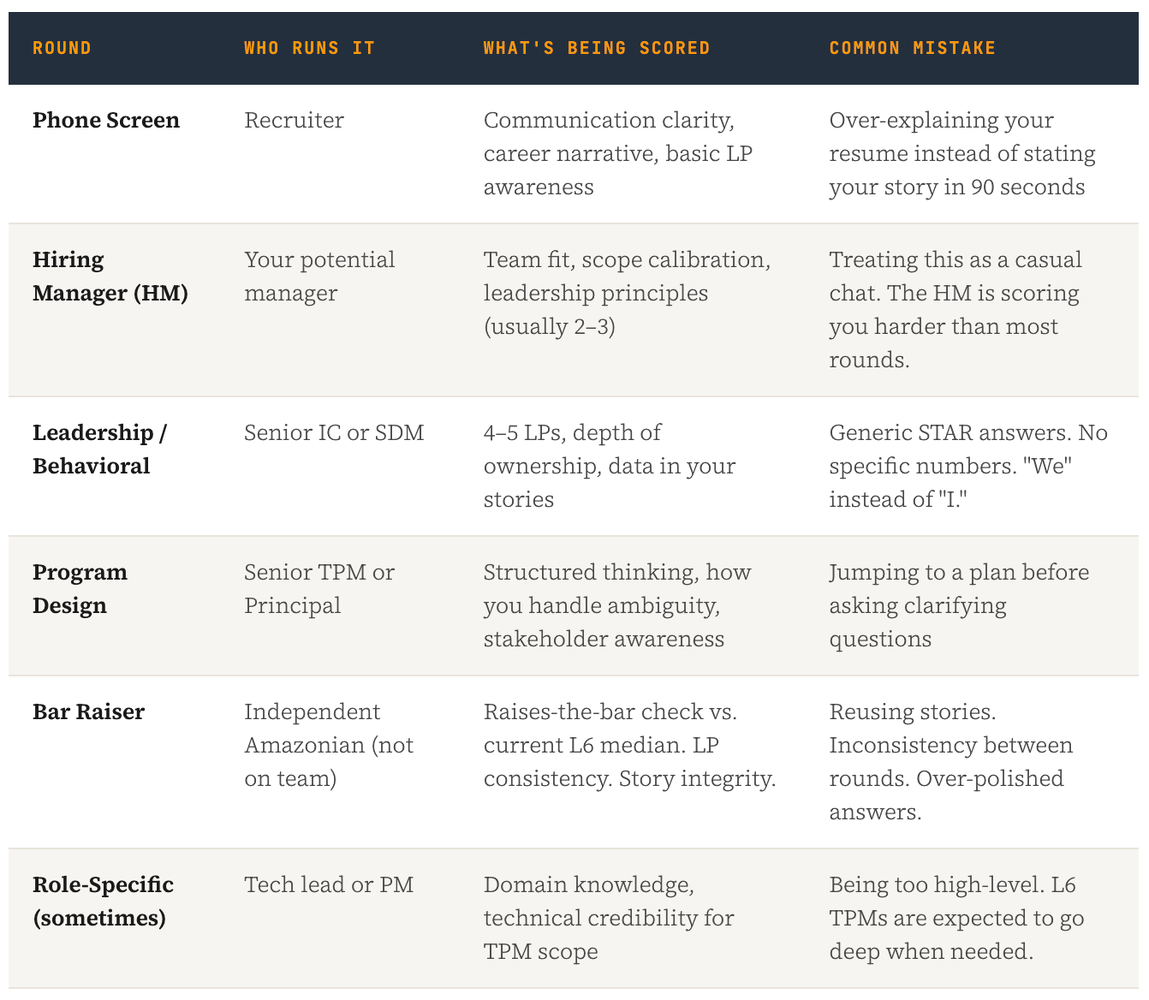
One thing candidates rarely know: interviewers write their assessments immediately after each round, before the debrief meeting. Your score in round 2 does not benefit from what you said in round 4. Each round is a standalone evaluation. Treat every interviewer like they are the Bar Raiser.
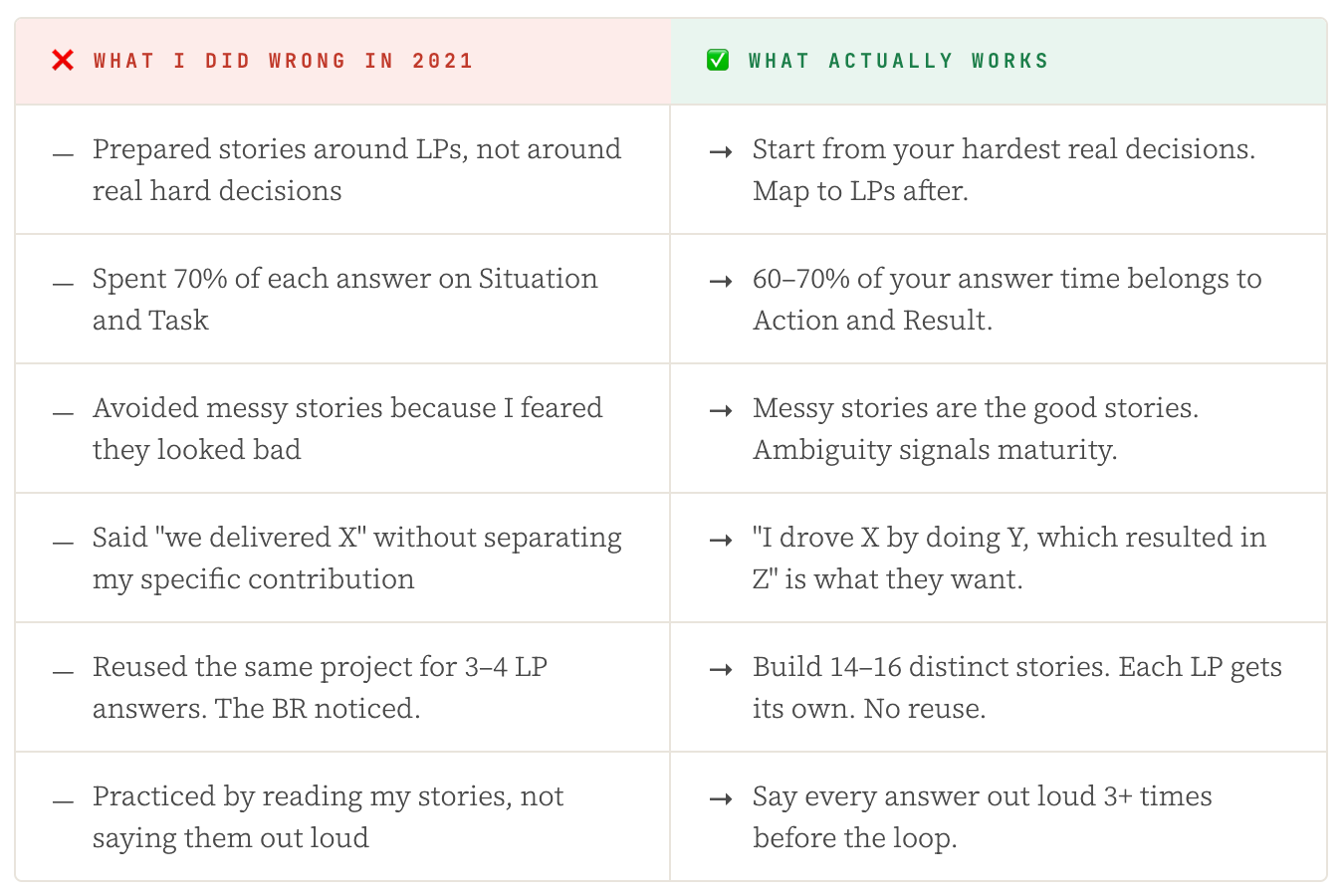
03 / The 2021 Failure: What I Got Wrong
2021 · Post-loop debrief memory
The Bar Raiser asked me about a time I pushed back on a decision from senior leadership. I told a story about a re-architecture project where I flagged a timeline risk. I thought it was a strong Ownership story. What I did not realize was that I spent four minutes on the situation and ninety seconds on what I actually did. The interviewer was looking for agency. I gave them context.
On the drive home I kept replaying it. I had talked too much. But it was not just that. The stories I had prepared were technically accurate but not honest about my actual role. I had sanitized the messiness. Amazon Bar Raisers are specifically trained to find the seams in polished stories.
04 / Let's Talk About Luck. Because It's Real.
I want to say something most interview guides will not say: luck is a genuine variable in big tech hiring, and pretending otherwise is dishonest.
🎲 The Luck Factors Nobody Writes About
Which Bar Raiser you draw matters. I have been in loops where the BR was probing hard on specific LPs that happened to not be my strongest. That is not skill. That is draw.
Which HC cycle you hit matters. Some hiring committees are more forgiving of slight LP gaps when a candidate is clearly growing into the level. Others are rigid. You do not know which one you are walking into.
What the team needed that specific week matters. A team under delivery pressure wants a different flavor of TPM than a team in planning mode. Your stories might be perfect for one and tone-deaf for the other.
Internal candidates can change everything. Sometimes a loop moves forward and an internal candidate surfaces at the final stage. The external loop stalls or closes. You will never know this happened.
None of this means preparation is pointless. Preparation raises your floor and widens the window in which luck can operate. You cannot control the draw. You can control how ready you are when a good one comes.
05 / The 16 Leadership Principles: What They're Really Probing
Every Amazon interview question maps to at least one LP. Interviewers do not always name which one — they ask the question and score the answer against a rubric. Here is what each LP is actually hunting for, especially through a TPM lens. The 🔥 highlighted ones come up disproportionately in TPM loops.
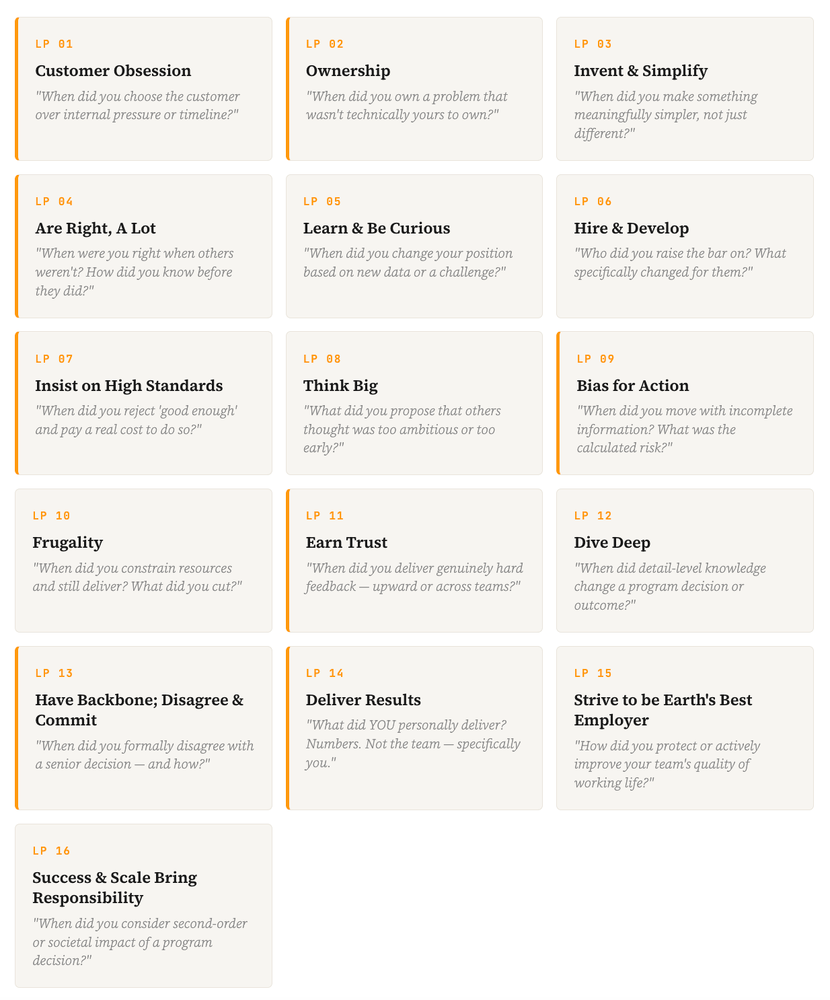
"The four LPs that sink most TPM loops are Ownership, Deliver Results, Have Backbone, and Insist on High Standards. If you only have time to go deep on four, go deep on those."
06 / STAR Is the Format. Not the Answer.
Everyone knows STAR. What nobody tells you is the time distribution most candidates get disastrously wrong.
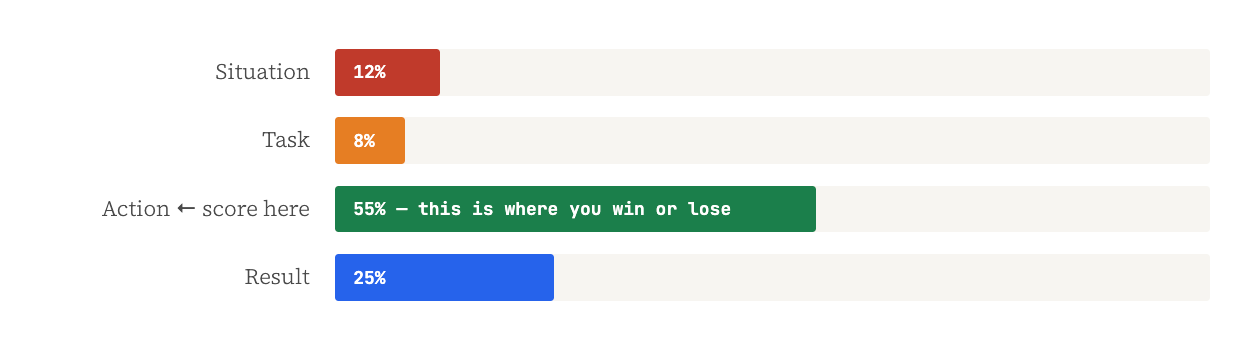
The interviewer has your resume. They do not need two minutes of setup. They need to hear what you specifically decided, what alternatives you considered, who you had to convince, and what happened because of your choice. That is the Action section — and most candidates sprint through it to get to the result, which is backwards.
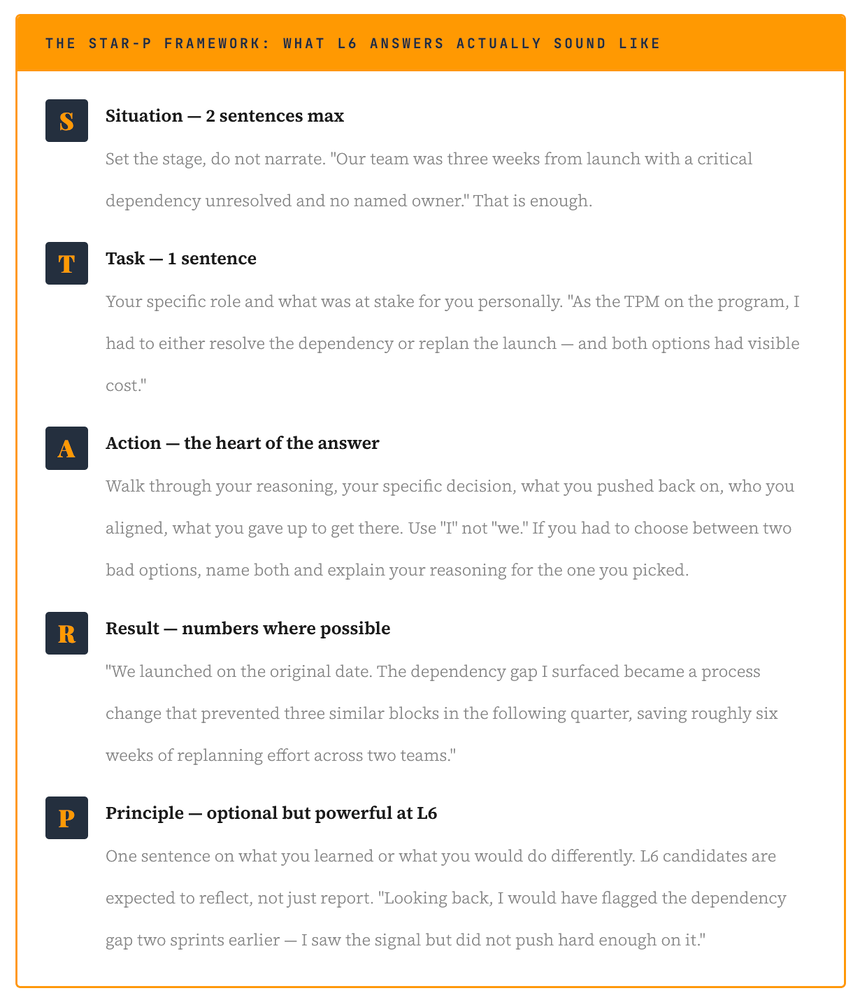
Sample question — Ownership (LP02)
"Tell me about a time you took ownership of a problem that was outside your defined scope."
1. S (2 sentences): We were six weeks into a platform migration
when the data team flagged that the migration scripts were corrupting a small subset of records. The engineering owner was on leave and the PM had escalated twice without resolution.
2. T (1 sentence): I was the TPM for the adjacent consumer product,
not the migration itself, but the corruption was going to block my launch if it was not fixed in the next ten days.
3. A (full detail): I did three things. First, I pulled the data team lead
into a working session and mapped the corruption pattern myself — I needed to understand the scope before escalating further. Second, I wrote a two-page document outlining the risk, the blast
radius, and a proposed fix path, and I sent it directly to the VP of Engineering, bypassing the normal escalation chain because the normal chain had already failed twice. Third, I volunteered to be the interim program owner until the original owner returned — which meant running daily standups, tracking fixes, and holding the data team accountable to a timeline that was not originally my responsibility to enforce.
4. R (numbers): The corruption was fully resolved in eight days. My
launch proceeded on schedule. The VP asked me to document the escalation pattern and the fix methodology, which became a template that two other migration programs used in the following quarter.
5. P (reflection): What I would do differently: I would have built a
relationship with the migration team earlier so the escalation did not need to bypass two levels. The outcome was good but the path was noisier than it needed to be.
07 / The Bar Raiser Round
The Bar Raiser is the most misunderstood part of the Amazon loop. It is not the "hardest" round in terms of question difficulty. It is the round where an independent Amazonian — not on the hiring team, sometimes from a completely different org — evaluates whether you raise the bar compared to the current median at your level. The BR can veto a hire. The hiring manager cannot override a BR veto.
The BR has usually interviewed 50–100+ candidates at your level. They have seen every version of every story. Do not perform. Be specific and honest.
They probe for consistency across rounds. If your Ownership story and your Deliver Results story involve the same project, they will ask why. Have 14–16 distinct stories prepared.
They listen for "we" versus "I." At L6, "we delivered" without clear personal accountability is a consistent yellow flag in every BR round I have been part of.
They will deliberately ask a follow-up that pokes at the weakest part of your answer. "You mentioned the team was aligned — walk me through specifically how you got the engineering lead on board." This is not aggression. It is signal extraction.
A longer-than-usual debrief meeting after a BR round is not necessarily a good sign. It means the committee is split, which can go either way.
The BR is looking for someone who raises the current bar. If your stories are "solid L5" they will vote no on an L6 loop even if every other interviewer voted yes.
08 / Amazon's Writing Culture and Why It Matters in Your Interview
Amazon does not use slide decks internally. The standard is the narrative memo — a 2-pager or 6-pager written in full prose that lays out a problem, a proposed solution, data behind it, risks, and a recommendation. Every senior meeting starts with 20 minutes of silent reading. This is not trivia about Amazon culture. It directly affects how your interview answers are evaluated.
When Amazon interviewers score a behavioral answer, they are partly scoring how structured your thinking is — whether your logic flows, whether you state your reasoning before your conclusion, whether you distinguish between what you knew and what you assumed. These are writing skills. The best verbal answers at Amazon sound like spoken
memos: clear problem statement, crisp options considered, reasoned decision, measured outcome.
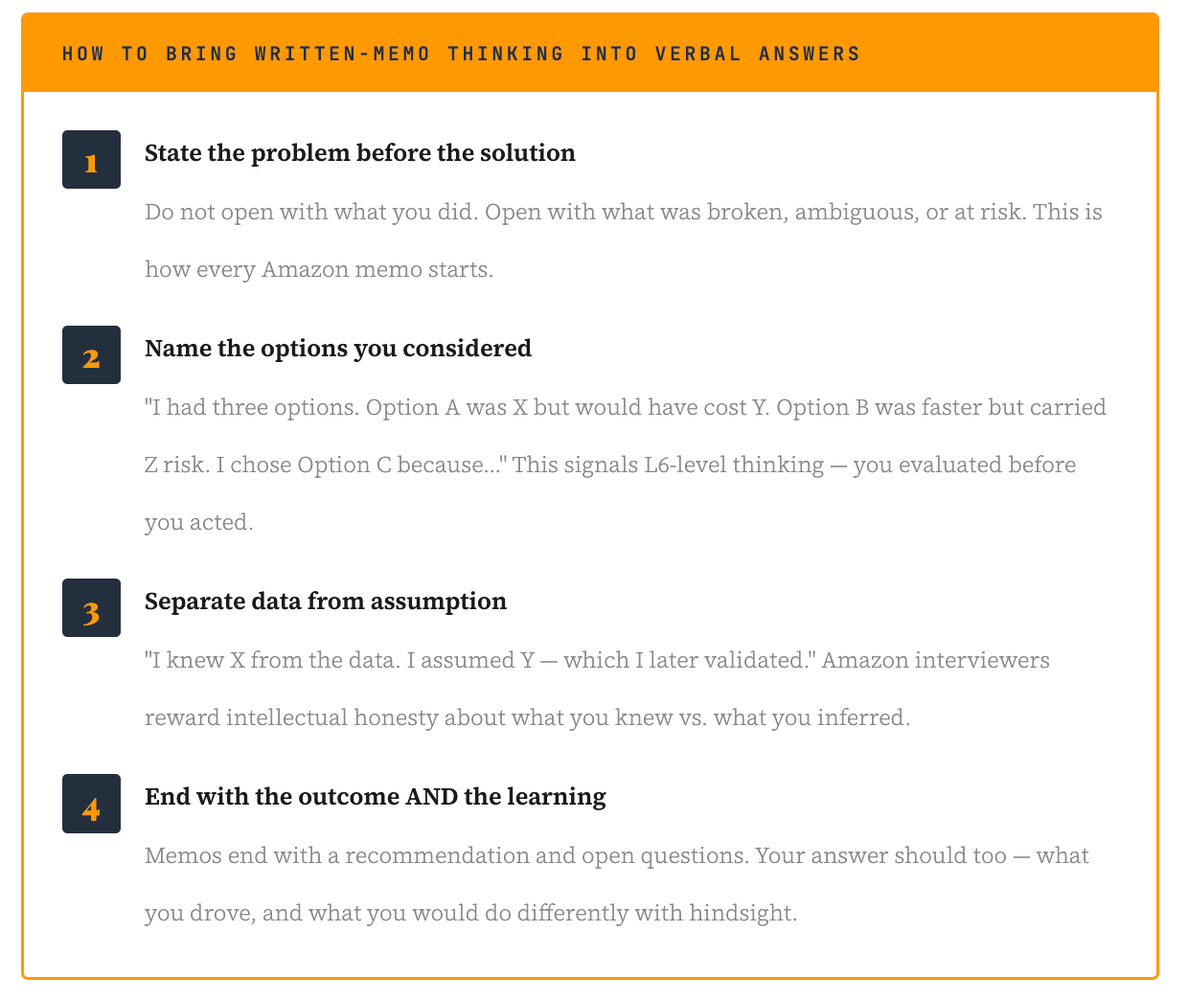
If the loop includes a written pre-work (some do), treat it as a 2-pager even if the prompt is informal. Use headers, state your assumptions explicitly, and give a recommendation. Do not bullet everything. Write in prose. Amazon readers are trained to spot shallow thinking in bulleted lists.
09 / Program Design Questions: How to Approach Without Freezing
The program design question is the round most TPM candidates dread and most under-prepare for. They prepare behavioral stories for weeks and then see a question like "design a program to launch Amazon Pay in three new markets simultaneously" and freeze because there is no single right answer.
That is exactly the point. The question is not testing whether you know the answer. It is testing whether you know how to think through ambiguity in a structured way. The best TPM candidates I have seen in this round spend the first 5–7 minutes asking clarifying questions before drawing a single box or naming a single workstream.
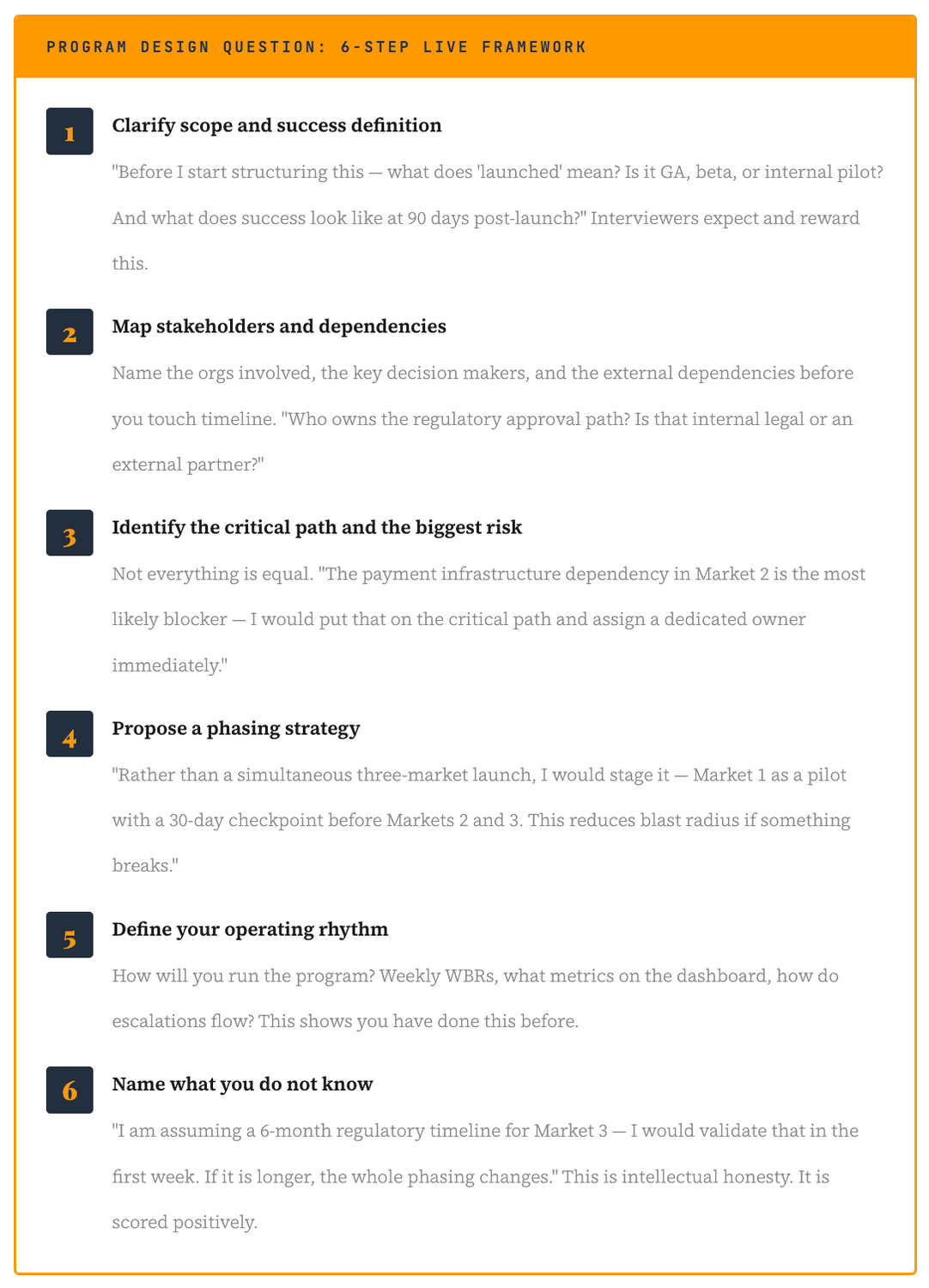
The single most common failure mode in program design questions is jumping to a Gantt chart. The best TPM answer at L6 never produces a timeline until it has first established what needs to be true for any timeline to be credible.
10 / What the TPM Interview Is Really Testing (vs. SDE)
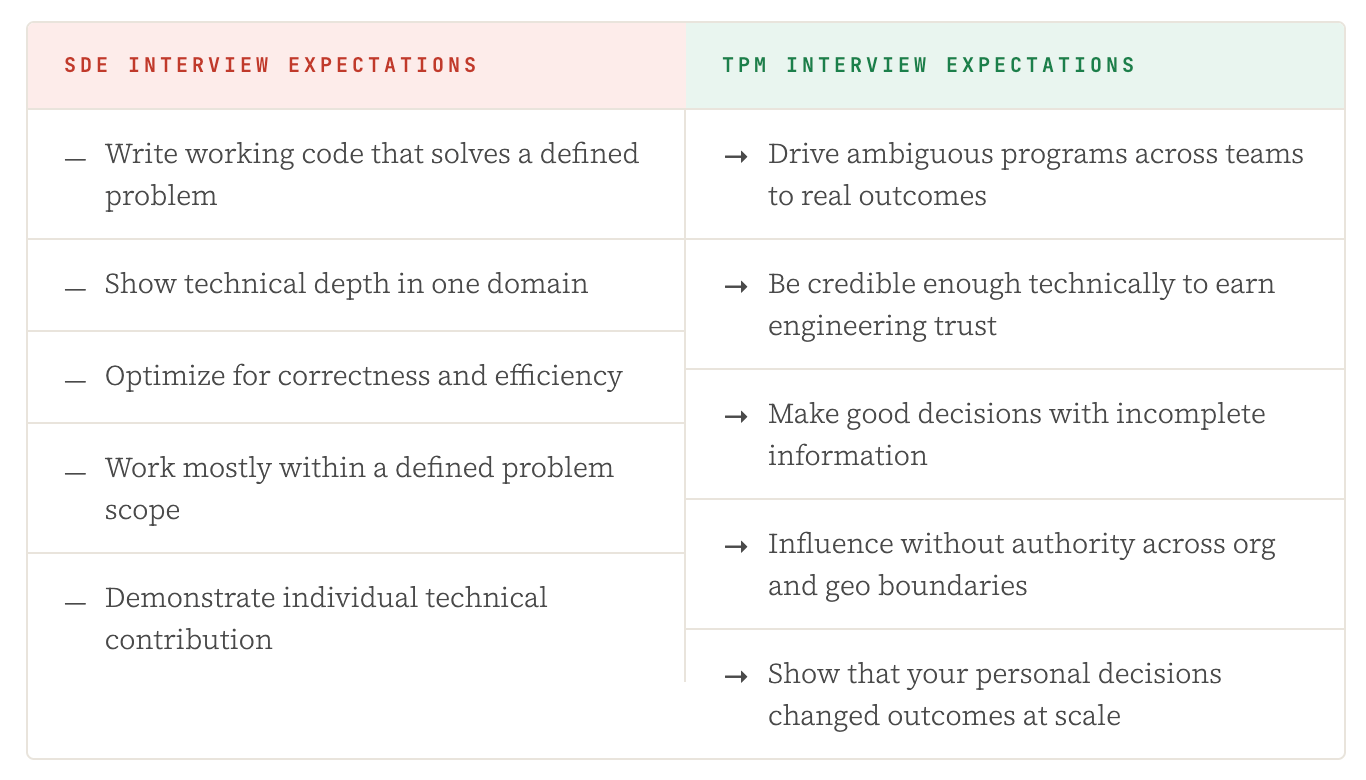
The technical bar for a TPM is real but different. You are not expected to write production code in the loop. You are expected to understand system design well enough to ask the right questions, to know when an engineering estimate is implausible, and to have credible technical
conversations with a principal engineer without needing a translator. If you cannot discuss service architecture, database tradeoffs, or API design at a high level, invest time there before your loop.
11 / How Other Big Tech Loops Differ from Amazon
If you are targeting multiple companies — or if you got a rejection from Amazon and want to redirect your energy — here is how the major big tech TPM loops compare. This is not theoretical: it is based on experience going through several of these and talking to peers who have done the others.
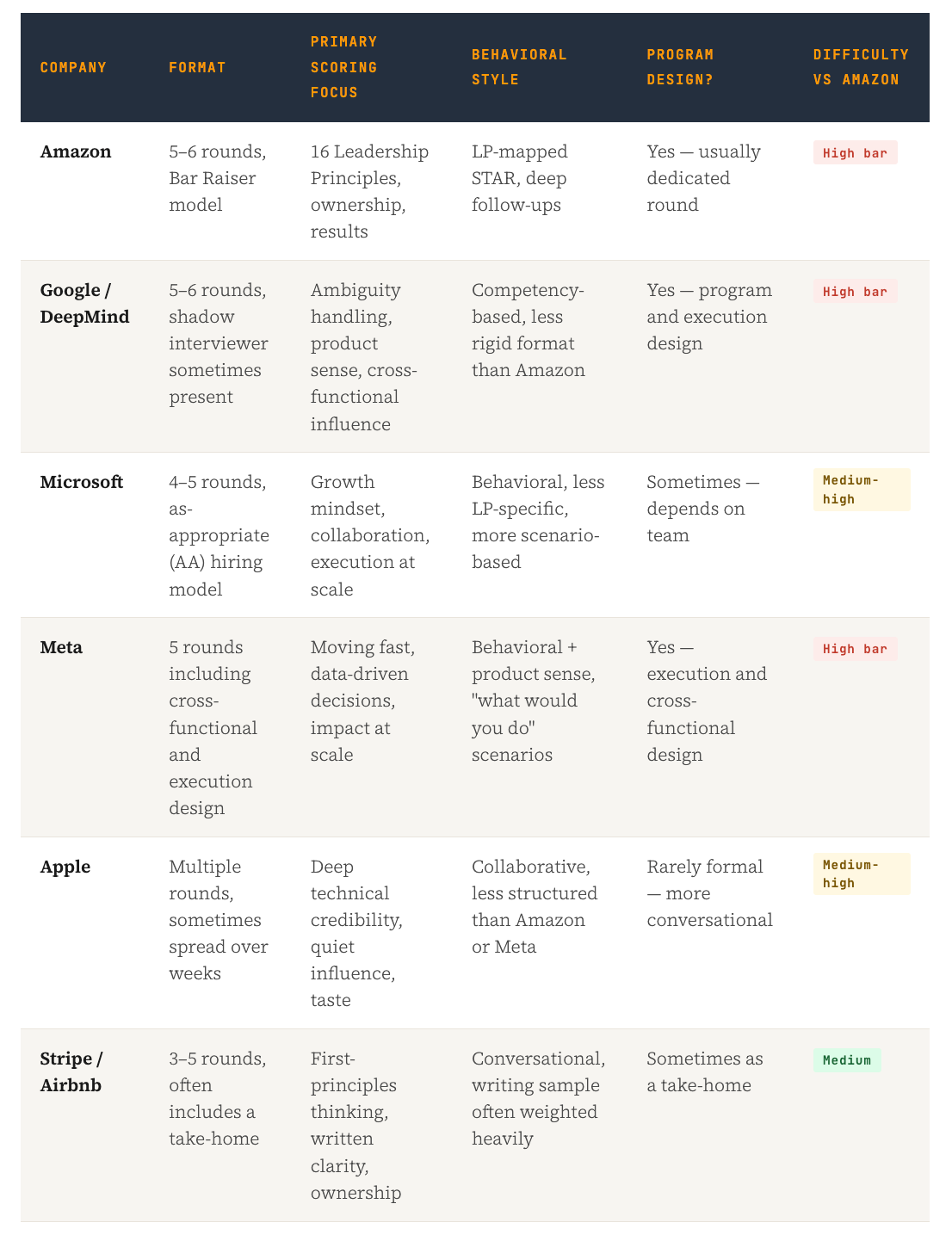
The biggest strategic difference between Amazon and most others: Amazon's LP framework means every question has a known scoring rubric that you can prepare against specifically. Google and Meta are little harder to prepare for systematically because the scoring is more holistic and interviewer-dependent. Amazon is actually more "crackable" than its reputation suggests — if you invest in understanding what the LP rubric is really looking for.
12 / How to Actually Prepare: The System That Worked
Build a Story Bank, Not a Script Bank
In a spreadsheet, map 15–18 real situations from your career — not polished interview answers, just raw situations. For each one write the actual decision, what was at stake, what you did, and what happened. Then tag each one against LPs. The rule: each LP needs a unique story. No LP reuse. That constraint forces you to go deep into real experience
rather than polishing one good story into something that sounds rehearsed.
Practice Out Loud, Not in Your Head
I practiced silently for 2021. I had read my stories. I had not said them out loud to another person who would interrupt me, ask follow-ups, or just look mildly confused while I rambled. There is a massive gap between how an answer sounds in your head and how it sounds at two minutes out loud. Use a Topmate or blind peer session with someone who has cleared Amazon at L6. One session of honest real-time feedback will change more than ten hours of solo prep.
Time Box Every Answer
Hard limits: 90 seconds for S+T combined. 3 minutes for A. 60 seconds for R. If you cannot land the result in 60 seconds, the result is not crisp enough. Every answer I prepared ran long on the first pass. Cutting is not losing content — it is finding the signal inside the noise.
Prepare for the Follow-Up, Not Just the Opener
Amazon interviewers almost always drill one level deeper. "Tell me more about what you personally did there." "What was the alternative you considered and why did you reject it?" "How did you know the outcome was attributable to your action and not something else?" Prepare your follow-up answers for every LP story. The follow-up is where many strong candidates fall apart because they prepared a surface answer and not a real one.
· · ·
13 / Negotiating the Offer: What Nobody Tells You
You got the offer. This is where many TPMs leave significant money on the table because they either do not know the compensation structure or they accept the first number because they are grateful and nervous. Here is what you actually need to know.
How Amazon Compensation Works
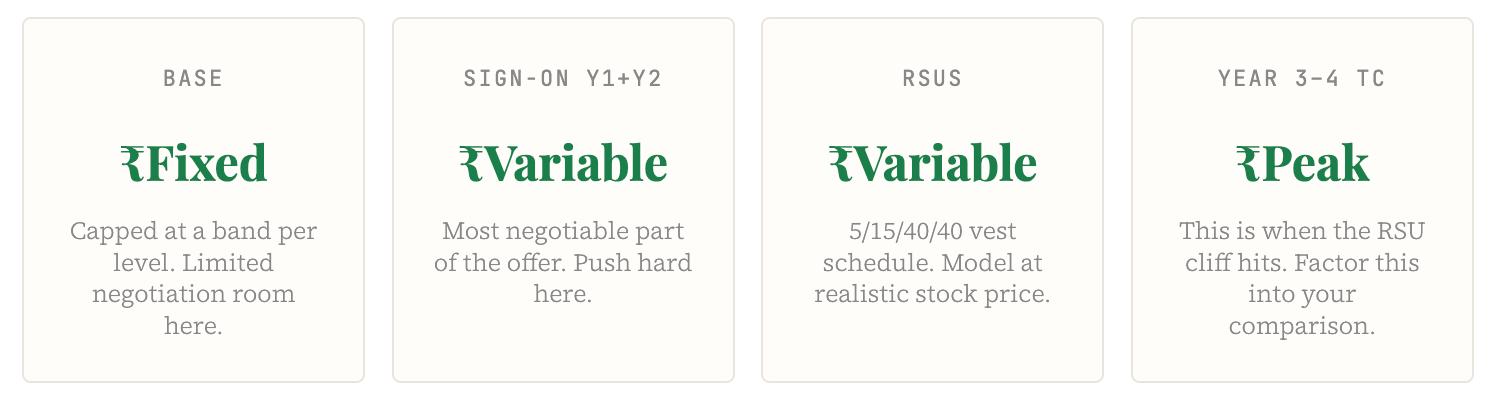
Amazon TC (total compensation) has four components: base salary, Year 1 sign-on bonus, Year 2 sign-on bonus, and RSU vesting. The RSU schedule at Amazon is unusual — it is not a standard 25% per year. It is typically 5% in Year 1, 15% in Year 2, 40% in Year 3, and 40% in Year 4. This means the first two years of TC feel lower than the headline number suggests. When comparing Amazon offers to Microsoft or Google, always model all four years.
How to Negotiate Without Losing the Offer
Never negotiate over email for the first response. Call the recruiter. The tone of a negotiation matters as much as the ask.
Always have a competing offer or a strong market data point before you push on sign-on. "Based on comparable L6 TPM offers I have seen in the market, I was expecting a sign-on closer to X" is a complete sentence. You do not need to name the competing company.
The sign-on bonus is the most flexible lever. Base salaries are banded. RSU grants can move but less easily than sign-on. Start your negotiation on sign-on.
If they cannot move on the initial sign-on number, ask about the RSU grant size. Even a 10% increase in the initial RSU grant compounds meaningfully over four years.
Ask about the start date flexibility. A two-week delay can sometimes be traded for a higher sign-on if the team needs you quickly.
For India-based offers: factor in LTA, HRA, NPS components in the CTC structure. The gross CTC number is not the take-home. Run the math on in-hand before accepting.
"The recruiter's job is to close you at a number the company is comfortable with. Your job is to find the ceiling. Those two things are not hostile — they are just different starting points."
14 / On Rejection: What It Means and What It Does Not
A rejection from Amazon is not a verdict on your career. It is a snapshot of one loop, on one day, with one Bar Raiser, against one hiring committee's bar. I know this is easy to say. I also know how it feels at 9 PM when you have just gotten the call after three months of preparation. Both things are true at the same time.
I have been part of Amazon hiring committees where we rejected candidates who were better program managers than some of our sitting L6s — because their storytelling was weak that day, or they hit a hard HC cycle, or the team had identified an internal candidate before the loop closed. I have also seen people get offers who I would not have hired. The system is good. It is not perfect. And it is measuring something specific — how well you translate your real capability into a specific format — which is a learnable skill, not a fixed attribute.
Ask the recruiter for specific feedback. Not all will give it, but some will. Even vague feedback like "the HC wanted stronger Deliver Results examples" is actionable.
Your cooldown period at Amazon is 6 months. Use the first 3 to rebuild your story bank and practice differently. Use the last 3 to prep specifically against the feedback you got.
Do not over-index on the rejection. The candidates who improve most between attempts are the ones who carry the specific lessons and release the general verdict.
Consider whether a different Amazon team or org might be a better fit for your story profile. The bar is Amazon-wide but the HC composition and team context vary.
15 / Your Prep Arsenal: Curated Resources
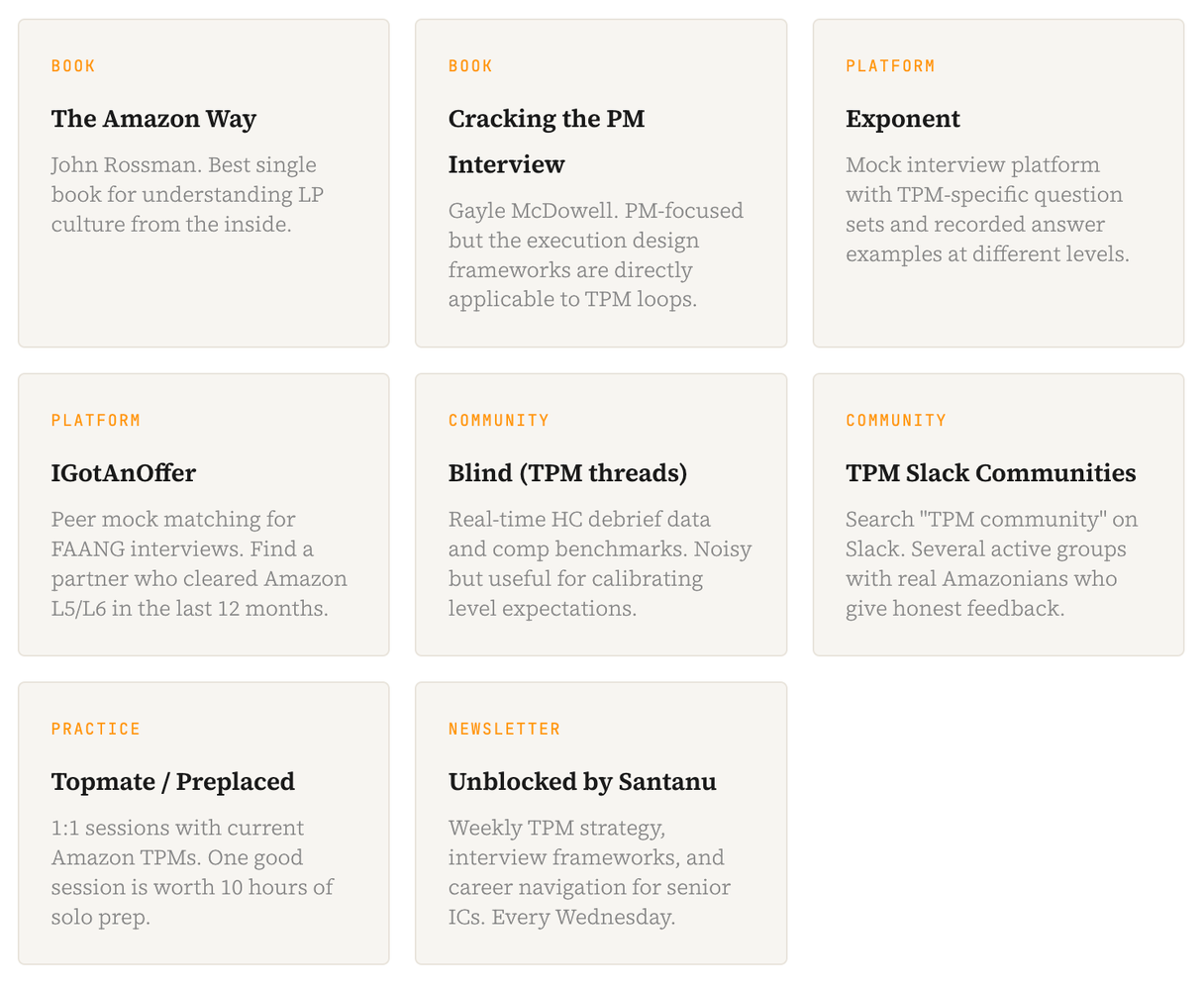
These are the resources I have actually used or that peers I trust have recommended. Not an exhaustive list — a useful one.
16 / The 4-Week Prep Calendar
If you have a loop scheduled in four weeks, here is how to allocate your time. This is not a study plan — it is a practice plan. The goal is not to learn more content. It is to get faster, more honest, and more specific in how you deliver what you already know.
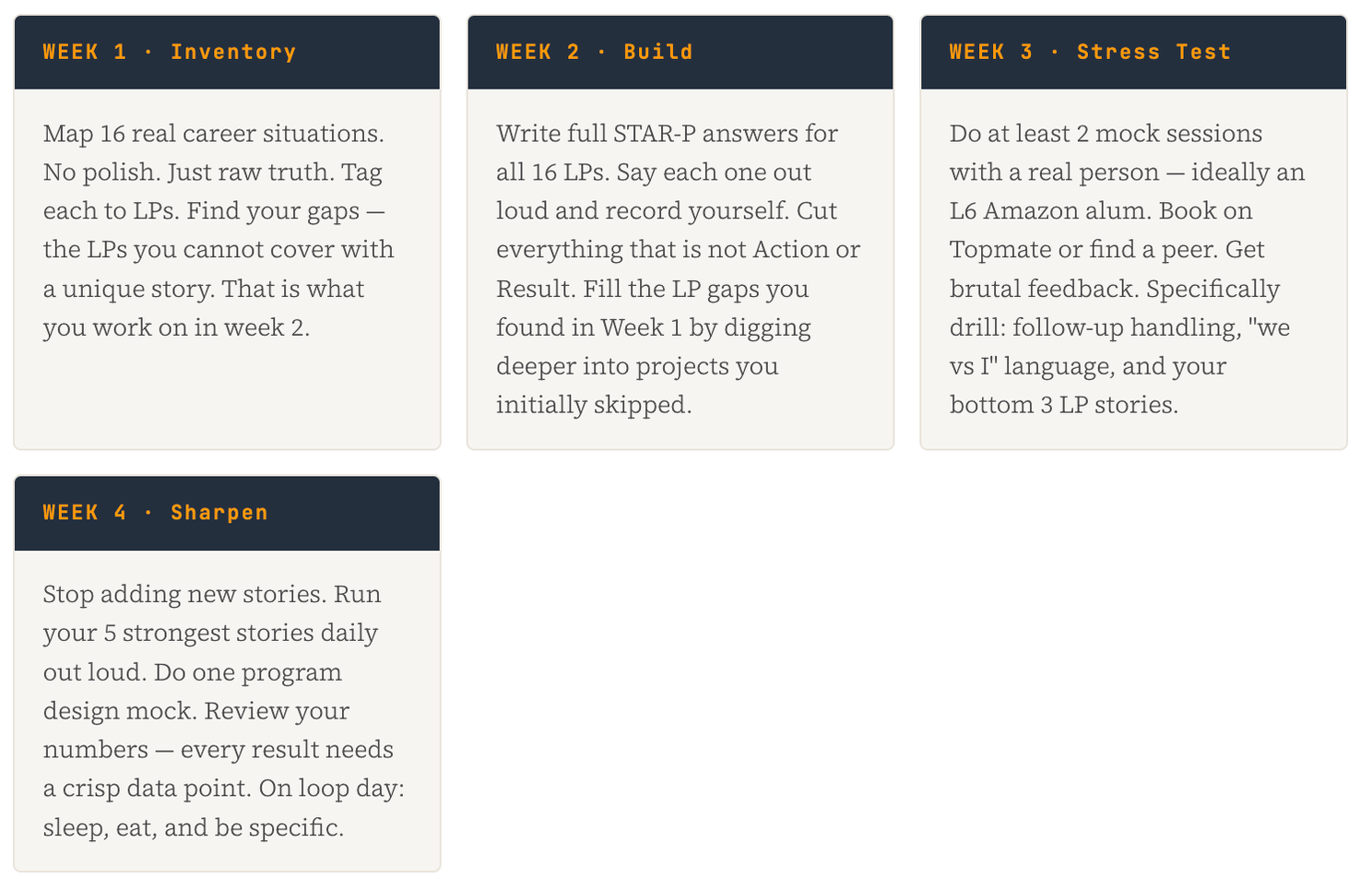
"Stop adding new content in Week 4. The goal is not to know more stories. It is to deliver the stories you have with zero friction."
Four Years Later
The call came in late 2024. I was still at LinkedIn when the recruiter said the hiring committee had voted strong hire on multiple LPs. I joined Amazon Advertising Trust in January 2025 as my first team. Same city I had been in for the 2021 rejection. Same person, mostly — three years of LinkedIn programs heavier, a lot more specific about what I personally drove versus what the program achieved, and considerably less interested in sounding polished at the cost of sounding true.
The gap between the 2021 version of me and the version that got the offer was not dramatic talent growth. LinkedIn made me a better TPM. But the interview did not get easier because I got better at the job — it got easier because I finally learned to translate what I was actually doing
into the format the interview is designed to surface. That is a learnable skill. It is separate from your actual capability as a program manager. And it takes longer to develop than most guides suggest, partly because it requires a kind of honesty about your own role in your stories that most people never practice.
If you are on this path, I genuinely hope something in here shortens your gap. Not because the job is the destination, but because the discipline of preparing for it forces you to look at your career clearly. That clarity, regardless of the outcome, is worth something.
Good luck. Seriously — you are going to need a little of it. Make sure you are ready when it shows up.
For more on this, subscribe to Unblocked — my weekly newsletter for TPMs who lead at scale. Next in Unblocked: Lets dive deep into Amazon and Anthropic $33B bet and the TPM way of looking into it
For 1:1 mentorship and coaching, I'm on Topmate
Real talk on TPM, AI, Leadership, real life stories and fun. No fluff. No corporate filter. Just
what actually works.
Michael, Kinjalk and 1,177 connections are subscribed
1,460 subscribers

30,000 Jobs Gone: Amazon’s Massive Layoffs and the Harsh New Reality of Work
7x in 9 months : Part 1 - scaling "infrastructure"
My Experience Navigating a RIF
Ann Parthemore
Matt Bye
Mareh A.
5 · 1 comment · 1 repost
Found this useful?
Book a 1:1 session to apply these frameworks to your specific situation — promotion prep, interview coaching, or career roadmap.
Book a Session →