$33 billion. A decade of compute. 100,000+ enterprise customers already on Bedrock. What every TPM needs to understand — before their roadmap is already obsolete.
The Setup
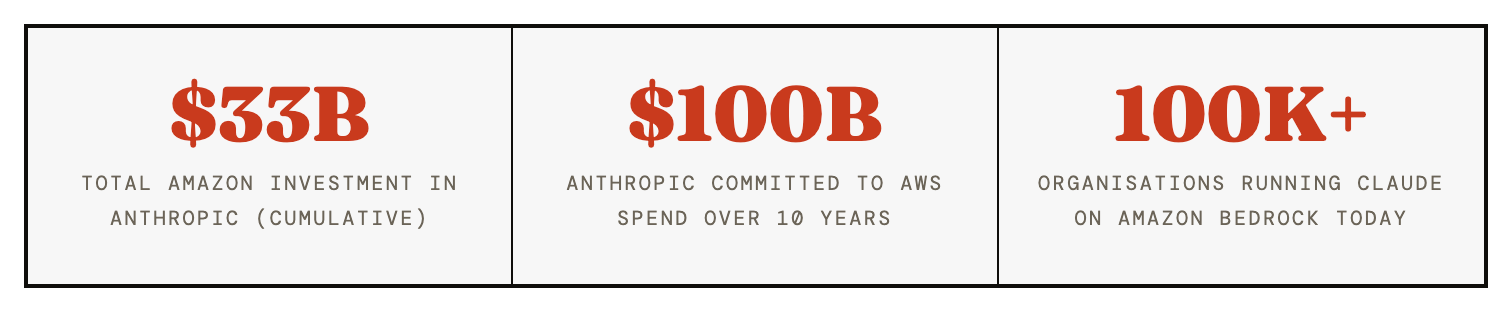
On April 20, 2026, Amazon announced it would invest an additional $5 billion into Anthropic — with the option for up to $20 billion more tied to commercial milestones. That brings the cumulative total to $33 billion. In the same announcement, Anthropic pledged to spend over $100 billion on AWS technologies over the next decade, securing up to 5 gigawatts of compute capacity. For context, that's not a footnote. That's an infrastructure treaty.
I've sat across enough executive QBRs to know the difference between a vendor partnership and a structural dependency. This one crossed that line months ago. What happened on April 20 just made it official — and public.
If you're a TPM, you need to care. Not because AI is trendy. Because your build-vs-buy decisions, your platform bets, your risk registers, your headcount justifications, and your long-horizon roadmaps are all
affected by how this plays out. This article is my attempt to give you the playbook — not just the news recap.
— ✦ —
Three Years, One Compounding Bet
September 2023
Amazon puts in an initial $4B. Anthropic names AWS its primary cloud partner. Both sides call it a "strategic collaboration." It was more than that — it was a compute dependency contract dressed in partnership language.
2024 — Project Rainier
Amazon and Anthropic launch one of the world's largest AI compute clusters. Anthropic starts running Claude training on over one million Trainium2 chips. This is not a pilot. It's frontier-scale production.
Late 2025
Anthropic's run-rate revenue reaches $9B. Claude for Enterprise lands on AWS Marketplace. More than 100,000 customers are now running Claude on Bedrock. Lyft cuts customer service resolution time by 87%. Pfizer saves 16,000 search hours a year on drug development — while reducing infrastructure costs by 55%.
Anthropic's run-rate revenue hits $30B — tripling in roughly four months. The new $5B + up-to-$20B investment drops. Anthropic commits $100B to AWS, spanning Trainium2 through Trainium4. AWS customers access the full Claude console natively, without separate billing or login. The lines between "Anthropic customer" and "AWS customer" are becoming semantic.
— ✦ —
The TPM Playbook
Six Things That Actually Change for How You Run Programs
Here's the thing most coverage misses. The financial numbers are the headline. But for those of us who run programs — who chase dependencies across 30+ teams, argue about capacity every Tuesday, and hold weekly stakeholder syncs where everyone has a different definition of "done" — the operational implications are the real story. Let me go through them one by one.
1. The Build-vs-Buy Calculus Just Shifted — Permanently
For years, large enterprises hedged. They built internal ML platforms, hired data scientists, trained proprietary models on their own infra — because frontier models weren't trusted, weren't integrated, and weren't cost-predictable. That calculus is changing fast.
When Pfizer saves 55% on infrastructure costs by moving drug- document search to Claude on Bedrock, the CFO doesn't need a consultant to tell them what to do. When Cox Automotive runs agentic workflows with 63% autonomous resolution, the headcount conversation shifts from "how many engineers do we add" to "what do our current engineers now own."
In my experience managing portfolios with 30+ active programs, the hardest part isn't the technology. It's the org readiness — the governance, the risk posture, the stakeholder alignment. This partnership accelerates the technology side so fast that org readiness becomes the new critical path. TPMs who see that early will be ahead.
2. AI Is Now a First-Class Dependency — And Your Risk Register Doesn't Know It Yet
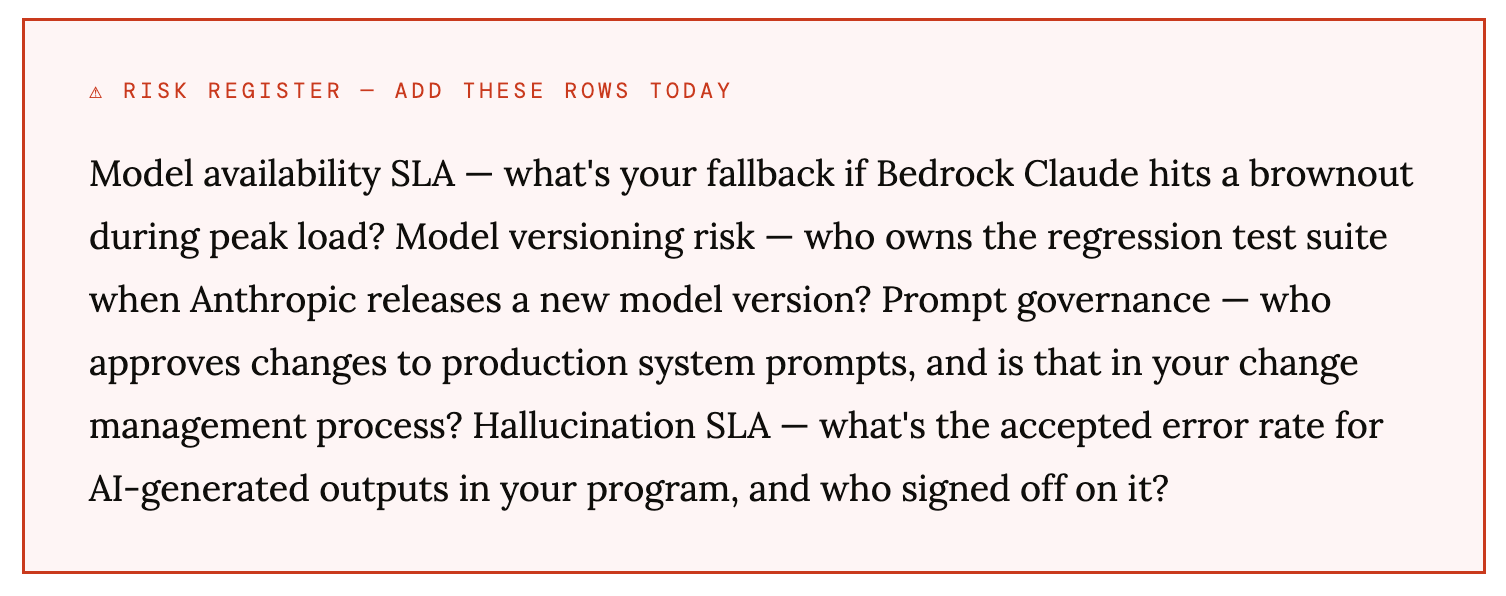
This is the angle I see least discussed, and it's the one that will hit hardest. When an agentic Claude workflow sits in your program's critical path — and within 18 months, I believe most enterprise software programs will have at least one — it is a dependency. A production dependency. With SLAs, failure modes, and incident ownership.
Anthropic's own blog admitted peak-hour performance degradation for paying customers as their revenue exploded from $9B to $30B. At that scale, "the model was slow" is not a startup teething issue. It's a P2 incident with downstream program impact. Your risk register needs a row for model availability, model versioning drift (Claude 3.5 vs 3.7 vs 4 — each behaves differently), and what your mitigation plan is if a prompt that worked last sprint breaks after a model update.
3. Bedrock AgentCore Is Becoming the Enterprise AI Operating System
AWS isn't just reselling Claude. They're building a full production-grade agent infrastructure around it. Amazon Bedrock AgentCore now ships with Runtime, Memory, Identity, Gateway, Code Interpreter, Browser Tool, and Observability — all managed. Agents can run autonomously for up to eight hours with auto-scaling. The latest Claude model hits 87.6% on SWE-bench Verified and runs agentic coding sessions that previously needed constant babysitting.
Think about what that means for how you staff a program. A technical program that used to require three engineers writing scaffolding code now needs one engineer who knows how to write a strong system prompt and wire up AgentCore. I'm not saying engineers disappear. I'm saying the shape of what they do changes faster than most roadmaps account for — and the TPM who can translate that shift to a VP during headcount season is worth their weight in program velocity.
4. Stakeholder Alignment in AI Programs Is a New Kind of Hard
This one is personal. I've watched smart, experienced teams fall apart at the stakeholder alignment step specifically because AI creates a three- way gap that didn't exist before. Engineers think in terms of what the model can do today. PMs promise capabilities based on demos they saw last quarter. Legal and compliance say no to things that have been in production at other companies for six months.
The Amazon x Anthropic deal makes this worse before it makes it better. When every AWS service announcement now comes with a Claude integration — Amazon Q, Amazon Connect, Amazon Kiro, Alexa — the pressure on product teams to "add AI" without a clear definition of what that means creates the perfect conditions for misaligned expectations. Your job as a TPM is to define those expectations in writing before anyone starts building. That means getting engineering, product, legal, and security in a room and agreeing on what "AI-powered" actually means for your specific program — what it can decide autonomously, what requires human review, and what it is never allowed to touch.

5. Vendor Lock-In Is Real — And So Is the Opposite Risk
I know some of you are already writing the comment: "this is dangerous concentration risk." You're not wrong. When your AI stack, your cloud infra, your procurement contract, and your model provider are all the same company, your negotiating leverage after year three is effectively zero.
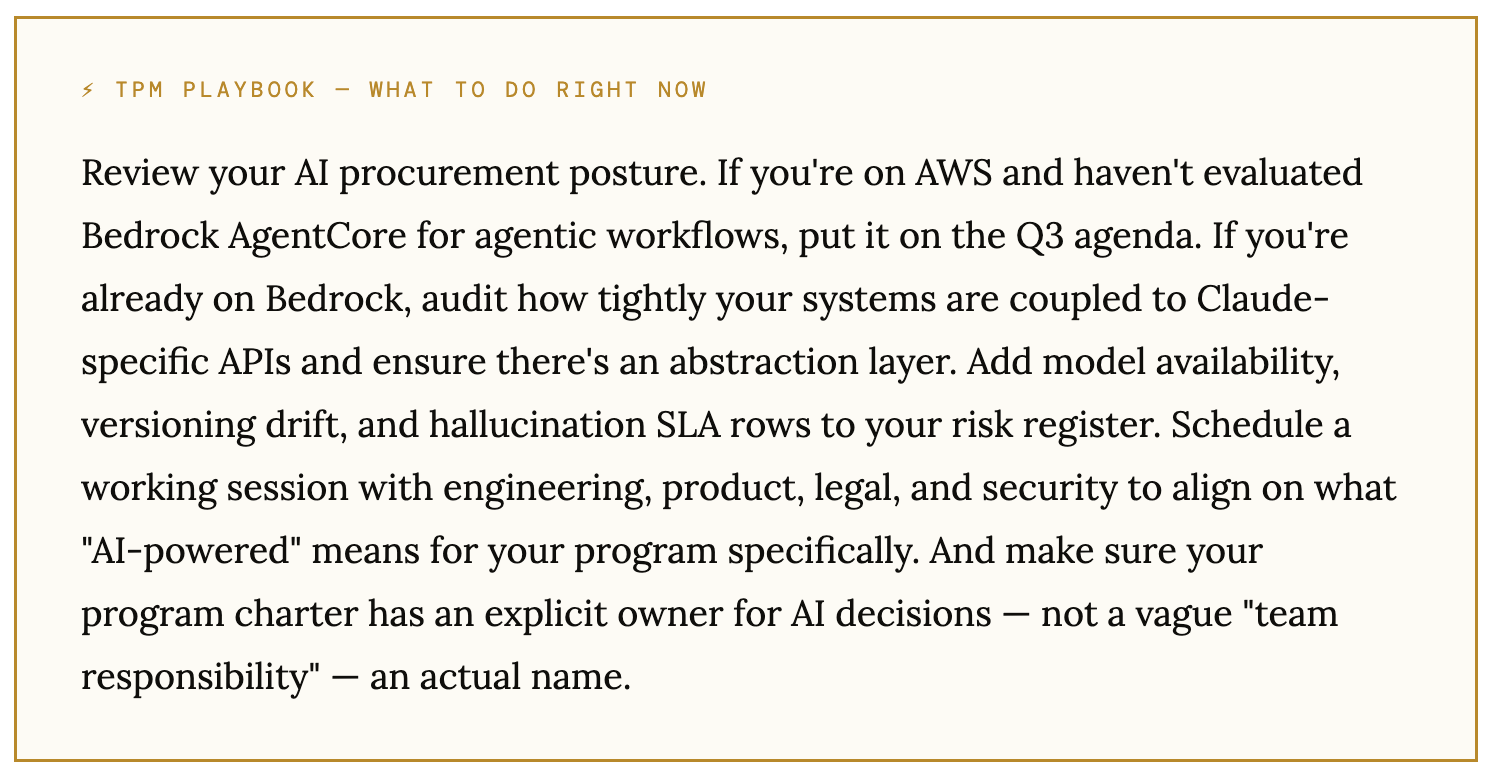
But the risk of moving slowly is equally real. Companies that waited on cloud in 2013 weren't being prudent. They were behind. The question for TPMs isn't "should we adopt" — it's "how do we adopt without painting ourselves into a corner." That means maintaining multi-model awareness, documenting abstraction layers, and resisting the temptation to hard-code Bedrock APIs into your core product logic without an exit seam.
6. The "Who Owns This Decision" Problem Is Getting Worse
This is the quietest crisis in enterprise AI adoption right now. When an AI system makes a call — routes a customer complaint, flags a fraud signal, generates a legal summary — who owns that decision? Is it the ML engineer who wrote the prompt? The PM who scoped the feature? The TPM who signed off on the charter? Legal, who reviewed the use case? None of the above?
At Amazon-Anthropic scale, this ambiguity gets embedded into hundreds of enterprise programs simultaneously. The companies that get ahead of it will define ownership explicitly in their charters before launch, not in a post-incident RCA after something goes wrong. As a TPM, this is your responsibility — not because you're the domain expert on AI, but because you're the person whose job is to make sure someone owns every decision in a program.
— ✦ —
The Competitive Landscape
The Hyperscaler AI Chess Board
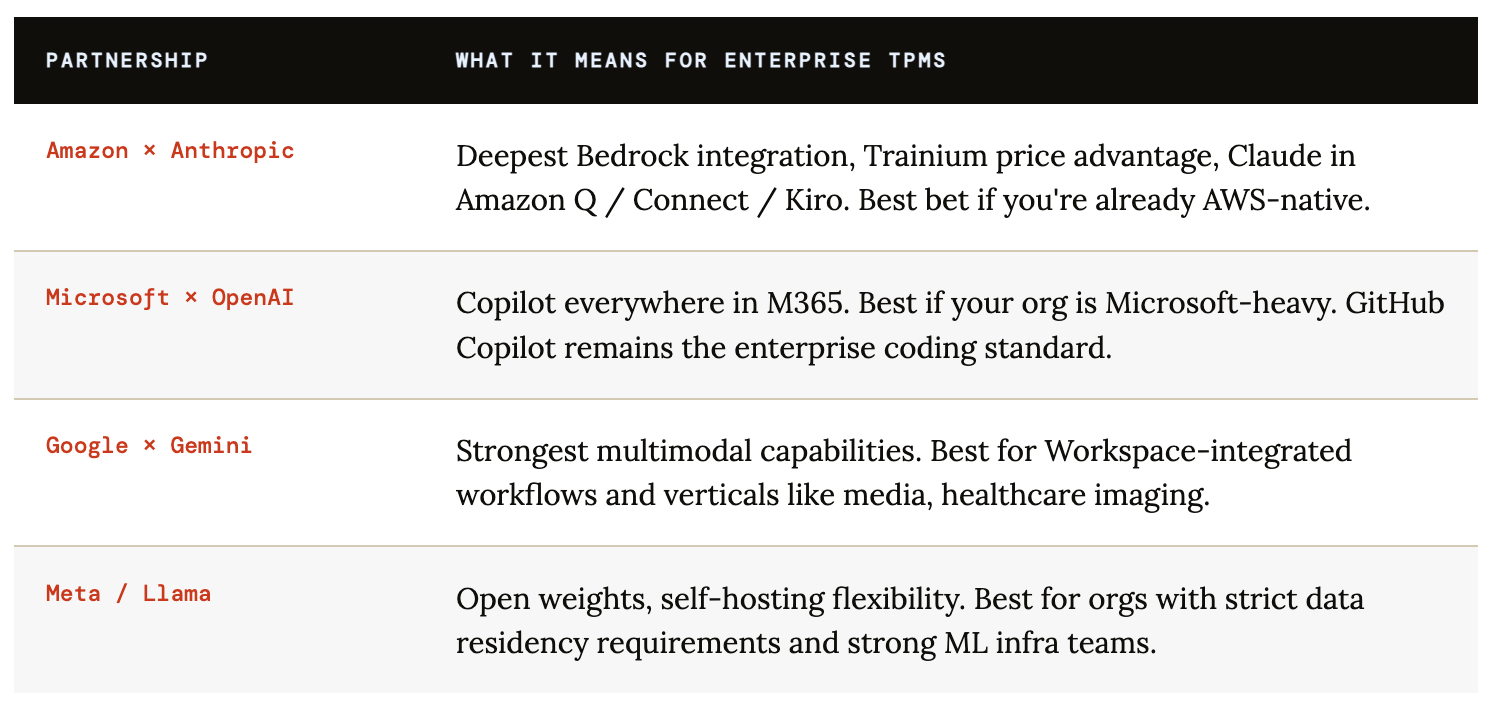
Every hyperscaler is now locked into a frontier model partnership, and those partnerships are structurally similar: massive compute commitments, equity stakes, and deep product integration.
Microsoft × OpenAI — $13B+
Google × Gemini — Internal
Amazon × Anthropic — $33B
Microsoft went all-in on OpenAI and baked GPT into everything from Word to Azure to GitHub Copilot. Google built Gemini internally and is embedding it across Workspace, Search, and Vertex AI. Amazon chose a different path: an external bet on a safety-focused lab, a shared chip strategy, and 100,000+ enterprise customers already on the platform.
The interesting wrinkle: Anthropic also recently closed partnerships with Microsoft (up to $5B in Azure compute) and Google/Broadcom. They're playing a multi-cloud strategy even as AWS deepens its anchor claim. That's good for enterprises — it keeps Claude's roadmap from being dictated entirely by Amazon's internal priorities.
— ✦ —
Looking Forward
Three Shifts Every TPM Should Be Modelling Right Now
Anthropic's revenue went from roughly $9B annualised to $30B in about four months. That's not a growth curve. That's a discontinuity. Something changed in how enterprises consume AI at scale — and the Trainium capacity expansion is a direct response to the strain that growth created. The $100B infrastructure commitment solves compute. But the harder problem — the one that lands on TPMs — is orchestration.
Agent-native program delivery. Within 18 months, I expect most enterprise software programs to include at least one autonomous agent in the critical path — not as a demo, but as a production dependency. That changes how you write charters, how you define success metrics, and critically, how you run incident response when the agent makes a wrong call at 2 AM. The on-call playbook needs a section for AI-related failures before you need it.
Custom silicon as a decade-long moat. The deal covers Trainium2 through Trainium4, with options on future generations. Anthropic's engineers communicate daily with Annapurna Labs on low-level chip optimizations. That feedback loop between model training and chip architecture is how you build a cost and performance advantage that compounds over time. For TPMs, this means the AWS AI stack is likely to stay price-competitive in a way that GPU-based alternatives may not match at scale.
AI procurement as a C-suite conversation. The Anthropic-AWS deal structure — Anthropic commits $100B to AWS, gets investment capital back — is a new procurement archetype. Usage commitments bundled with equity. Every VP of Engineering and CPO will face a version of this decision in the next three years. TPMs who understand the mechanics of these arrangements — the EDP implications, the ELA negotiations, the multi-year lock-in tradeoffs — will be valued in those rooms. Start learning the language now.
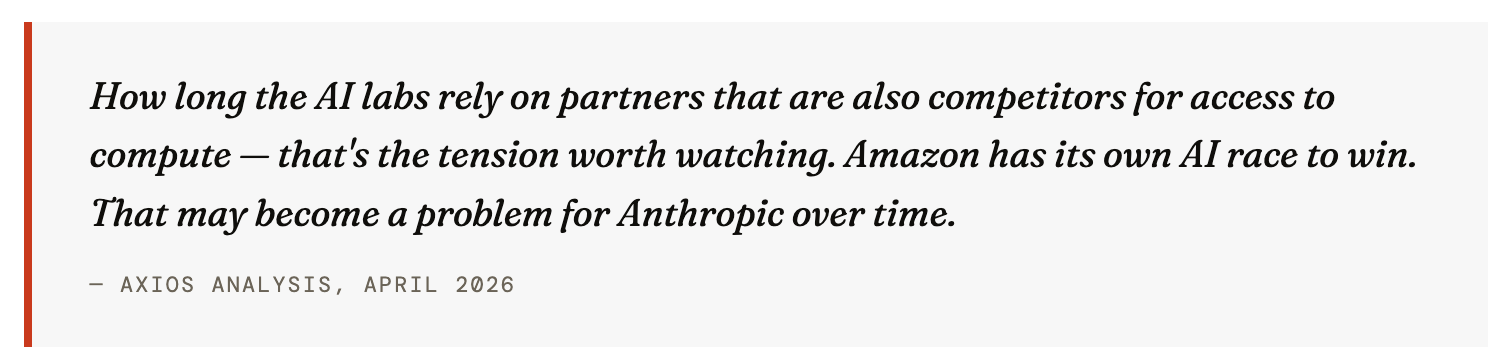
That observation is the most honest thing written about this deal. Amazon and Anthropic are partners. They are also, in some markets, competitors. Amazon Q competes with Claude for Enterprise. AWS's internal model investments create an incentive misalignment that money currently papers over. TPMs should model the scenario where those incentives diverge — and plan accordingly.
— ✦ —
The Honest Take
This Is Not a Hype Cycle. It's a Platform Shift.
I was a software engineer before I became a TPM. I've seen platform shifts before — the move to cloud, the shift to mobile, the microservices wave. Each one looked optional at the beginning and structural in hindsight. This feels the same. Not because of the dollar numbers, but because of what the dollar numbers are buying: not features, but infrastructure treaties measured in gigawatts and decade-long chip roadmaps.
The companies that figure out how to embed AI into their delivery pipelines — not as a side project but as a first-class program capability with proper risk governance, explicit ownership, and stakeholder alignment baked in — will deliver faster, surface risk earlier, and make better decisions at scale. The TPMs who understand the stack well enough to guide those decisions — not just facilitate them — will be the ones who matter in the next chapter.
I don't have a clean three-step framework to offer here. I have a conviction: the window to build that understanding intentionally is shorter than most organisations think. The Amazon-Anthropic deal didn't open that window. It's a signal that the window is closing.
Start now. Or explain later why you didn't.
For more on this, subscribe to Unblocked — my weekly newsletter for TPMs who lead at scale. Next in Unblocked: Let's dive deep into my preparation for the Claude Certified Architect Exam and Tips.
For 1:1 mentorship and coaching, I'm on Topmate
— ✦ —
Real talk on TPM, AI, Leadership, real life stories and fun. No fluff. No corporate filter. Just
what actually works.
Michael, Kinjalk and 1,177 connections are subscribed
1,460 subscribers
⚡ Autoscaling in Amazon EKS – Mastering Horizontal Pod Autoscaler & Cluster Autoscaler for Cloud-Native…
AWS re:invent 2023 Summary (New products, major enhancement and capabilities from all the Keynotes…
Amazon Web Services: Accelerating Digital Diffusion
Antonio Grasso
🚀☸️ Akhil Kumar Khatri
Niranjan Mohapatra
12 · 1 repost
16 · 3 reposts
Found this useful?
Book a 1:1 session to apply these frameworks to your specific situation — promotion prep, interview coaching, or career roadmap.
Book a Session →