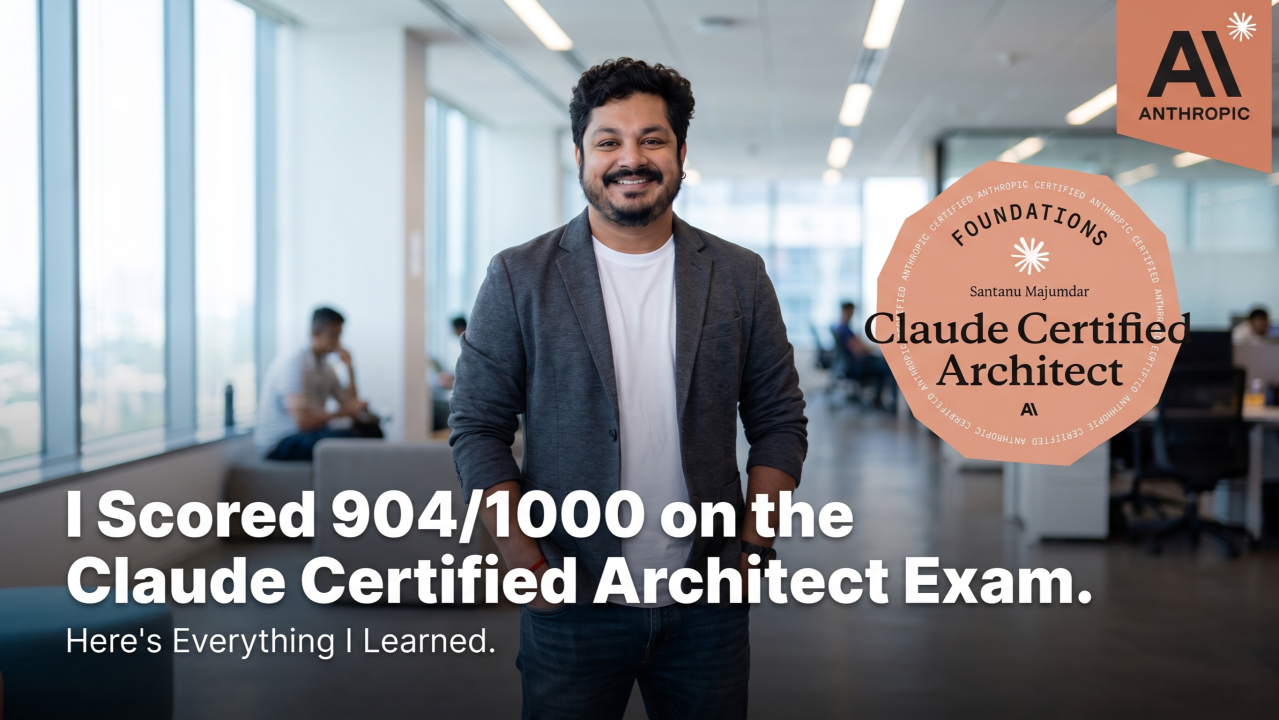
I scored 904/1000. Here's the complete guide — who this exam is for, how hard it really is, what tripped me up, and the exact 4-week path that got me there.
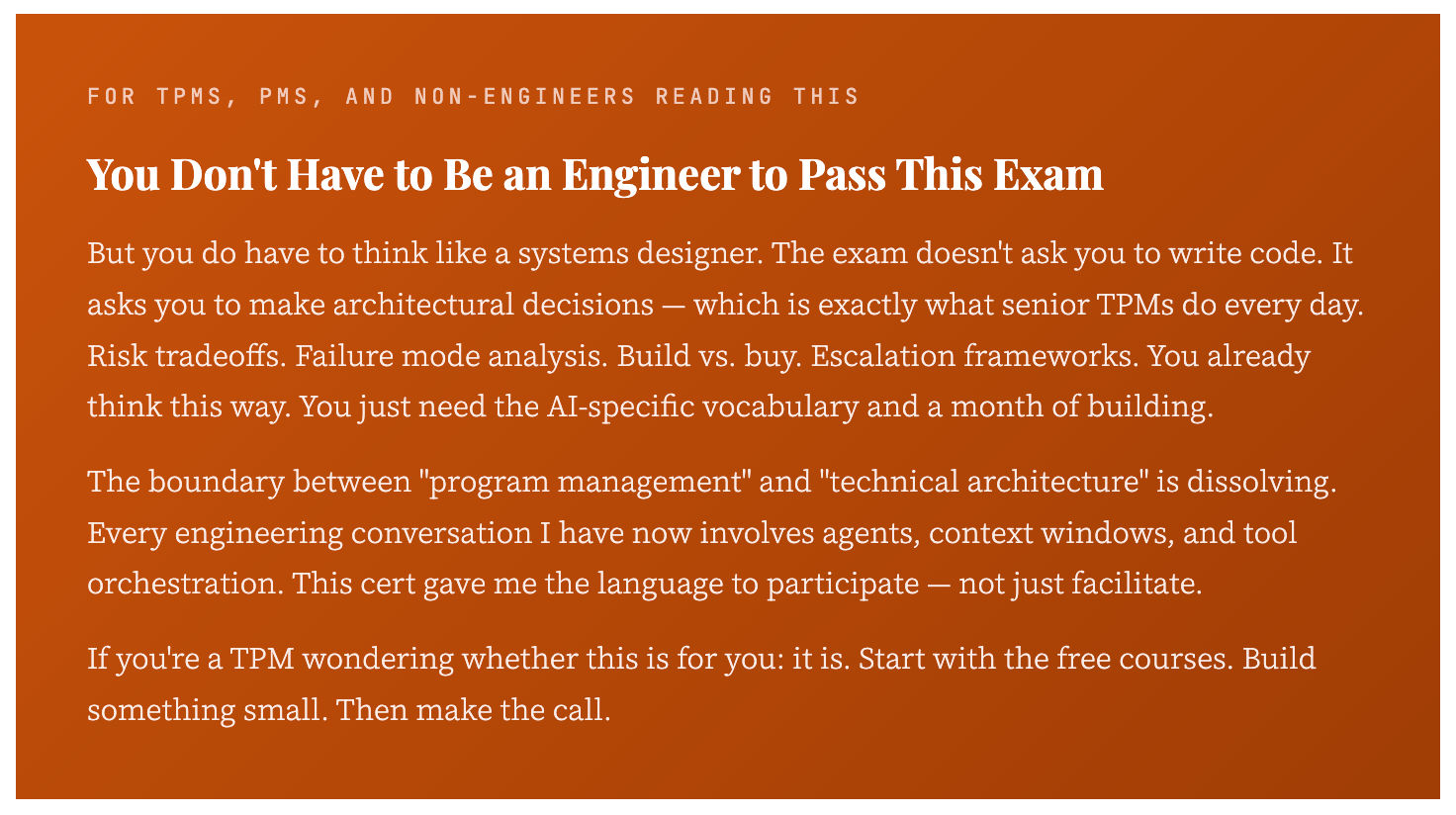
I'm a TPM. My job is delivery — roadmaps, dependencies, escalations, stakeholder alignment. I don't ship code. I don't design APIs. I'm not supposed to be the person sitting at an architecture-level AI exam.
This is not a "I'm special" story. It's a "the world changed, and I decided to keep up" story. And I want to give you everything I know — because the window on this credential is closing fast, and the people who move early will have an advantage that compounds.
"The AI market has enough prompt users. What it needs now is real AI architects."
Why a TPM Sat an Architect Exam
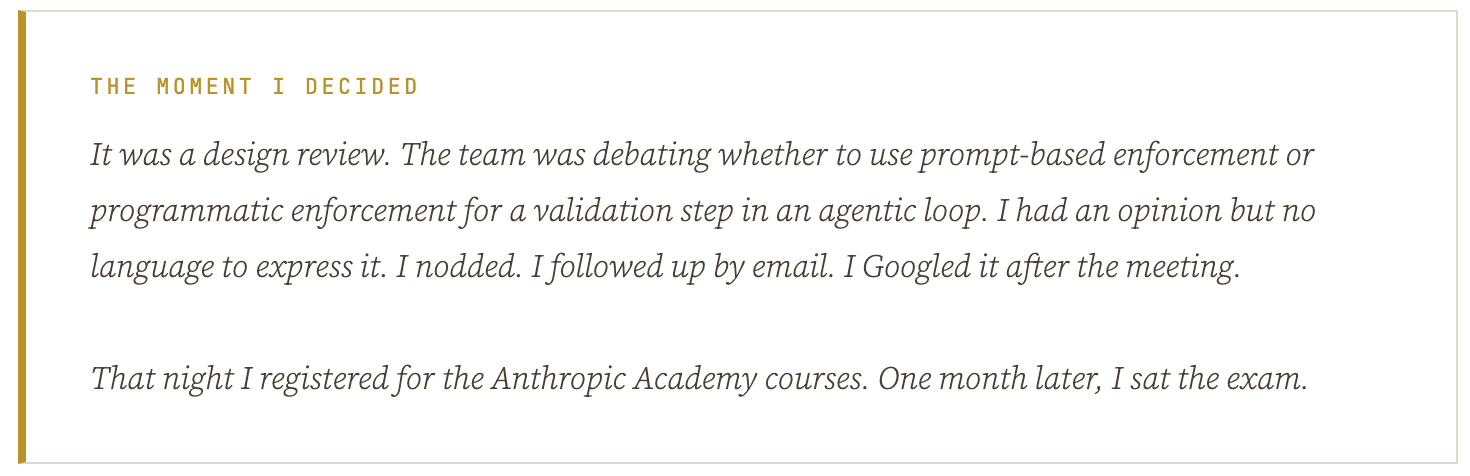
Three months ago, I kept running into the same problem in my day job. Engineering would walk me through an agentic pipeline — multi-agent orchestration, MCP integrations, fallback loops — and I'd follow the
delivery thread fine, but I'd hit a wall when the conversation turned architectural. I could ask smart questions, but I couldn't push back with precision.
That gap bothered me. I've led 30+ programs at Amazon. I've delivered platforms that moved the needle. But AI is different. You can't manage what you don't understand at the systems level — and "I understand the concept" stopped being enough somewhere around early 2026.
I'm writing this for anyone in a similar position — TPMs, product managers, tech leads, consultants — who can feel the floor shifting under them and want to do something concrete about it.
What Is the Claude Certified Architect?
Anthropic launched the Claude Certified Architect — Foundations (CCA- F) on March 12, 2026. It's their first official technical credential, and it's unlike anything else in the AI certification space right now.
This is not a course completion badge. It's not an AI literacy test. It does not care how many prompts you've written or how long you've been on Claude.ai.
It tests one thing: can you architect production-grade Claude applications at enterprise scale?
60 scenario-based questions. 120 minutes. Fully proctored — no Claude, no docs, no second tab. Scaled scoring from 100 to 1000. You need 720 to pass. The exam is built around 6 real production scenarios; your sitting randomly draws 4, so you have to study all 6.
The Five Exam Domains (Know the Weightings)
This is the first thing to internalize. Over half the exam sits in just two domains. If you study evenly across five, you're allocating incorrectly.
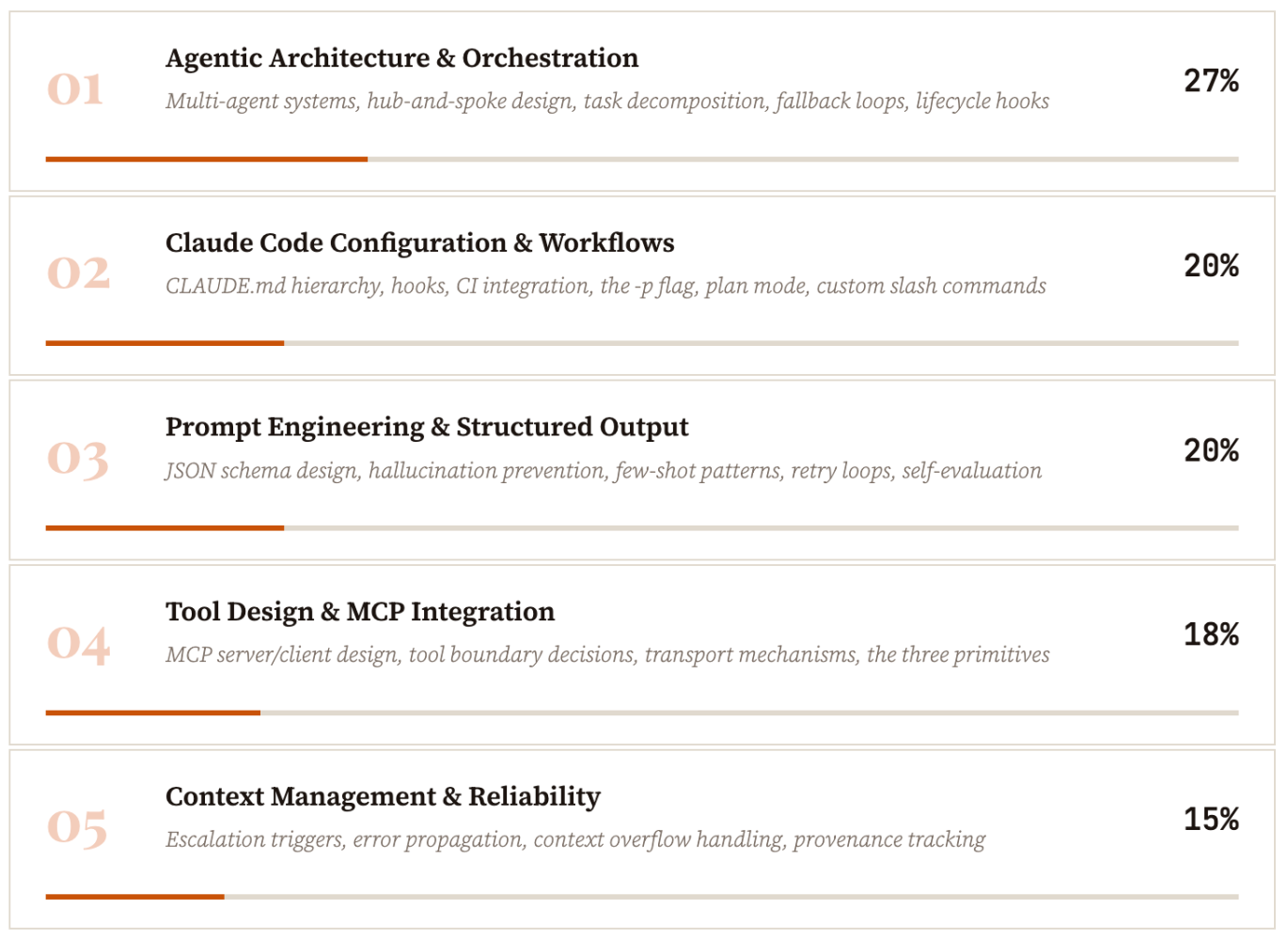
Domain 5 carries the smallest weighting — but every failure there cascades into everything else. It's the one most people underinvest in. Don't.
How Hard Is It, Really?
Harder than any AI cert I've seen. More honest than most.
The questions don't test recall. They put you inside a production system and make you decide. When should an agent escalate vs. handle autonomously? What breaks first when your context window overflows mid-task? How do you structure a fallback loop that doesn't spiral? The distractors are genuinely tempting — designed to catch people with partial knowledge.
Anthropic recommends 6+ months of hands-on experience with the Claude API, Agent SDK, Claude Code, and MCP. That's not boilerplate — it surfaces fast if you haven't built real systems.
For reference, most people who passed reported 2–4 weeks of focused prep if they had already built with Claude daily. I spent one month coming in as a TPM without a production Claude background. It was tight.
What Actually Tripped Me Up
This is the section I wish someone had written for me. Here's where I nearly lost marks — and what I'd do differently.
1. Prompt Engineering ≠ writing good prompts: I came in thinking
this domain was about crafting effective instructions. It's not. It's about designing reliable, schema-enforced, structured output pipelines at production scale — retry logic, self-evaluation loops, validation against JSON schemas. Completely different mental model.
2. Tool descriptions matter more than I expected: In MCP, when two
tools have overlapping or minimal descriptions, the model guesses. And it guesses wrong in production. The fix — writing descriptions that include input formats, example queries, edge cases, and explicit boundaries — is directly tested. I underestimated Domain 4 early on.
3. The -p flag is not optional knowledge: In Claude Code, the -p flag
enables non-interactive (print) mode. Without it, CI jobs hang
indefinitely. This is explicitly tested. I know it now. I didn't know it on Day 1.
4. Escalation triggers have specific wrong-sounding-right
answers: Domain 5 has some of the most carefully crafted distractors in the exam. Two unreliable escalation triggers sound sensible, but aren't. Study all three valid ones until you can recall them without thinking.
5. Subagents have no shared memory — everything must be
passed explicitly: In multi-agent systems, every piece of information a subagent needs must be explicitly passed in its prompt. There's no automatic history propagation. If your synthesis agent needs the research agent's findings, you pass them directly. I got a scenario question wrong on this in my practice exam. Not on the real one.
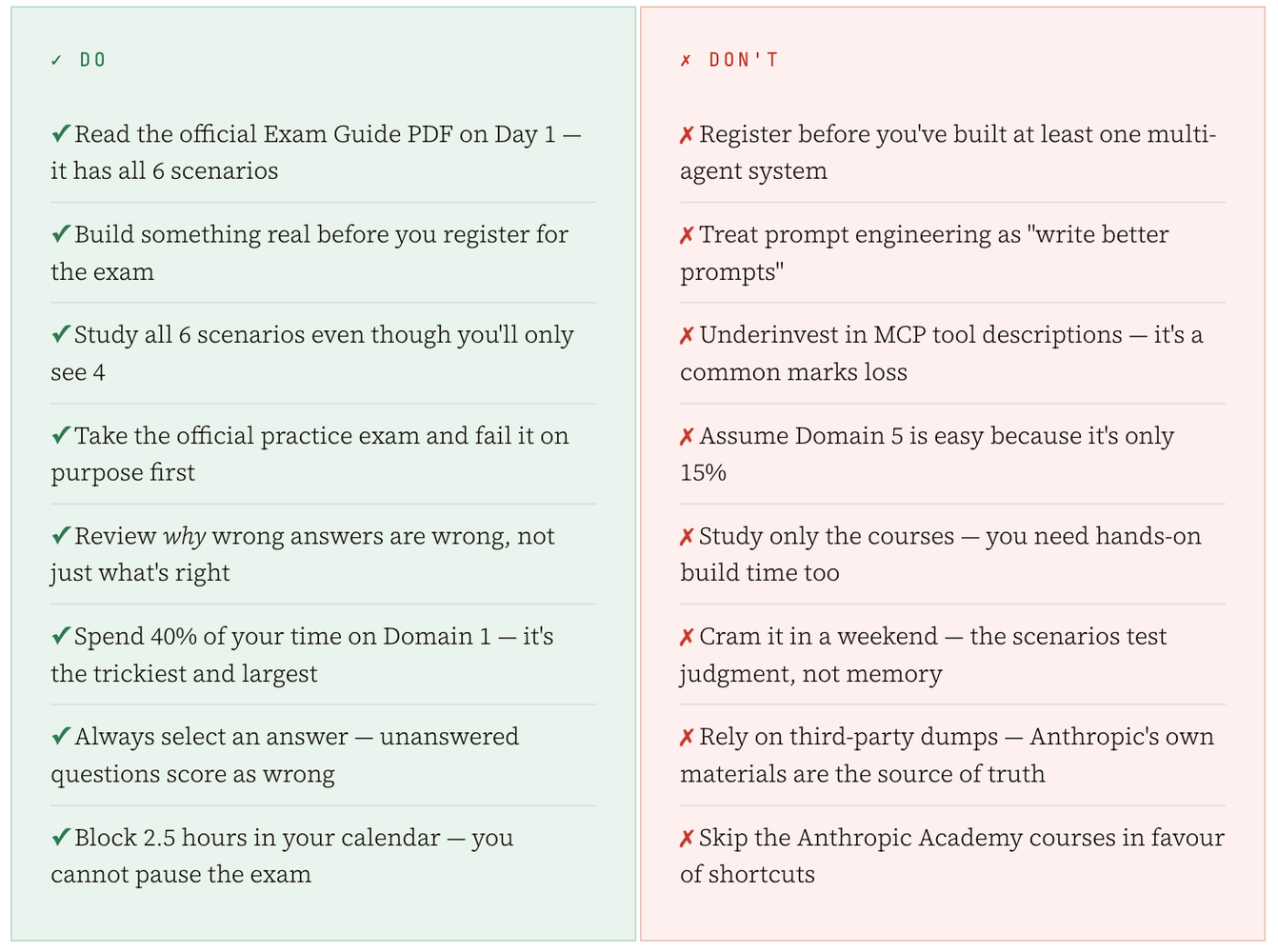
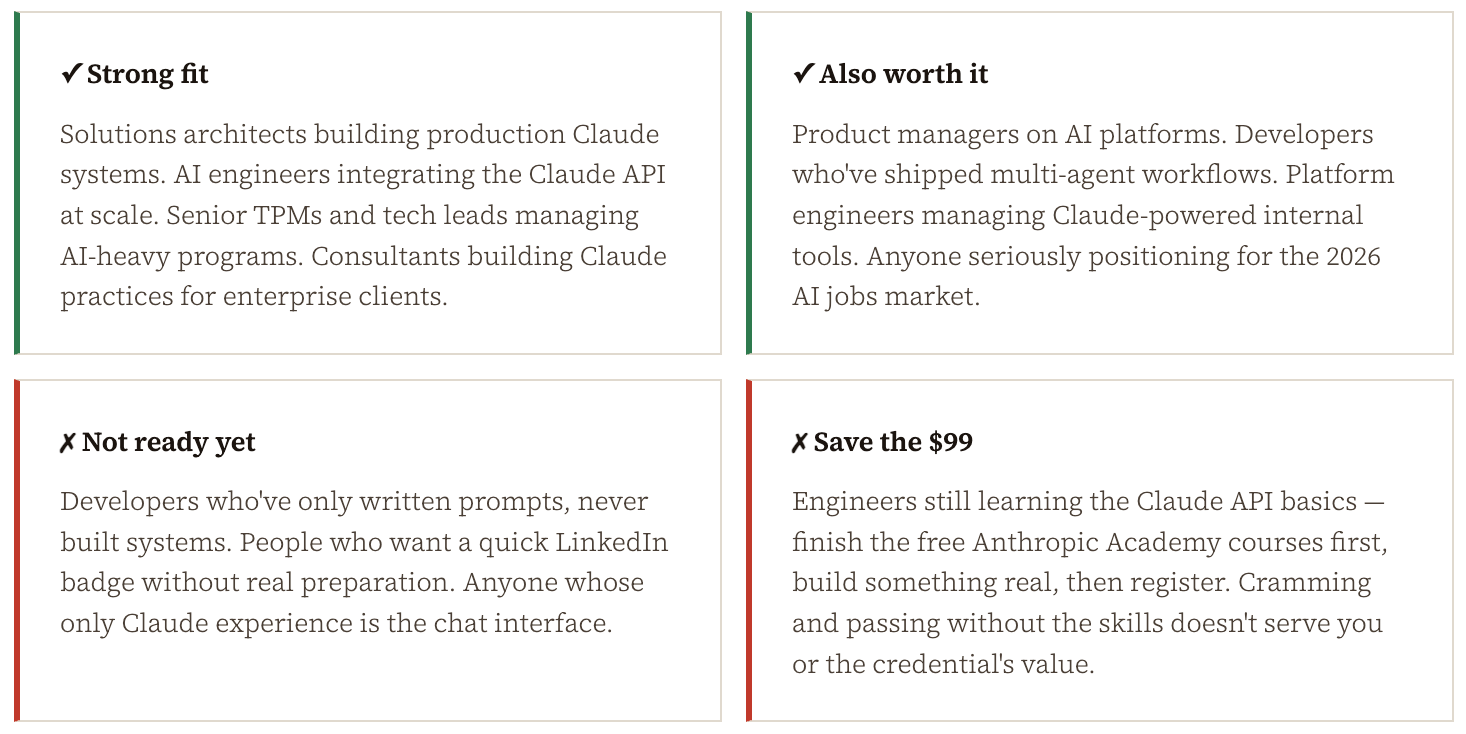
Do This. Not That.
Who Should — and Shouldn't — Sit This Exam
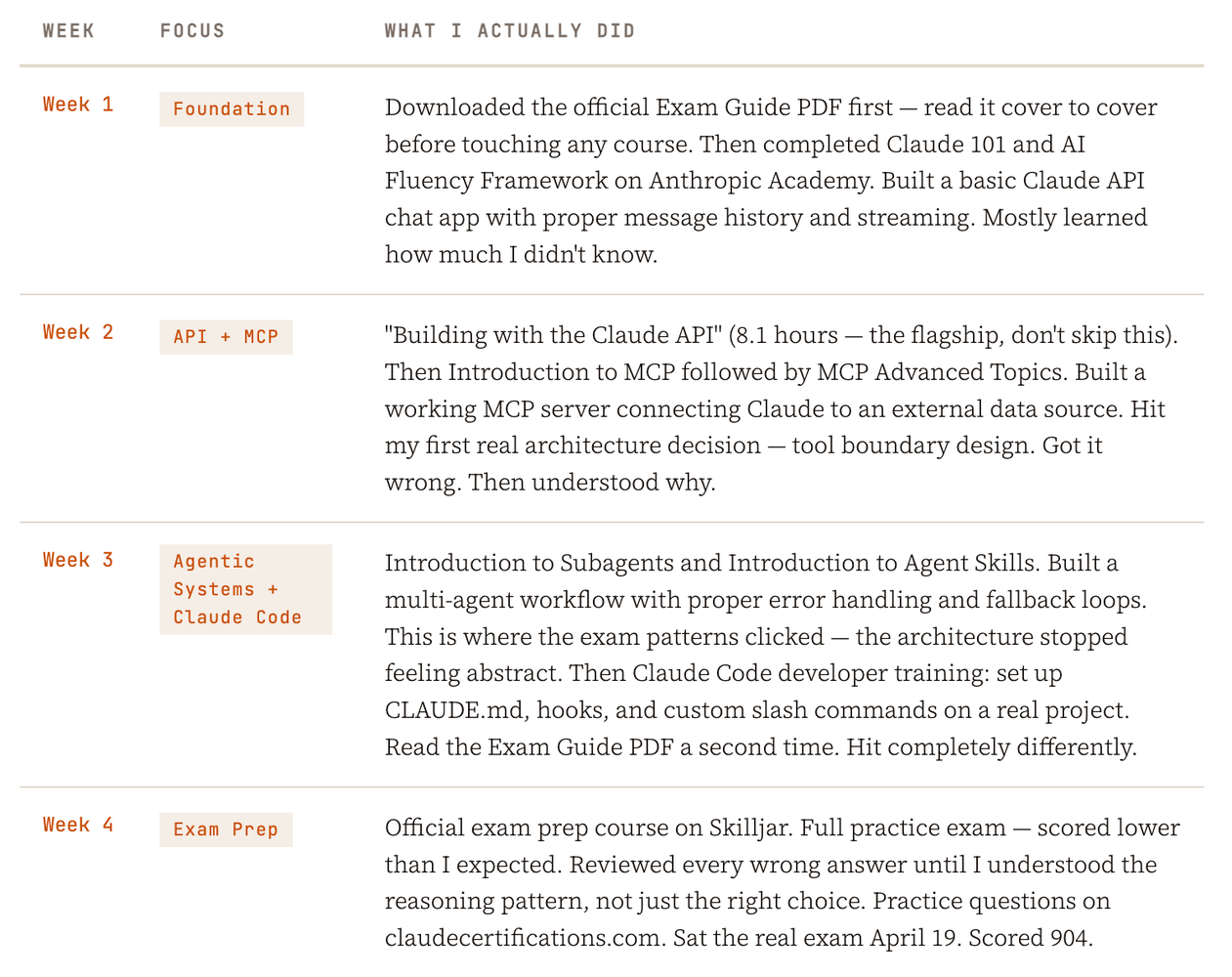
My 4-Week Preparation Path
One month. Here's exactly what I did, week by week — what I studied, what I built, and what actually moved the needle.
If you want to accelerate your practice, I've built a 647-question practice bank — 3 full mock exams, domain-wise tests, and full explanations — based directly on my exam experience. Use code UNBLOCKED for a launch discount: https://www.udemy.com/course/claude-certified- architect-exam-prep-647-qa-4-full-mock/? couponCode=UNBLOCKED
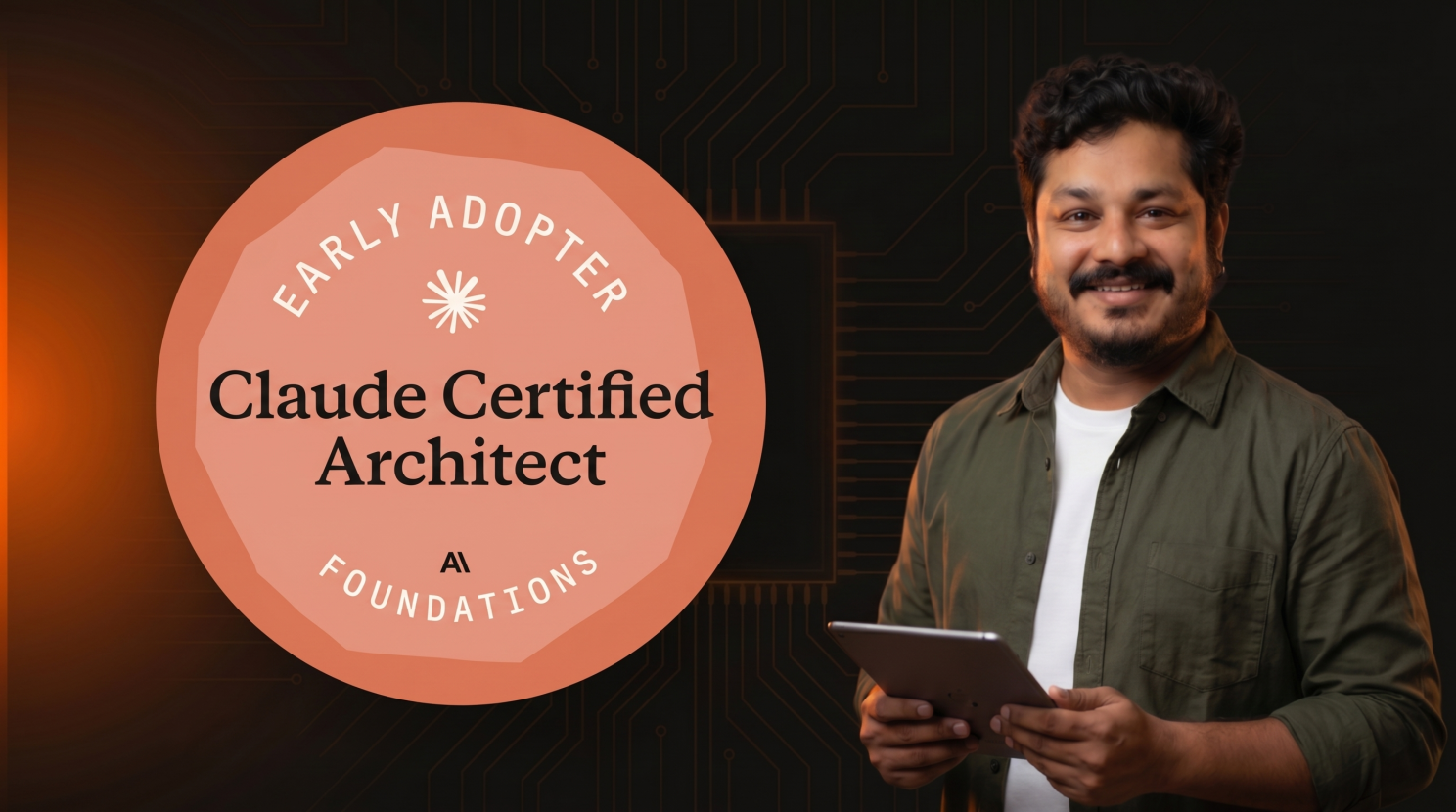
Launched Udemy Course to Crack Claude Certified Architect Certification
The honest truth: the courses alone wouldn't have got me to 904. Building between the courses is what made the scenario questions feel like real decisions rather than abstract multiple choice. You can't paper- read your way to architectural judgment — you have to feel where systems break.
The Full Claude Ecosystem (What the Exam Covers)
One of the most valuable things this prep gave me was a map of the full Claude product ecosystem. Broader than most people realise — and the exam draws from all of it.
The Models
Claude Opus (complex reasoning, highest capability), Claude Sonnet (balanced, the everyday workhorse), Claude Haiku (fastest, most cost- efficient). Choosing the right model for a given workload is an architecture decision — the exam tests it in a production context.
Claude API
The core developer interface. Streaming, tool use, structured output via JSON schemas, prompt caching, and the Batch API for high-volume async workloads. Batch API cost optimisation comes up directly in exam scenarios. If you're not thinking about it, you should be.
Claude Code
Terminal-based coding assistant. Not just autocomplete — it reads your codebase, writes code, runs tests, and manages Git workflows. CLAUDE.md is the persistent "tech lead" for your project. Hooks intercept and validate agent actions. The -p flag enables non-interactive CI mode. This is 20% of your exam weight.
Model Context Protocol (MCP)
The emerging standard for connecting AI to external tools and data — think USB-C for AI systems. Three core primitives: tools (executable functions), resources (data), and prompts (templates). The exam tests MCP server design, client configuration, transport mechanisms (Python and TypeScript), and how tool boundary decisions affect downstream reasoning quality.
Claude Agent SDK
The framework for building multi-agent systems — orchestrating coordinator-subagent patterns, managing lifecycle hooks, and handling session state. Domain 1 (27%) lives almost entirely here. This is where candidates win or lose the exam.
Claude Projects & Artifacts
Projects give Claude persistent memory and instructions across sessions. Artifacts generate standalone deliverables — code, documents, interactive tools. Not core exam domains, but useful ecosystem context for architecture conversations.
Anthropic Academy
13 free self-paced courses on Skilljar. No paywall, no subscription. This is your primary study platform. Start at anthropic.skilljar.com.
What Exam Day Actually Feels Like
The first scenario loaded, and I immediately felt the difference between "I read about this" and "I built this." Questions where I'd actually constructed a fallback loop felt obvious. Questions where I'd only studied the concept felt uncertain.
The clock doesn't feel threatening — 120 minutes for 60 questions is 2 minutes per question, which is enough if you know the material. Where people slow down is on the distractors. The wrong answers are designed to sound like good engineering. You have to read carefully.
I flagged 8 questions for review, went back to 5 of them, and changed 2 answers. Submitted with 14 minutes left. Score report arrived 36 hours later: 904.
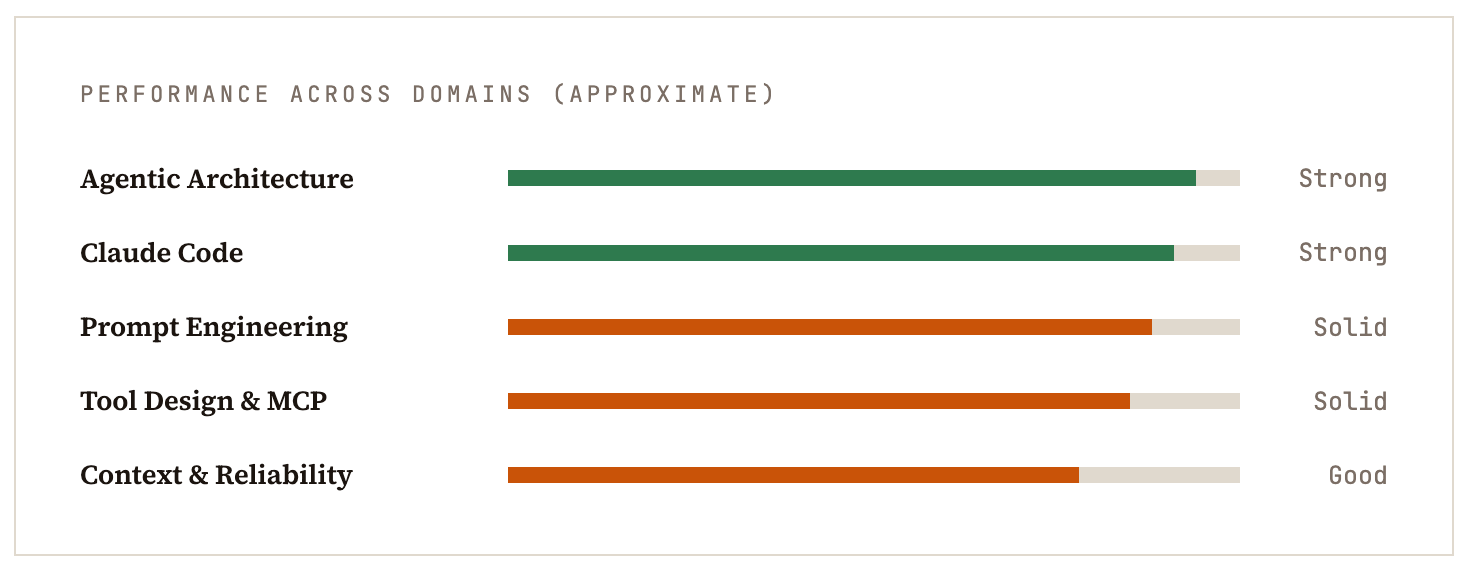
The section breakdown confirmed what I already suspected — I was strongest in Agentic Architecture and Claude Code, and dropped a few marks in Context Management. Worth knowing for anyone prepping: Domain 5 is where careful candidates pick up points that distracted candidates leave on the table.
Step-by-Step: How to Register and Sit the Exam
1. Download the official Exam Guide PDF — today: Before any
course, before any prep. It contains all 6 production scenarios, every domain task statement, and sample exercises. Direct link: Official CCA Exam Guide PDF ↗
2. Start the free Anthropic Academy courses: No partner access
needed. Begin at anthropic.skilljar.com. Start with "Building with the Claude API" if you're comfortable with Claude, or "Claude 101" if you're starting fresh. All 13 courses are free, self-paced, and directly mapped to exam domains.
3. Join the Claude Partner Network: Apply free
at claude.com/partners. Any organisation bringing Claude to market qualifies. No minimum company size. Unlocks exam registration and priority access to future certification tiers.
4. Build something real — before you register: A project touching at
least three exam domains: a multi-agent workflow with tool use, structured output, and error handling is ideal. Don't register until you've hit at least one real production problem and figured out why it broke.
5. Register for the exam: Access request
at anthropic.skilljar.com/claude-certified-architect-foundations- access-request. Cost: $99 (free for the first 5,000 partner employees).
6. Take the official practice exam — aim to fail it first: Available in
Skilljar after registration. 60 questions, same scenario format as the real exam, with explanations. Don't take it when you feel ready — take it earlier, review every wrong answer, then take it again. Aim for 900+ before booking the real slot.
7. Take the proctored exam: 60 questions, 120 minutes. Webcam on.
No tools. Always select an answer — unanswered questions score as wrong. Block the full 2.5 hours. You cannot pause. Score arrives within 5 to 7 business days.
Official Anthropic PDFs
CCA Foundations Exam Guide PDF (Official Direct Download) — all 5 domains, 6 scenarios, task statements, and sample exercises. Read on Day 1 and again after Week 3.
Official Practice Exam (Skilljar, post-registration) — 60 questions, same format as the real exam, with explanations per answer. Complete this before booking your actual slot.
All Key Resources
Anthropic Academy — 13 free courses
Claude Partner Network — join free
Exam Registration Portal
claudecertifications.com — free study guide + 25 practice questions
Anthropic Documentation — source of truth for all exam content
Anthropic Cookbook on GitHub — working code examples for every major pattern
CCA-F Practice Bank (Udemy) — 647 unique questions, 3 full mock exams, full explanations. Use code UNBLOCKED for launch discount
What's Coming Next in the Credential Stack
The CCA Foundations is the entry point of a multi-level program. Anthropic has confirmed more certifications in 2026:
Seller certifications — for go-to-market professionals positioning Claude in enterprise deals
Developer certifications — targeted at hands-on implementation engineers
Advanced Architect tracks — for complex, multi-system design at scale
Partners who join the network now get priority access to new certifications as they roll out. The scale of adoption makes this meaningful: Accenture is training approximately 30,000 professionals on Claude. Cognizant has opened Claude access to roughly 350,000 associates. Deloitte has equipped around 470,000 employees. Certified architects operating in that ecosystem will not struggle to find work.
What Actually Changed After I Passed
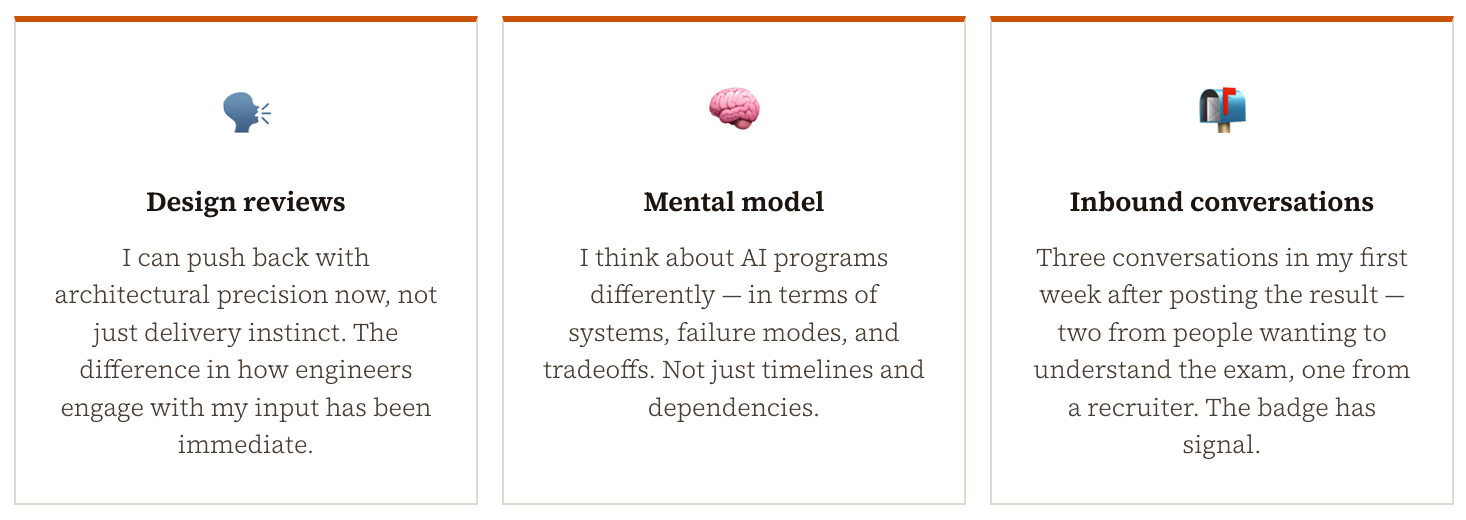
The certification also forced something I hadn't planned: building. I have built AI agents that work for free 24/7. So this experience is sitting in me now in a way that no course completion could replicate. If you're preparing for the exam and want the closest thing to real exam conditions — that's exactly what I built the practice bank for.
"The certificate is just a badge. The knowledge is the asset. The building is how you get the knowledge."
Should You Sit This Exam?
If you're building with Claude — or leading programs that do — yes.
If you're a TPM who keeps hitting the same wall I hit in design reviews — yes.
If you're thinking, "I'll do this when things slow down, — they won't. The window on being an early-mover in this credential is closing. 5,000 free seats won't last forever, and the people who certify now will be the ones that enterprises look for first when the hiring picks up.
Start the free courses today. Build something before the month is out. Earn the right to register — then go get the score.
If you have questions about any of it — prep path, specific domains, how I approached the scenario questions as a non-engineer — drop them in the comments. I'll answer everyone.
I've also packaged everything into a 647-question Udemy practice course — link in the first comment.
Real talk on TPM, AI, Leadership, real life stories and fun. No fluff. No corporate filter. Just
what actually works.
Michael, Kinjalk and 1,177 connections are subscribed
1,460 subscribers
The IT Services Industry Is at a First‑Principles Reset — And AI Is Forcing the Honest Conversation We’ve Avoide…
CloudNative Unlocking [2of30]: Microservice Design Pattern
The Most Important File in Your Repository is domain.md
Amit Singh
Technically Speaking
Senthilraj Krishnan
4 · 1 comment
6 · 1 comment
Found this useful?
Book a 1:1 session to apply these frameworks to your specific situation — promotion prep, interview coaching, or career roadmap.
Book a Session →