
You Don't Need to Be an Engineer to Ace the AWS AI Exam. You Need to Be a TPM. "Most People Study for the AWS AI Exam. I Ran It Like a Program.
I was sitting in a meeting when a leader said something that stopped me cold.
"TPMs are behind engineers when it comes to using AI in their day to day work."
The room moved on. I didn't.
That comment sat with me for days. Because I knew it was true — and I knew I wasn't going to let it stay true. Not for me. I decided right there: I was going to flip the game. No matter how much effort it took. No excuses, no half-measures.
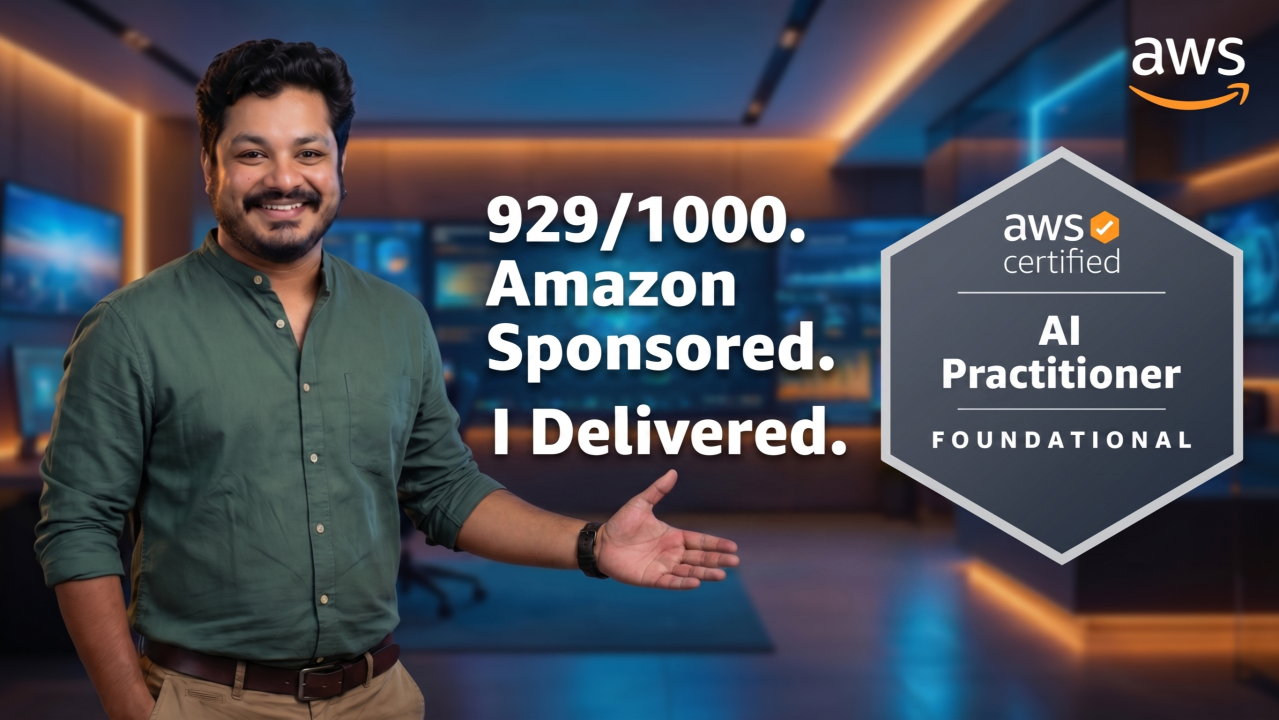
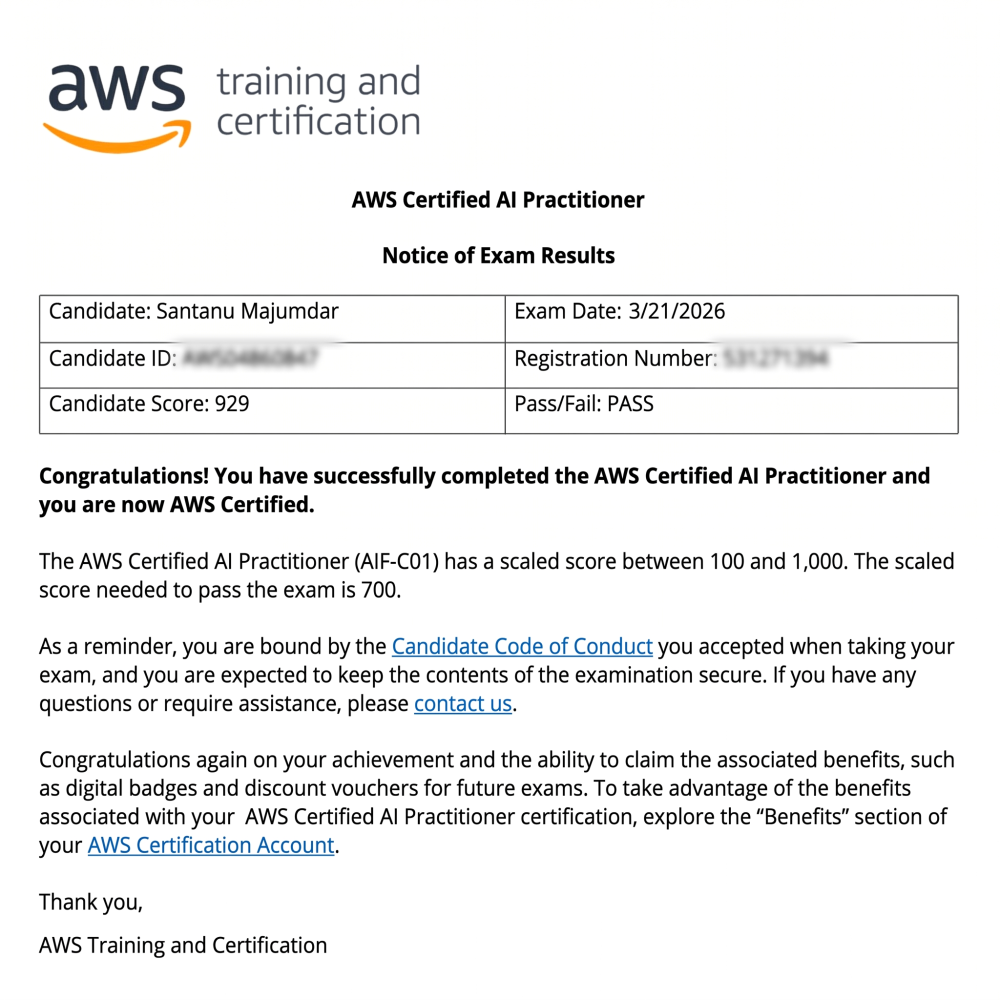
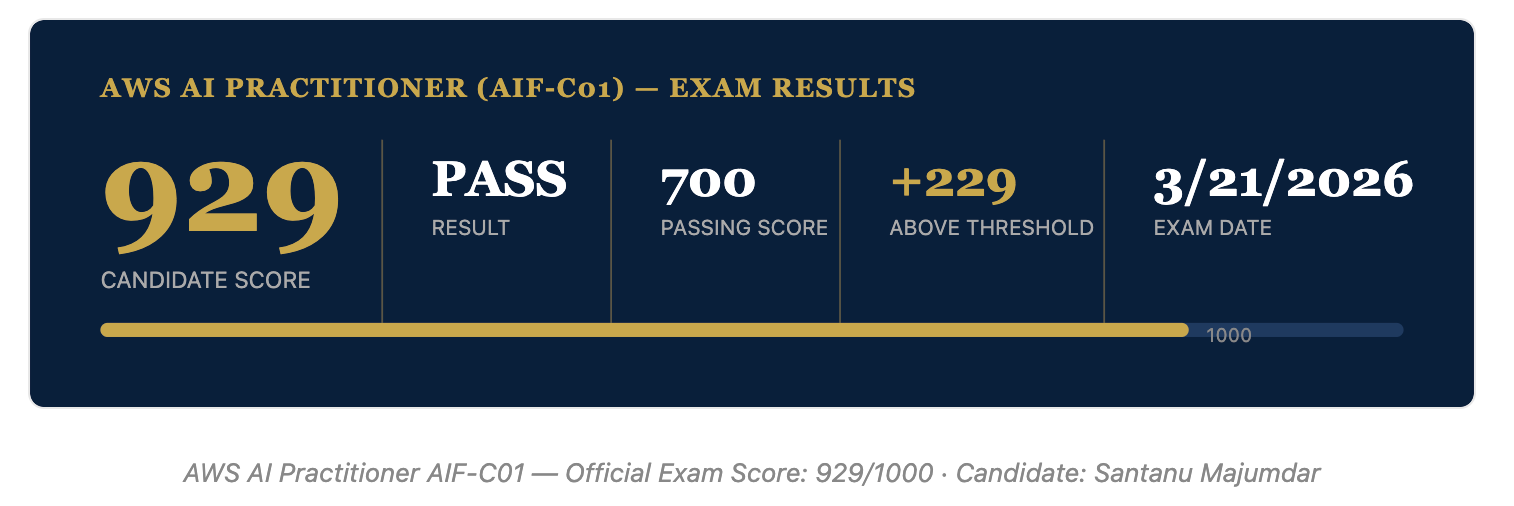
In March 2026, I walked out of the AWS AI Practitioner exam with a 929 out of 1,000 — 229 points above the passing threshold of 700. Amazon had sponsored my entire training through AWS Skill Builder. They gave me a 50% exam voucher. There was no fallback plan and no room to fail.
But here's the part no one tells you about corporate-sponsored certifications: the psychological pressure is real.
When your employer pays for your training, when the voucher is already applied, when your calendar is blocked — you don't just want to pass. You have to pass.
I'm a Senior TPM at Amazon. I manage programs where ambiguity is the default state and failure is a postmortem waiting to be written. I applied the same structured, risk-aware program thinking to my own certification journey. And it worked.
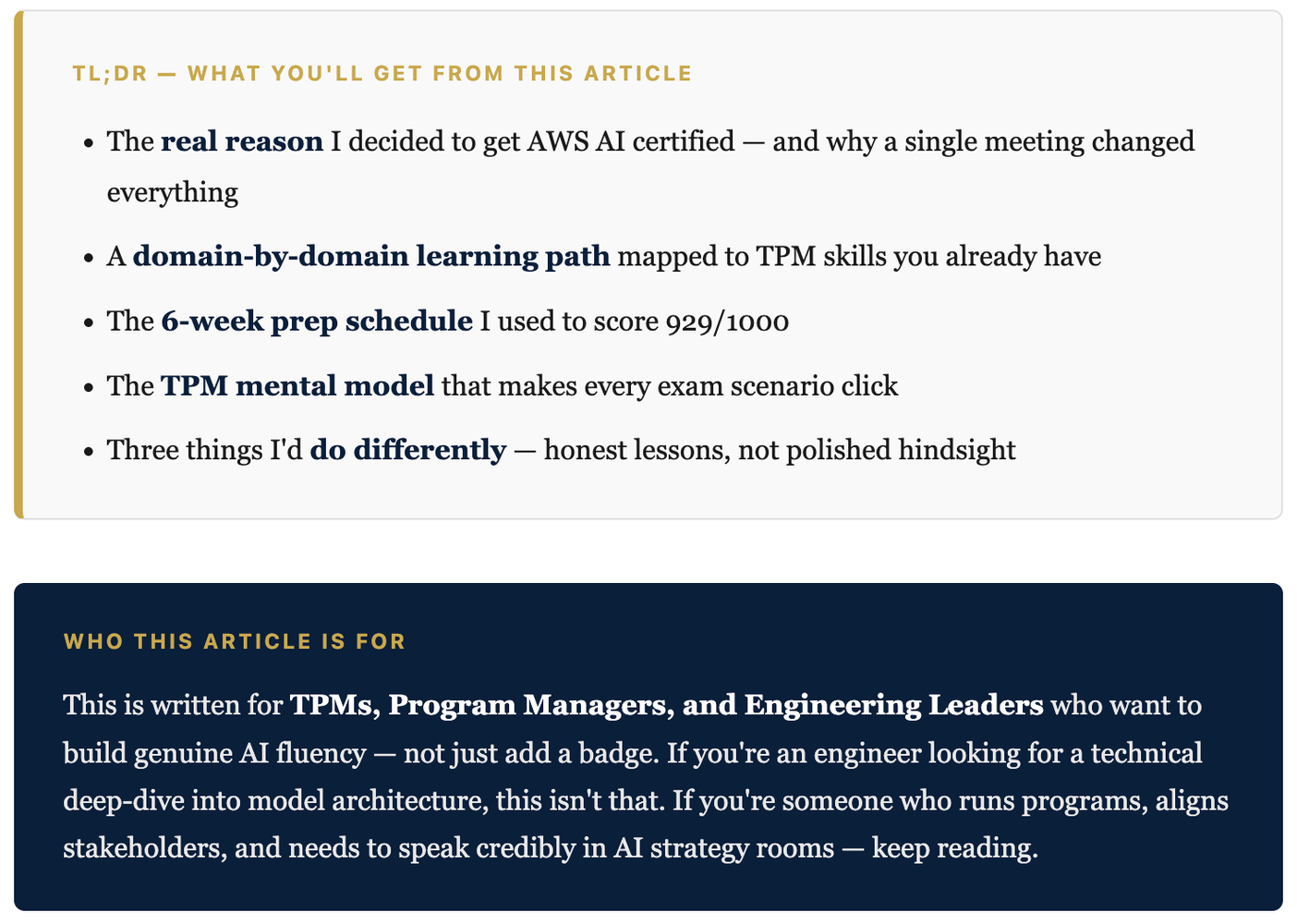
This article is the full playbook — not the motivational version, the operational one. I'll walk you through the five domains, the learning path that actually works, the mental model that changed how I approached AI concepts, and why this certification matters more than most people realise.
Why This Certification Is Different — And Why TPMs Should Care
Let me be specific about what the AWS AI Practitioner (AIF-C01) actually tests. This is not a builder's exam. You won't be writing SageMaker code or building Bedrock pipelines. This is a practitioner's exam — designed for the people who commission AI systems, govern them, and make the strategic calls.
Sound familiar? That's exactly what a Senior TPM does every single day.
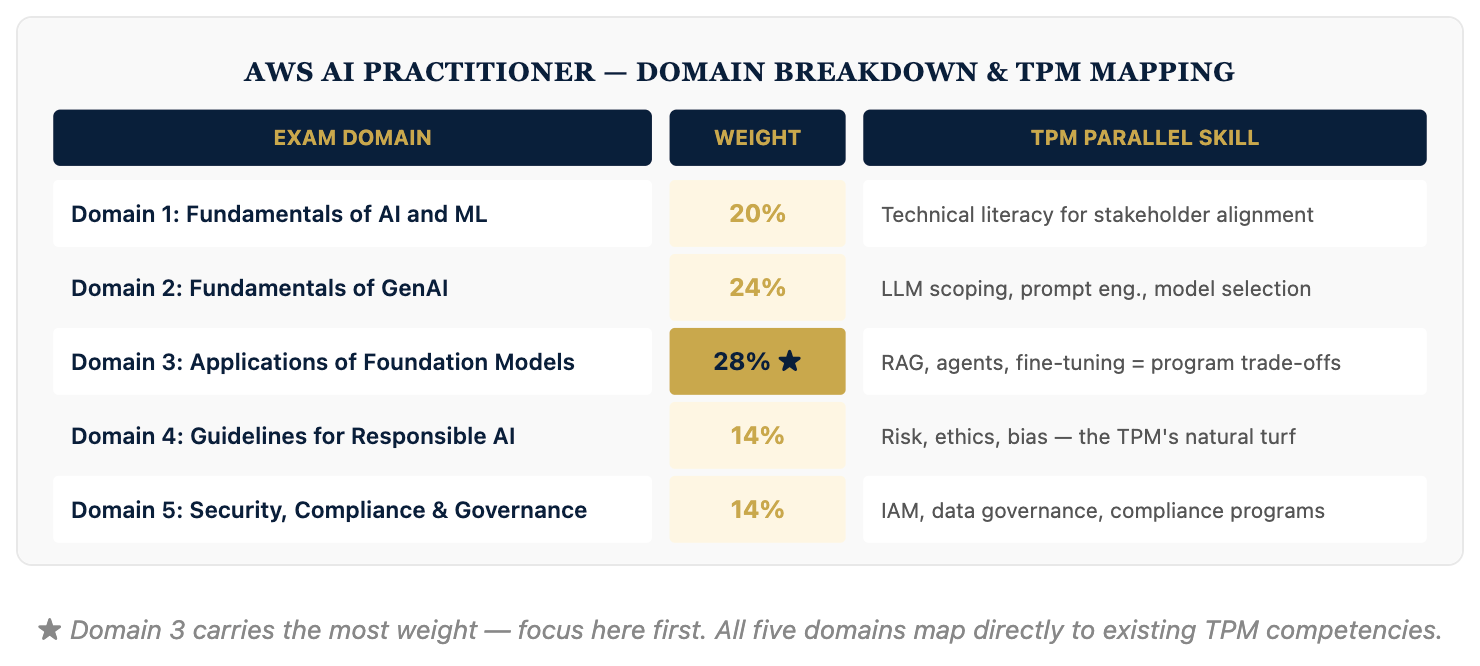
The exam tests five domains — and as I'll show you, each one maps cleanly to a TPM skill you already have. The question is whether you can articulate it in AWS vocabulary.
The Amazon Advantage: Trained Where the AI Was Built
Here's something I don't take for granted: Amazon sponsored my entire learning journey through AWS Skill Builder. As a full-time employee, I had access to the complete learning path across all five domains — structured courses, labs, and practice content — before I ever registered for the exam.
Then came the exam voucher: 50% off the AIF-C01 registration fee. That brings the investment down significantly. But it also changed the calculus entirely. A partially-funded exam, scheduled on your calendar, with your manager aware? You've just committed publicly. In my world — and any TPM's world — that's a working backwards doc you can't un- publish.
I treated the certification like a program with one launch date, one stakeholder (AWS Training), and a binary success metric. Pass with distinction or rework the program.
The Learning Path That Actually Works: All 5 Domains
I see too many candidates approach certifications like a sprint. Read a cheat sheet. Take a mock test. Hope for the best. That's not a learning path — it's a lottery ticket.
Here's what a structured TPM approach to AIF-C01 prep actually looks like:
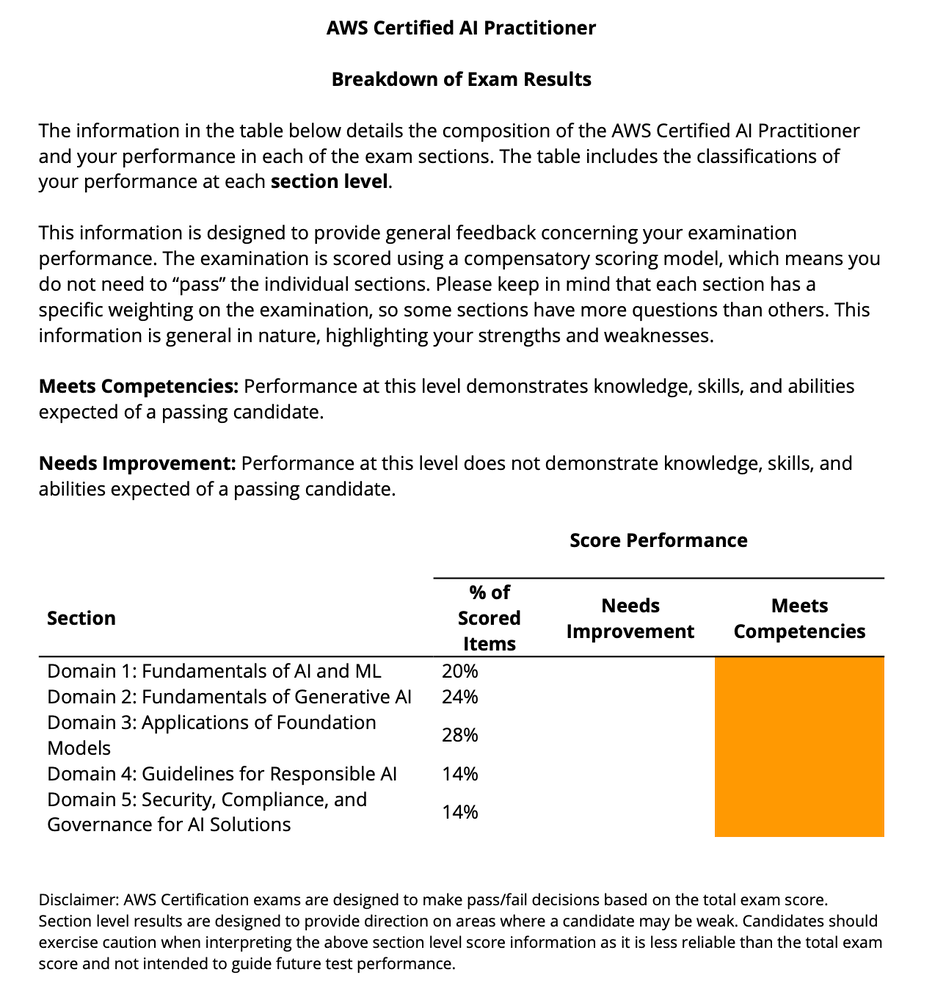
Domain 1: Fundamentals of AI and ML (20%)
Start here to build your vocabulary. This domain covers the building blocks: supervised vs. unsupervised learning, model training concepts, inference, and the AWS ML stack. For most TPMs, this is the most technical-feeling domain — but the exam doesn't ask you to code. It asks you to understand. Know the difference between a training job and an inference endpoint. Know when to use SageMaker vs. Rekognition vs. Comprehend.
Skill Builder focus: "Foundations of Machine Learning" + "Introduction to Amazon SageMaker" learning paths.
Domain 2: Fundamentals of Generative AI (24%)
This is where the exam gets modern. LLMs, foundation models, embeddings, tokenisation, prompt engineering, temperature and top-p sampling. Learn what a transformer architecture actually does (at a conceptual level). Understand why context window size matters for your business use case. This domain rewards candidates who have actually used these tools — which, as a TPM at Amazon in 2026, you almost certainly have.
Skill Builder focus: "Generative AI Essentials" + Amazon Bedrock service overviews. The Bedrock console documentation is your best friend here.
Domain 3: Applications of Foundation Models (28% — Highest Weight)
This is the domain that separates good candidates from great ones. RAG (Retrieval-Augmented Generation), agents, fine-tuning vs. prompt engineering trade-offs, multi-modal models, embeddings-based search. The exam will present business scenarios and ask you which approach is most appropriate. This is pure TPM territory: trade-off analysis, constraint-based decision making, build vs. buy framing.
Skill Builder focus: "Building with Amazon Bedrock" + "Responsible AI" module. Spend the most time here. Know RAG architecture cold.
Domain 4: Guidelines for Responsible AI (14%)
Bias, fairness, explainability, hallucination mitigation, human-in-the-loop design. Every question in this domain has a real-world program management analogue. You've managed risk registers. You've run pre- mortems. You know what a mitigation plan looks like. Apply that muscle here.
Skill Builder focus: AWS's Responsible AI documentation + the "AI Ethics and Governance" course. Read Amazon's published AI principles — they are tested.
Domain 5: Security, Compliance, and Governance for AI Solutions (14%)
IAM roles for AI services, data encryption, model access controls, compliance frameworks, audit trails. If you've ever worked on a SOC-2 program or GDPR compliance project, this domain feels familiar. Know how Amazon Macie protects training data. Know how AWS Config monitors AI service configurations. Know the shared responsibility model applied to AI.
Skill Builder focus: AWS Security Fundamentals + the Bedrock access controls documentation. Cross-reference with your existing knowledge of AWS IAM.
The TPM Mental Model for AI Exams
Here's what 15 years of program management taught me about passing certification exams: every question is a stakeholder alignment problem in disguise.
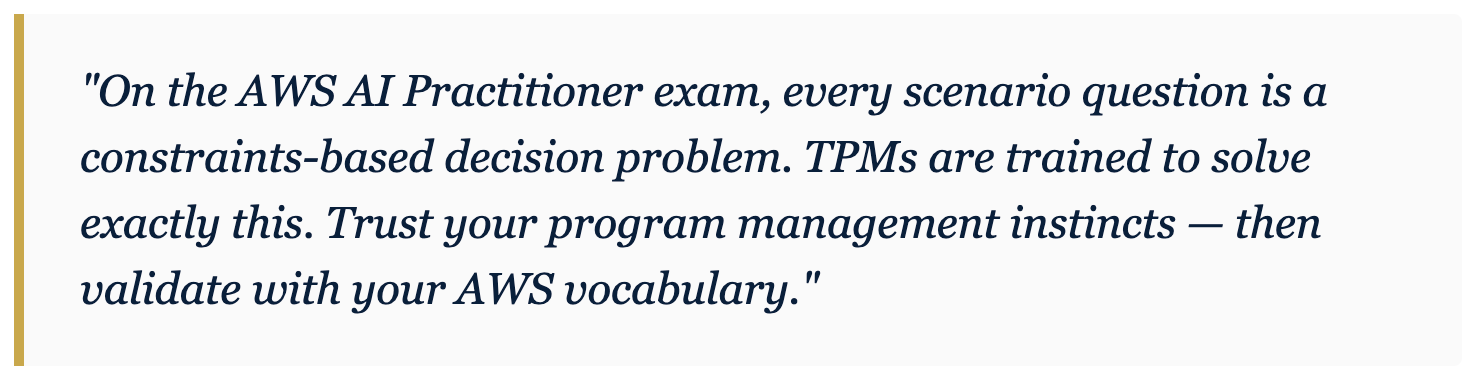
When the exam presents a scenario — "A company wants to build a customer support chatbot that handles complex queries accurately without sharing proprietary data externally" — it's not asking you to write code. It's asking you to make the right architectural decision given the constraints. That's a scope + risk + build-vs-buy trade-off. A TPM processes this in seconds.
The candidates who fail AIF-C01 are usually the ones who over-engineer their thinking. They get lost in implementation details instead of reading the constraint clues in the scenario. Read the constraint. Match it to the AWS service or approach that directly addresses it. Move on.
Why I Published a Udemy Course Immediately After
The week after I passed, I started building. Not because I had to — but because the preparation process revealed something uncomfortable: the quality of practice materials available for AIF-C01 is not proportional to the exam's growing importance.
Gartner projects that 75% of enterprises will operationalise AI by 2026. The AWS AI Practitioner certification is one of the fastest ways to credentialise your AI program management skills. Demand is real. Supply of quality prep material? Still catching up.
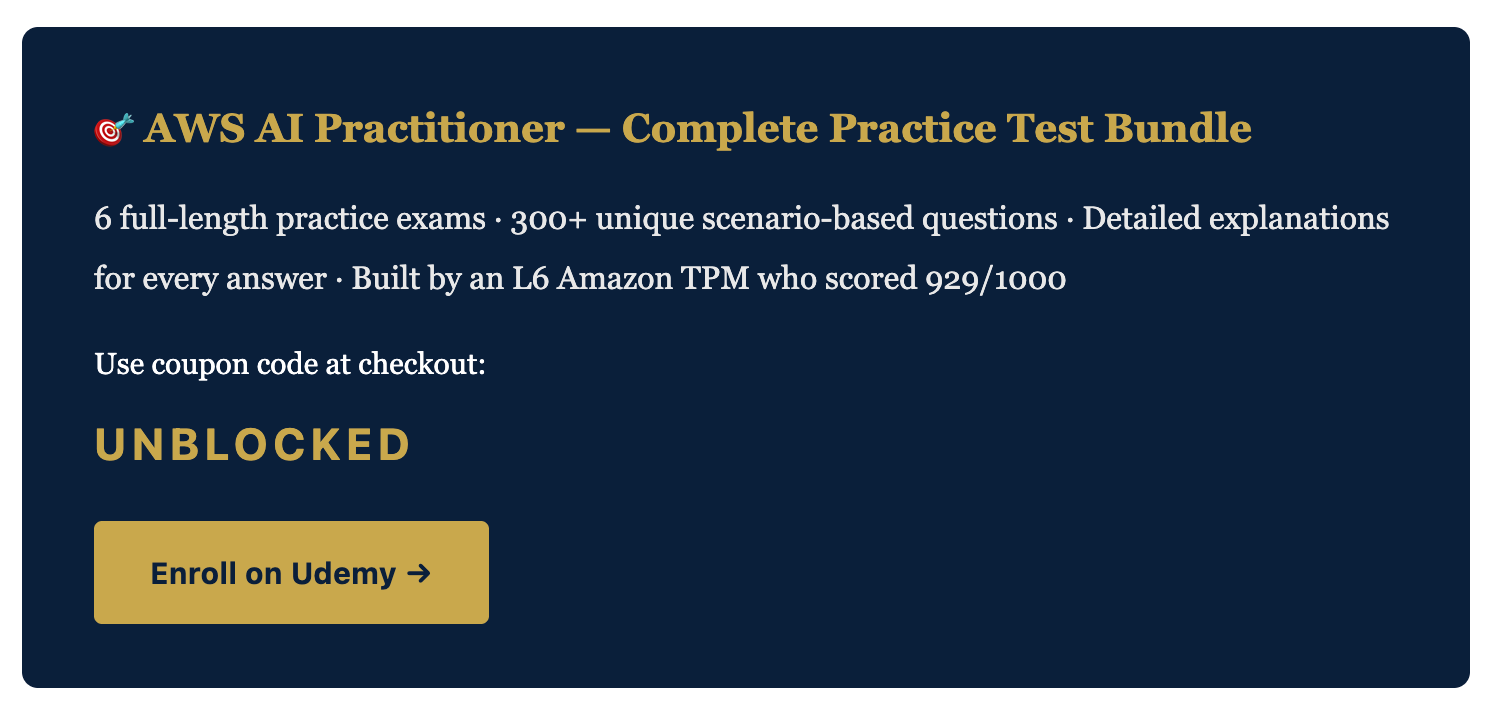
So I built what I wish I'd had. A complete, scenario-first practice test bundle — 6 full-length practice tests, zero duplicate questions across the set, every answer explained with the "why" not just the "what." The kind of practice that builds judgment, not just familiarity.
The Bigger Picture: Why AI Literacy Is Now a TPM Core Skill
Let me give you the data point that should get your attention: 85% of AI projects fail to reach production (Gartner, 2024). Not because the models don't work. Because the programs around them do.
Someone has to define the success criteria before the model is trained. Someone has to align the ML team, the data engineering team, the legal team, and the business stakeholders on what "good" looks like. Someone has to build the governance framework that stops a hallucinating LLM from making it into a production customer experience.
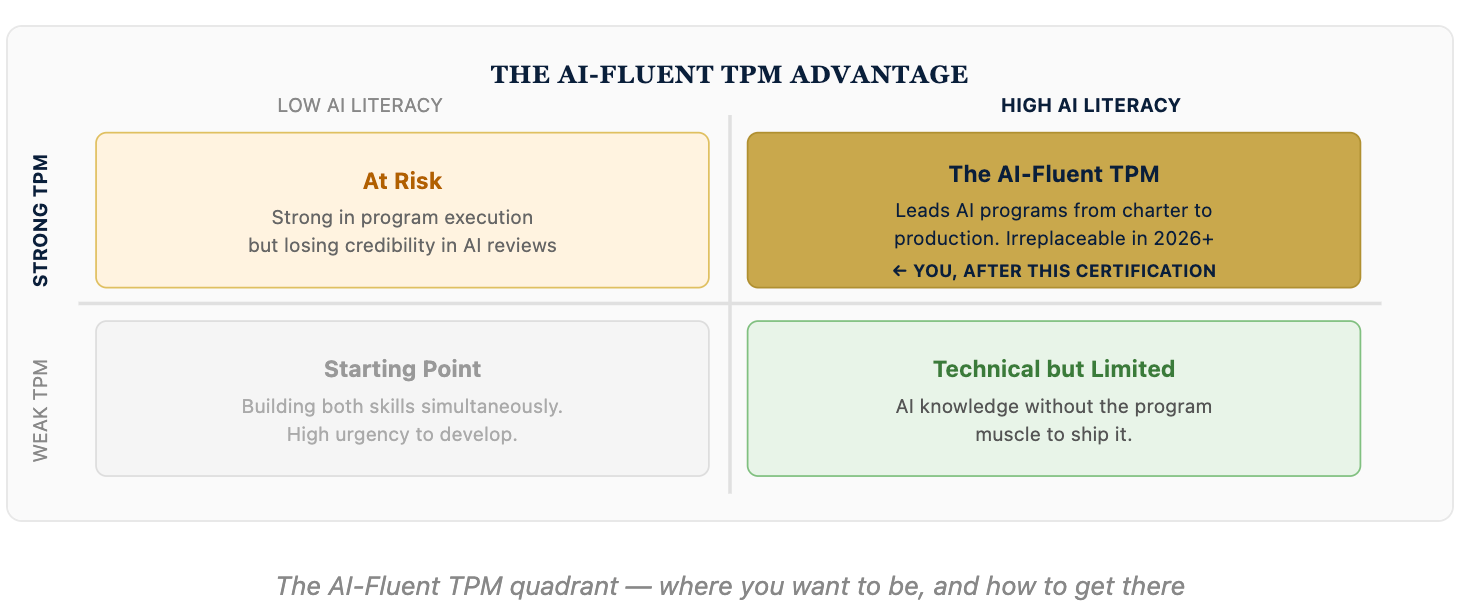
That someone is a TPM. And in 2026, that TPM needs to speak the language of AI programs — not just manage the calendar.
The AWS AI Practitioner certification is not a technical certification. It's a fluency certification. It proves you can sit in the room where AI architectural decisions are made and contribute meaningfully — not just nod along and send the follow-up email.
What I'd Do Differently (Honest Lessons)
A 929 looks clean on paper. The preparation wasn't. Here are the three things I'd adjust if I ran this program again:
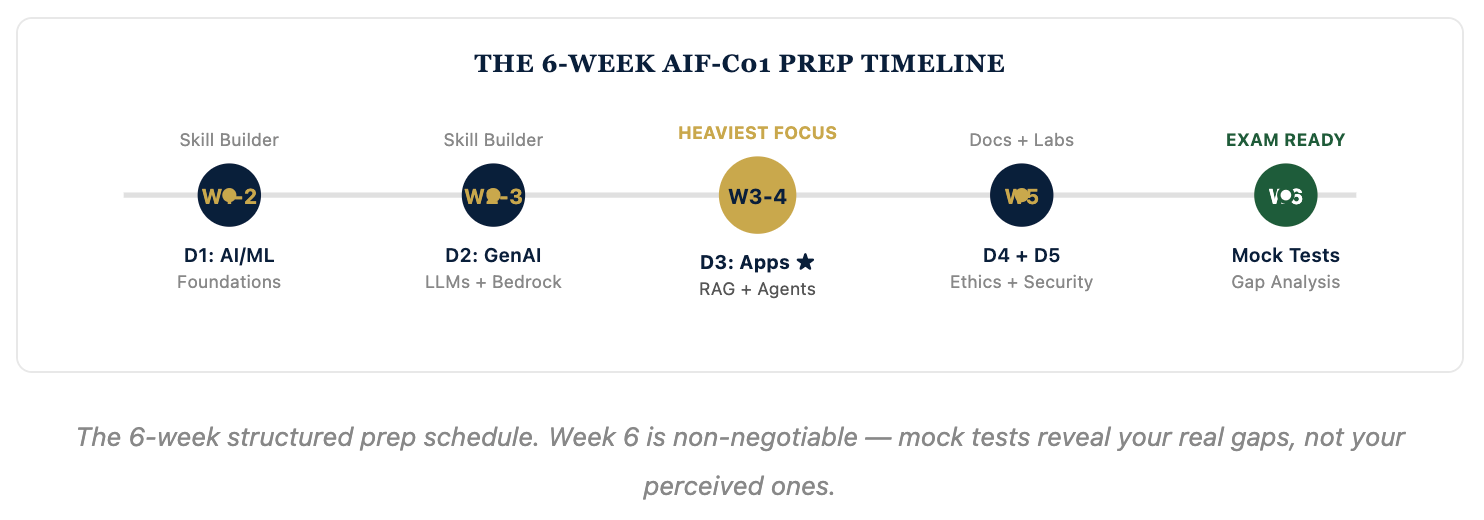
Start mock tests in Week 3, not Week 5. I waited until late in my prep to take full-length practice tests. Starting earlier reveals your actual knowledge gaps — not your perceived ones — while you still have time to close them.
Map every AWS AI service to a business use case first. I spent too long memorising service names without anchoring them to "when would I actually recommend this?" The exam is scenario- driven. The service list is just vocabulary. Context is the test.
Read the AWS AI/ML blog for 20 minutes a week. The exam is designed by practitioners. Questions often reference the kinds of
architectural trade-offs that appear in real AWS blog posts. This isn't about finding "leaked questions" — it's about building genuine contextual fluency.
Your Next Step
If you're a TPM reading this and you haven't yet added AI certification to your professional development plan — 2026 is the year to move. The window where "I'm not an AI person" is a defensible position is closing fast.
The AWS AI Practitioner is the most accessible, most relevant, and most strategically valuable starting point. It doesn't require a technical background. It requires the ability to think about trade-offs, constraints, and governance — which is already what you do.
I started this journey because a leader said TPMs were behind. I finished it with a 929. Amazon sponsored the training. The voucher was applied. The calendar was blocked. There was no version of this story where I didn't deliver.
You don't need Amazon to sponsor your exam. You don't need a leader to challenge you in a meeting. You just need to decide — the way I decided that day — that this is the year you stop being behind.
I built the practice tests I wish I'd had when I was preparing. Use them. Pair them with AWS Skill Builder's free learning paths. Give yourself 6 weeks. Score above 700. Then walk into your next AI strategy meeting and contribute — not just coordinate.
One More Thing: The Unblocked Newsletter
Every week I write Unblocked — a newsletter for TPMs who want to go from competent to exceptional. No generic career advice. No motivational filler. Just frameworks, playbooks, and real lessons from 15+ years of program management across Amazon, LinkedIn, Citrix, Cisco, and Oracle.
If this article gave you one thing you can use — a domain approach, a mental model, a prep strategy — the newsletter goes deeper on all of it. AI program management. Stakeholder alignment. L6 promotion strategy. The craft of being an exceptional TPM in a world where AI is changing every program you'll ever run.

Comments
16 · 6 comments
Comment Share
Add a comment…
Most recent
Smruti Ranjan Mishra • 1st Vice President - Sales & Alliance | Driving Al Cloud Growth | Business …
Congrats Santanu
Celebrate ·
1 Reply
Soudipta Kundu • 1st Senior Technical Program Manager | $50M+ Digital Transformations | …
Santanu Majumdar, PMP®, SPC®, that opening quote from the leader in your meeting is the exact catalyst driving my own upskilling right now. After 21+ years driving enterprise programs, I couldn't agree more with your core premise: AI literacy for TPMs is no longer a technical nice-to- have; it's a core fluency requirement for survival. …more
Celebrate ·
1 Reply · 1 reply
Author
Soudipta Kundu This is exactly the kind of response that makes writing these playbooks worth it.
"We don't need to learn how to code the models; we need to know how to govern their delivery." …more
Like · 1 Reply 54 impressions
Namita Baddula • 2nd Engineering Manager at F5 | Leading Product & Engineering Teams | 1…
The honest prep advice here is refreshing because too many people online act like every certification can be cracked in 3 days with “secret hacks.” Santanu Majumdar, PMP®, SPC®
Celebrate ·
1 Reply · 1 reply
Author
Namita Baddula Exactly this. The “crack any exam in 3 days” content is everywhere. And it sets people up to walk in underprepared and walk out disappointed. Real prep isn’t glamorous. It’s 6 weeks of structured work, honest gap analysis, and mock tests that humble you before the real exam …more
Like Reply 25 impressions
Load more comments
Real talk on TPM, AI, Leadership, real life stories and fun. No fluff. No corporate filter. Just
what actually works.
Michael, Kinjalk and 1,177 connections are subscribed
1,460 subscribers
AWS Certified Machine Learning – Specialty (Beta)
How I passed the AWS Machine Learning Specialty Exam
My Journey to AWS Certified AI Practitioner: Cert #7
John Merline
Liubov Koreva
Rob Whyte
18 · 1 repost
Found this useful?
Book a 1:1 session to apply these frameworks to your specific situation — promotion prep, interview coaching, or career roadmap.
Book a Session →